Tag Archives: wildlife crossings

Montana passes landmark wildlife crossing legislation

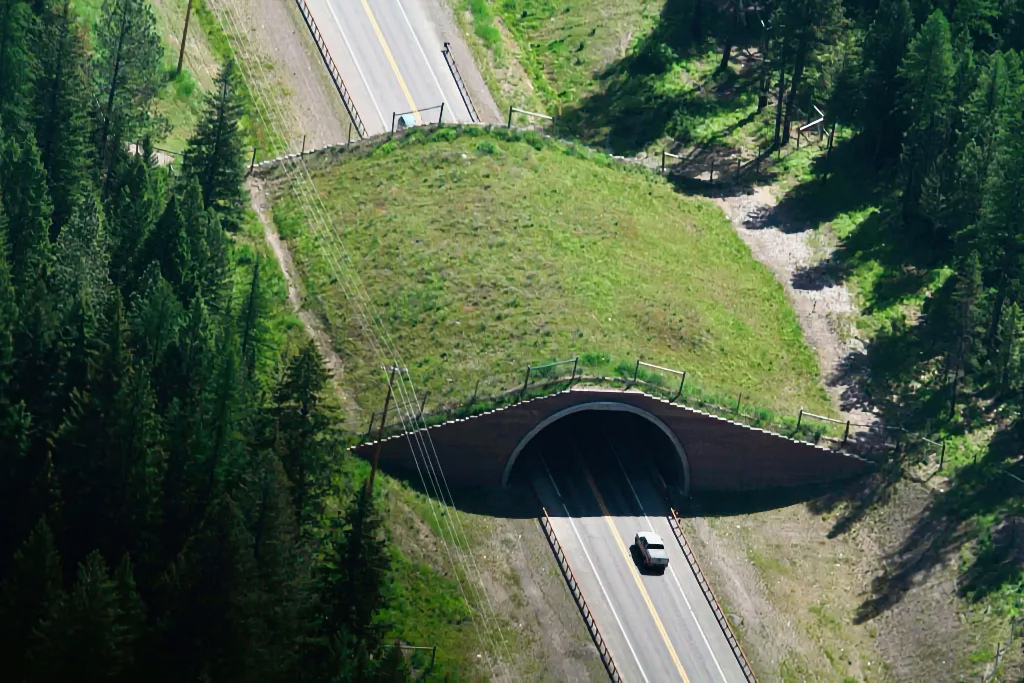
A wildlife overpass along U.S. Highway 93 in Montana - Kylie Paul, Center for Large Landscape Conservation
A wildlife overpass along U.S. Highway 93 in Montana – Kylie Paul, Center for Large Landscape Conservation

Montana now has some dedicated funding to support wildlife crossing efforts . . .

Montana has taken a major step toward protecting both wildlife and drivers with the passage of two groundbreaking pieces of legislation this spring: House Bill 855 and House Bill 932. Together, the bills establish the state’s first dedicated funding streams for wildlife crossings, structures proven to reduce collisions and improve landscape connectivity.

Montana currently has the second-highest per capita rate of wildlife-vehicle collisions in the United States. The average driver faces a 1 in 53 chance of hitting an animal each year and 13 percent of total reported collisions in the state related to wildlife, according to the Montana Department of Transportation. These crashes pose serious risks to people and animals alike, and cost Montanans tens of millions of dollars annually.

Kylie Paul, road ecologist at the Center for Large Landscape Conservation, a nonprofit creating strategies to solve large-scale challenges like climate change and habitat fragmentation, told Mountain Journal the nonprofit supported the legislation.

“In Montana, we have  a lot of roads cutting through intact wildlife habitats and migration routes,” Paul said. “Many are high-speed, low-light and, to some level, still low-traffic highways which help animals still feel safe to move across them.”

Read more . . .

Improving safety for drivers, wildlife on the road ahead

Good op-ed in the Bozeman Daily Chronicle about efforts to establish wildlife crossings along Hwy 89, which bisects Paradise Valley and is the north entrance to Yellowstone National Park…

It is not uncommon to hear Montanans refer to driving certain wildlife-dense sections of highway as “running the gauntlet.” Those of us who have hit wildlife remember the incident each time we pass the location — our stomachs in our throats and our heads on a swivel.

According to a 2017 report, there is a one in 57 probability of hitting a deer on Montana highways. We rank second in the U.S. for reported deer-vehicle collisions, and damage from wildlife collisions costs Montanans $212 million a year. Nationally, the annual cost of wildlife collisions is $8 billion. This includes costs associated with human injuries and fatalities, vehicle repairs, towing, lost hunting value, and more. As more Americans move into rural and suburban areas, and wildlife populations expand, collisions and their associated costs will only increase.

Beyond putting people, property, and individual animals at risk, roads also inhibit wildlife movement. They fragment habitat, isolate populations, and disrupt migrations.

Fortunately, there are solutions. Research shows when crossing structures and appropriate fencing are built in areas frequented by wildlife it reduces wildlife-vehicle collisions by up to 97%. Wildlife crossings work. These projects are expensive, so in 2021 the Bipartisan Infrastructure Law allocated $350 million over five years to fund wildlife crossings. In December, the Federal Highway Administration announced the first round of grant recipients. Two Montana projects were among the 19 selected — one submitted by the Montana Department of Transportation and the other by the Confederated Salish and Kootenai Tribes.

Continue reading . . .