All posts by nfpa

Montana FWP seeks public comment on Flathead River hybrid trout removal

Montana Fish, Wildlife and Parks is seeking public comment on their current Flathead River Hybrid Trout Suppression Project . . .

As part of ongoing efforts to maintain populations of native westslope cutthroat trout, Montana Fish, Wildlife and Parks is proposing to continue removing hybrid and rainbow trout from the Flathead River drainage.

The public has until March 8 to comment on the Flathead River hybrid trout suppression project’s environmental assessment draft, released earlier this month for a 30-day public review. The project could get underway a week later on March 15, according to an anticipated schedule.

Continue reading . . .

Related reading: Flathead River Hybrid Trout Suppression Project

Searching for fishers in Glacier National Park

Do fishers live in Glacier Park? Probably not, but there are a lot of good reasons to look . . .

After wading across the Middle Fork of the Flathead River in a pair of brand-new defective waders and skiing sodden-footed through a miles-long thicket of tangled deadfall, Glacier National Park wildlife biologist John Waller admits he may be chasing a phantom.

His research often requires skiing across 15 miles of steep, rugged terrain in a single day and working from dawn until dusk – a trying effort for what may prove to be the wildlife biologist’s equivalent of a snipe hunt. But even if the critter he’s pursuing eludes him, and even though the ultra-lightweight Hodgman waders he just bought are worthless, the scientific data Waller’s study will produce and the questions it may help answer are invaluable.

Continue reading . . .

National park photos by Ansel Adams accessible online

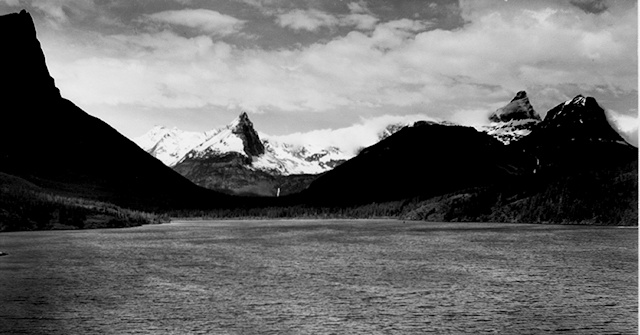
St. Mary Lake, Ansel Adams, 1941

Here’s a little gem I ran across this morning on the U.S. National Archives website. It seems they have a pretty good collection of photos taken by Ansel Adams back in 1941 of many of the national parks. This includes some two dozen photos of Glacier National Park. According the the site:  “In 1941 the National Park Service commissioned famed photographer Ansel Adams to create a photo mural for the Department of the Interior Building in Washington, DC. The theme was to be nature as exemplified and protected in the U.S. National Parks.” The advent of World War II killed the project, but the images are in the national archives and accessible to the public.

Further reading:

“Ansel Adams Photographs” page at the U.S. National Archives

“Discover Ansel Adams’ 226 Photos of U.S. National Parks (and Another Side of the Legendary Photographer)” via Open Culture

Rocky Mountain Front Heritage Act reintroduced in Congress

It’s time to take another run at it. The Baucus/Tester-sponsored Rocky Mountain Front Heritage Act has been reintroduced in this session of Congress . . .

After a near-miss last year, the Rocky Mountain Front Heritage Act has been reintroduced in the 113th Congress, on the 100th anniversary of the Sun River Game Preserve.

The bill, co-sponsored by Montana Sens. Max Baucus and Jon Tester, would protect wilderness, ranching and recreation opportunities in the mountain range between Augusta and Dupuyer, west of Great Falls. It would designate 208,000 acres as a conservation management area that allows motorized access, biking and other current uses, add another 67,000 acres to the Bob Marshall Wilderness Complex, and support noxious weed prevention programs for agricultural and public lands across the Front. The bill would not affect mineral leasing in Teton and Pondera counties, or energy production on private and state land.

Continue reading . . .

Moose population shrinking

In Montana, and elsewhere, Moose populations are shrinking, but no one knows exactly why . . .

Hunters spent more than 4,200 combined days in the field searching for moose across Montana in 2011, but the harvest total was the lowest in more than half a century.

Why?

The possible answers remain up for debate. But wildlife managers fear the situation could be bleak and worsening.

Shrinking moose populations have become the subject of escalating concern across the U.S…

Continue reading . . .

‘Walking Bear Comes Home’ preview available for viewing online

The Geat Bear Foundation is putting together a documentary about the life and work of their founder, Dr. Charles Jonkel. Chuck Jonkel is a major figure in bear research and has been associated with the North Fork for over 30 years. Here’s the GBF announcement, which includes a link to the film preview on YouTube . . .

As many of you know, the Great Bear Foundation and Salish Kootenai College Media/KSKC Public TV have been hard at work on a film project documenting the life and work of GBF President and pioneer of bear biology, Chuck Jonkel.

Walking Bear Comes Home combines archival film footage of Jonkel’s historic polar bear research in the Canadian Arctic with interviews with Jonkel, his colleagues, friends, and family, to tell the story of one of the most interesting characters in wildlife conservation, and the co-founder and President of GBF.

Chuck Jonkel’s legacy in wildlife biology and conservation is varied and far-reaching. Just to list a few of his many accomplishments, Jonkel developed the first capture-and-handling procedures for polar bears and black bears, developed the first database on Canada’s polar bears and their habitat requirements, co-drafted and signed the International Agreement on Conservation of Polar Bears, directed the Border Grizzly Project, the most comprehensive field study on the habitat requirements of the grizzly bear in the Lower 48 States, co-founded the Great Bear Foundation and the International Wildlife Film Festival, along with many, many more achievements that have helped to protect wildlife and habitat in North America and beyond.  Jonkel’s big heart, generous nature, and unique character may have made as big an impact as his research and advocacy work.

We’d like to thank all of you who have helped out with this project, whether you contributed money, photographs, film footage, stories, interviews, advice, or moral support.  We’ve been overwhelmed by your generosity and support!  We will continue to keep you posted on the progress of this project.

We screened a preview of this film-in-progress for the first time publicly on February 2, 2013 at the FLIC Cinemafest in Polson, Montana.

You can watch the latest preview here:  http://www.youtube.com/watch?v=LeYPSEuQbss

For more information, or to donate to the project, please visit our website: http://greatbear.org/projects/#docfilm

This project is sponsored by the Great Bear Foundation, Salish Kootenai College Media, The Cinnabar Foundation, Humanities Montana, and numerous private donations.

Sierra Club BC and Royal BC Museum doing special event on Canadian Flathead

If you happen to be up that way, our neighbors to the north are doing a special event on the Canadian Flathead Valley. Here’s the announcement . . .

Join us at the Royal BC Museum for this special event

It’s called a BioBlitz!

On February 28, please join Sierra Club BC and the Royal BC Museum for an evening of stories, science and imagery about B.C.’s Flathead River Valley. RSVP for your free ticket!

In August 2012, Royal BC Museum staff and volunteers joined forces with other scientists in a 7-day BioBlitz to survey and record as many species as possible in the Flathead River Valley. For one intensive week, they documented the valley’s birds, insects, fish, plants, mammals, salamanders, spiders, frogs, slugs, snails, and other surprises!

When: February 28, 2013
Where: Royal BC Museum – Newcombe Conference Hall, 675 Belleville St., Victoria
Free admission, but please RSVP through Eventbrite for a ticket

Join us and begin to appreciate the richness of the Flathead River Valley – a natural treasure in our own backyard.

U.S. Forest Service releases Region 1 annual report

The U.S. Forest Service has released its annual report for the Northern Region (Region1). It’s available online for viewing and downloading . . .

The U.S. Forest Service has published its Year in Review report for the Northern Region across northern Idaho, Montana and North Dakota and northwestern South Dakota in 2012.

The Northern Region, or Region 1 as the agency designates it, is comprised of 13 forests and grasslands, and manages more than 25 million acres of public lands that include wilderness areas, wild and scenic river corridors, plus many other recreational opportunities.

The report offers a recap of projects and efforts from the past year, including the historic fire season and the biomass research conducted by F.H. Stoltze Land and Lumber in Columbia Falls.

Continue reading . . .

Direct link: USFS Region 1 Annual Report

Wolves vs. Moose

A couple of articles have surfaced over the last few days discussing wolves killing moose. You’d think wolves would choose an easier target, but apparently not. Here are the two write-ups . . .

Moose study begins in Northwest Montana

Montana Fish, Wildlife and Parks has begun a moose study in three areas across the state, with one area focused near Libby.

The agency is conducting the study in light of decreasing moose populations and declining hunter opportunity, according to a news release from Fish, Wildlife and Parks.

Last week, 12 cow moose were darted, captured and fitted with radio collars in the East Cabinet study area south of Libby.

Continue reading . . .

Research shows Grand Teton wolves have taste for moose

Research shows wolves in the northern part of Grand Teton National Park have an appetite for moose during the wintertime.

Park and U.S. Fish and Wildlife Service researchers documented some 55 moose killed by wolves over the past three winters.

Continue reading . . .

Brian Peck: Wolves and unintended consequences

Brian Peck just submitted the following excellent op-ed to the Daily Inter Lake. It should appear in the paper later this week . . .

Recently, the Montana Legislature, in its seemingly infinite lack of wisdom, passed HB 73, a measure to allow more people to kill more wolves more easily, cheaply, and in more places — even right up to the doorsteps of Yellowstone and Glacier National Parks.

As the 2012-2013 wolf season nears its conclusion it’s accounted for almost 200 wolves, while kills by Wildlife Services and private citizens takes the kill number past 300. It seems to me that Montana hunters generally, and the wolf haters in the legislature specifically, may well have overlooked some unintended consequences in their unrestrained zeal for wolf slaughter.

First, is the possibility that an excessive wolf kill will provide the ammunition for a petition to the U.S. Fish and Wildlife Service to relist wolves as a Threatened species. Montana says it has no quota for its hunt, but with perhaps 700 wolves initially, and a stated desire for a population of 425, it seems clear that the unstated “quota” is 275 wolves — a number now exceeded.

Add to that the 2011 Idaho kill of 379 wolves (50% of its population), and the recently approved Wyoming plan that allows wolves to be killed anywhere, anytime, for any reason in 82% of the state, and you can see where the body count is headed. While this may have the hater crowd cheering, there aren’t a lot of Americans or federal courts – “activist” or otherwise – that will look favorably on this kind of overkill.

Second, the most recent figures indicate that only about 5% of the U.S. population still hunts, and even in Montana, with the highest number of hunters per capita, the number is only around 33%. So, what does that have to do with wolves?

Well, polls of Americans consistently show that while 82% support hunting for meat, that number plummets to 20% for trophy hunting, and if trapping is involved, support drops off a cliff. Clearly, wolf hunting is the very definition of Trophy Hunting, and by including trapping in the mix, Montana FWP and Montana hunters give themselves a black eye with those 292 million Americans who no longer hunt — the same Americans who control the public lands on which you and I hunt and fish.

Having hunting guaranteed in the Montana Constitution will do us little good if our irresponsible actions and attitudes toward wolves turn those millions of non-hunters into anti-hunters, who decide we can’t be trusted to responsibly and ethically hunt on federal public lands.

Third, wolves are highly social animals that hunt in family groups. There’s considerable evidence that hunting, by removing larger adult animals, tends to create a younger, less experienced population — and younger, less experienced wolves are more likely to be involved in livestock depredations. So, those who advocate ever larger wolf kills as a way to lessen livestock losses may well be causing the exact opposite result.

More than 70 years ago, hunter, conservationist, and biologist Aldo Leopold said, “Conservation is a state of harmony between men and the land. By land is meant all of the things on, over, or in the earth. Harmony with land is like harmony with a friend; you cannot cherish his right hand and chop off his left. That is to say, you cannot love game and hate predators; you cannot conserve the waters and waste the ranges; you cannot build the forest and mine the farm. The land is one organism.”

Montana hunters and legislators would do well to heed those words and consider the Law of Unintended Consequences.