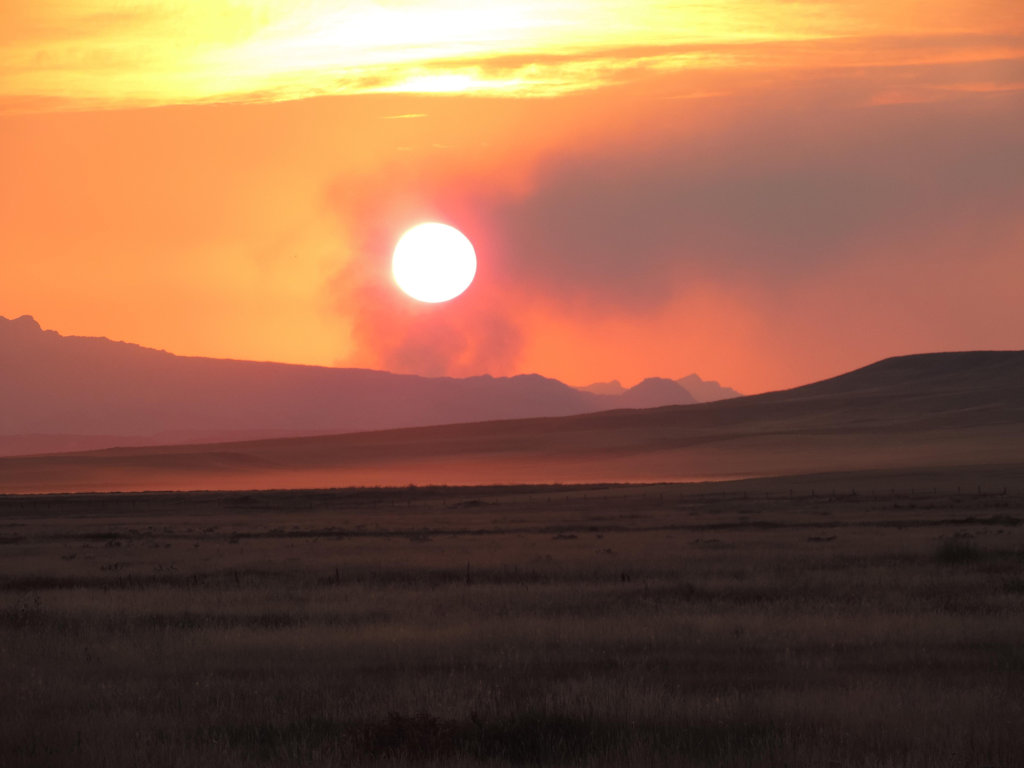
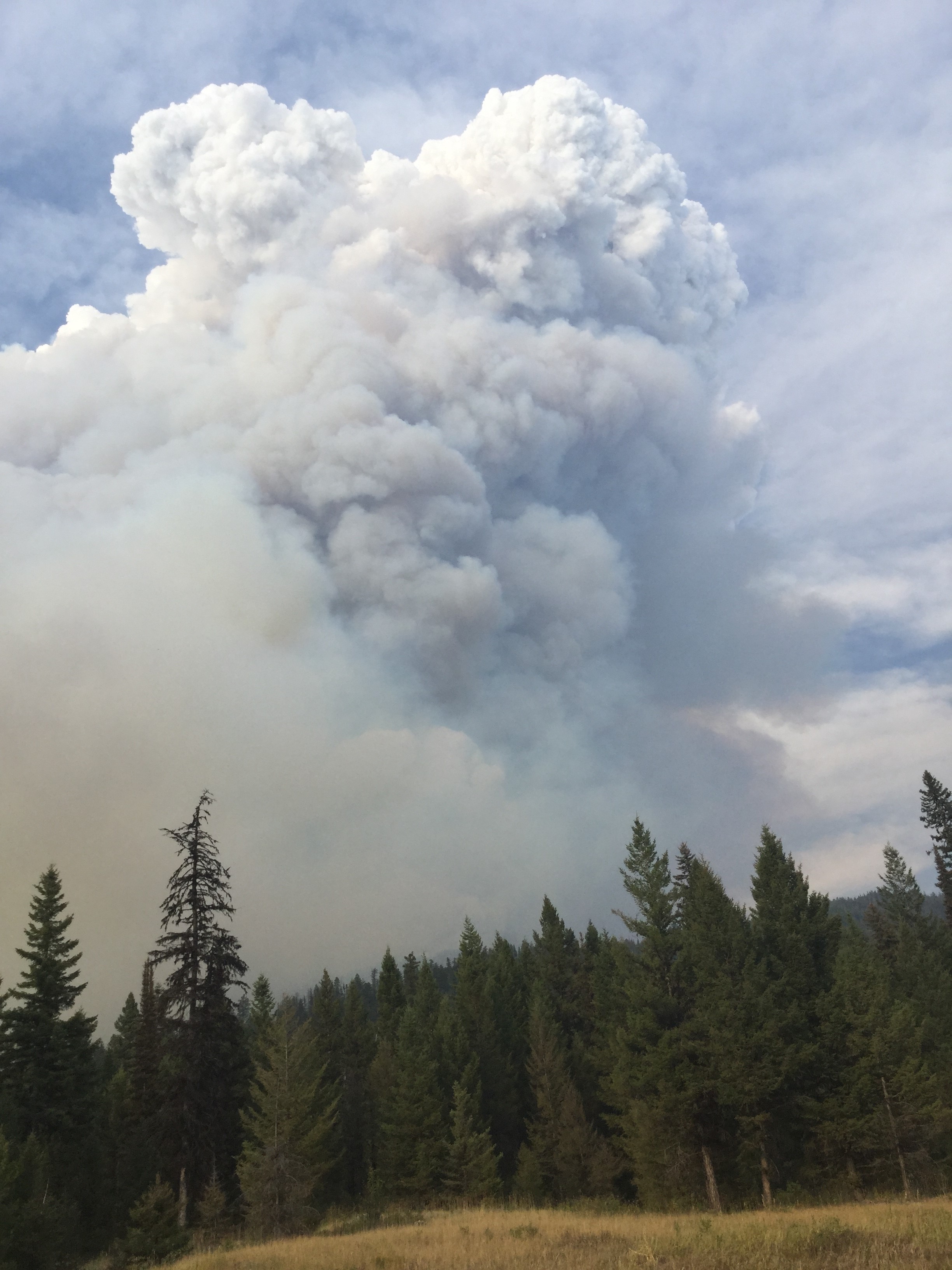
A column of smoke from the Glacier National Park Thompson Fire could be seen rising over the Rocky Mountain Front at sunset Aug. 12, 2015. The remote backcountry fire has burned about 14,900 acres. (Photo by Jonathan Moor)
This article from the New York Times most definitely does not serve as the starting point for an informed discussion on wildfire management. It does, however, highlight some interesting issues . . .
With long strides, Chad T. Hanson plunged into a burned-out forest, his boots kicking up powdery ash. Blackened, lifeless trees stretched toward an azure sky.
Dr. Hanson, an ecologist, could not have been more delighted. “Any day out here is a happy day for me, because this is where the wildlife is,” he said with a grin.
On cue, a pair of birds appeared, swooping through the air and alighting on dead trees to attack them like jackhammers. They were black-backed woodpeckers, adapted by millions of years of evolution to live in burned-out forests. They were hunting grubs to feed their chicks.
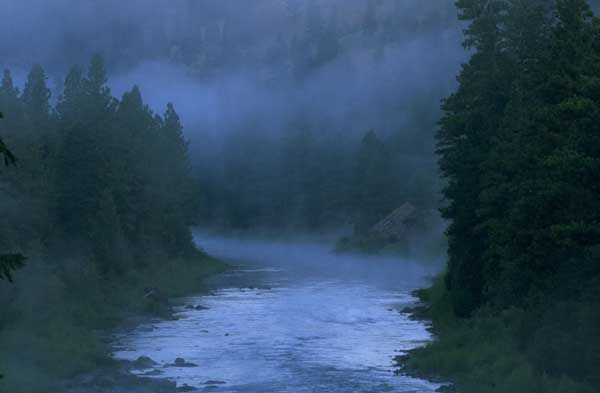
Blackfoot River, Lewis and Clark National Historic Trail – BLM Montana
Another nice Sunday spread by the Missoulian. This one, by Rob Chaney, concerns the Blackfoot Clearwater Stewardship Act . . .
Alec Underwood accidentally hooked one of the biggest justifications for passing the Blackfoot Clearwater Stewardship Act as he floated by Belmont Creek last week. A 21-inch bull trout snatched the artificial hopper he’d tied to his tippet in hopes of hitting a cutthroat. The Montana Wilderness Association conservation associate got the raft to shore, jumped in the water and quickly unhooked the fish. It torpedoed back into the cooler depths of the channel.
Without those cold waters, and without those tributary streams, the Blackfoot River would hold no bull trout. As is, the fish known as the grizzly bear of the trout world faces the same challenge as its land-based predatory kin — near extinction due to loss of living space. Anglers must release any bulls they catch, unharmed.
In hopes that one day bull trout might be legal game fish in the Blackfoot again, Underwood and a flotilla of fellow advocates want to build support for the Blackfoot Clearwater Stewardship Act. The bill offered by Sen. Jon Tester, D-Montana, would add about 80,000 acres to the Bob Marshall, Mission Mountain and Scapegoat wilderness areas.
Upper Missouri River Breaks National Monument in Montana – Bob Wicks/BLM
The Upper Missouri River Breaks National Monument is officially on the “do not touch” list . . .
Interior Secretary Ryan Zinke says he will not recommend changes to Montana’s Upper Missouri River Breaks National Monument as he continues to review national monuments for possible elimination or reduction.
Zinke says the monument is one of the only free-flowing areas of the Missouri that remains as explorers Lewis and Clark saw it more than 200 years ago.
Montana Gov. Steve Bullock had asked Zinke to keep the Breaks monument unchanged as he reviews 27 national monuments designated by previous presidents. President Donald Trump ordered the review, calling many monument designations land grabs by the federal government. Monument designations protect federal land from energy development and other activities.
Here’s a thought provoking scientific study. It appears that people have been altering tropical forests for a long time — “sustainably” in some cases, but altering them nevertheless . . .
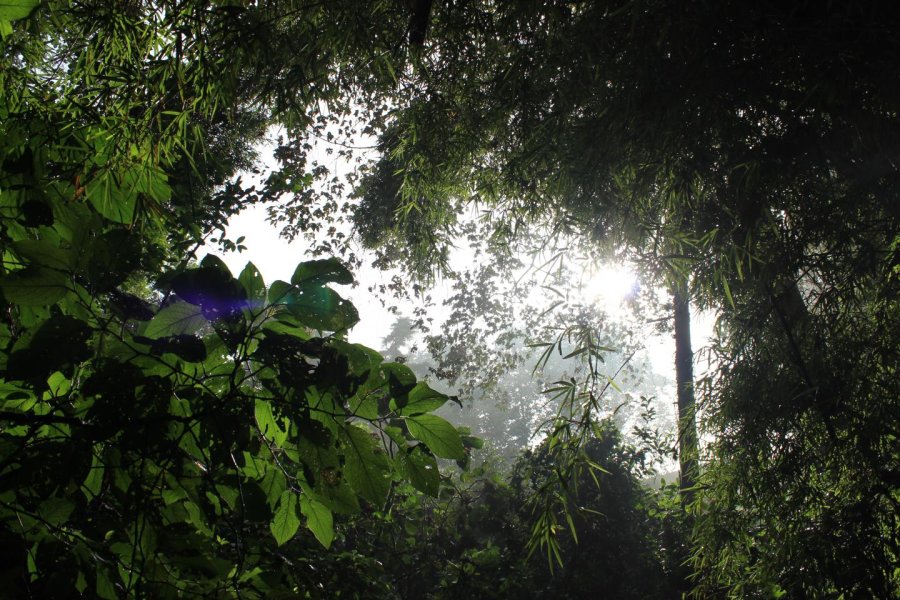
The first review of the global impact of humans on tropical forests in the ancient past shows that humans have been altering these environments for at least 45,000 years. This counters the view that tropical forests were pristine natural environments prior to modern agriculture and industrialization. The study, published today in Nature Plants, found that humans have in fact been having a dramatic impact on such forest ecologies for tens of thousands of years, through techniques ranging from controlled burning of sections of forest to plant and animal management to clear-cutting. Although previous studies had looked at human impacts on specific tropical forest locations and ecosystems, this is the first to synthesize data from all over the world.
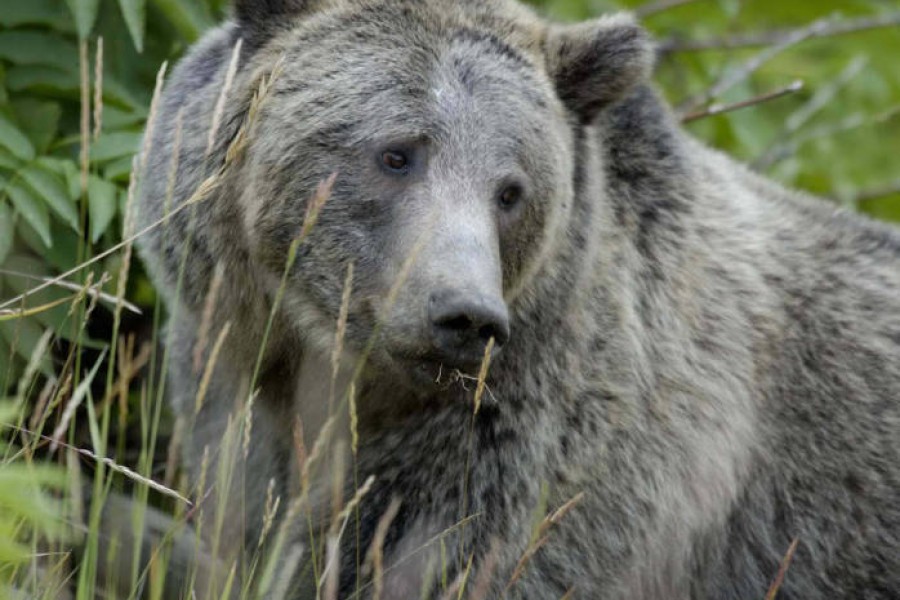
Grizzly Bear – U.S. Fish and Wildlife Service-Terry Tollefsbol, NPS
Grizzly bears in the Greater Yellowstone Ecosystem were officially removed from the threatened species list on July 31. Of course, there’s the matter of dealing with a number of lawsuits . . .
For the second time in a decade, the U.S. government has removed grizzly bears in the Yellowstone region from the threatened species list.
It will be up to the courts again to decide whether they stay off the list.
The decision by the U.S. Fish and Wildlife Service to remove federal protections from the approximately 700 bears living across 19,000 square miles in Montana, Idaho and Wyoming took effect Monday.
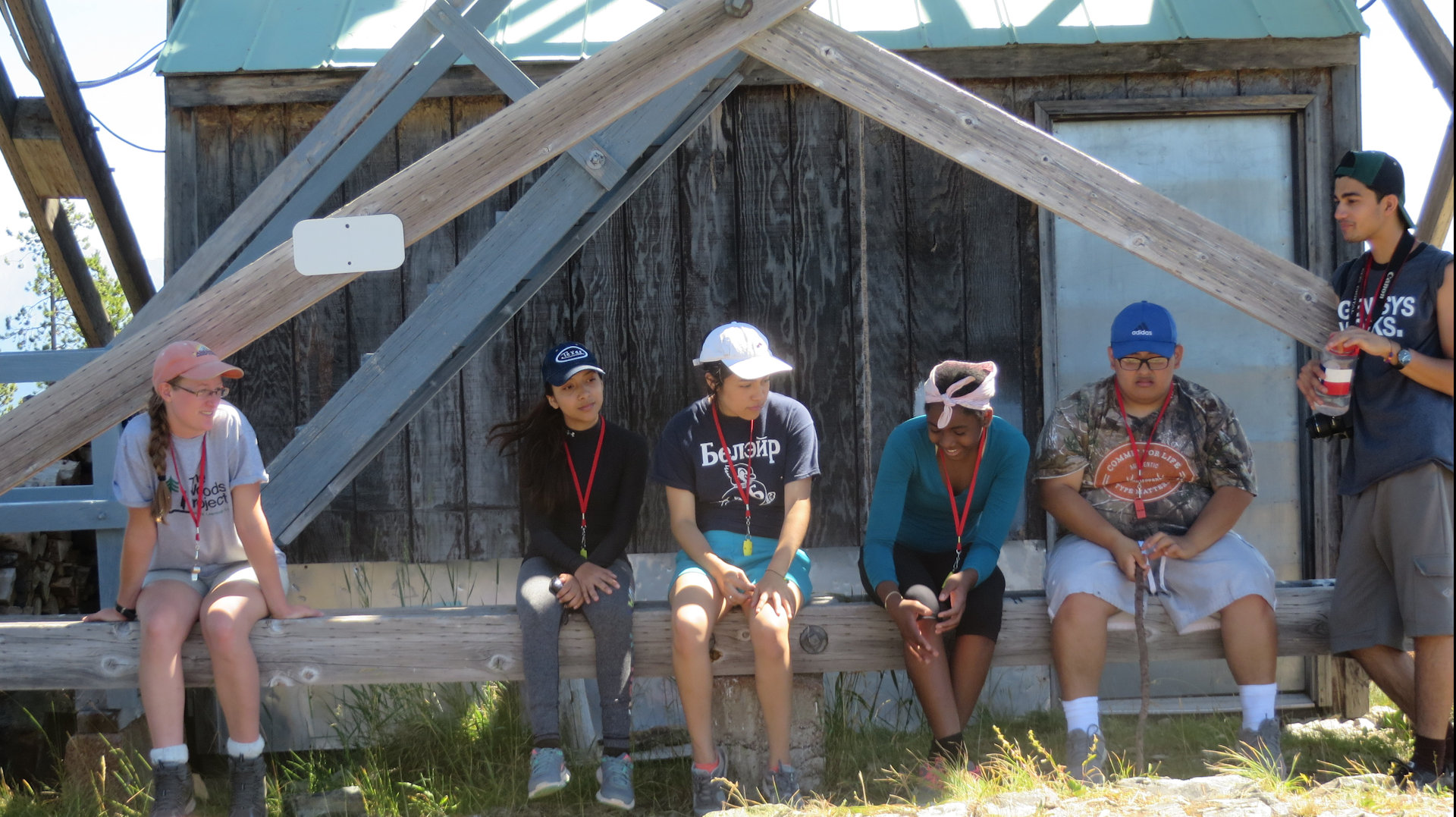
Woods Project participants at Cyclone LO, July 23, 2017 – by W. K. Walker
From NFPA President Debo Powers: The Woods Project gets inner-city high school students into the woods. Two groups of these students visited Cyclone Lookout this past week . . .
It’s hard to find nature when you’re surrounded by concrete and steel.
The 16 teenagers from Houston gathered in the shade of the Cyclone Lookout on the Flathead National Forest last week would tell you that’s a fact. For many of them, the concrete, steel and busy bustle of Houston’s city life has been the only thing they’d ever known until good fortune shined on them when their paths crossed with The Woods Project.
Started in 2006, the program has offered an opportunity for hundreds of teenagers from low-income families a chance to broaden their horizons through year-round outdoor programming that includes a 14-day adventures into the wilds.
7:30pm Dr. Tabitha Graves on “A Search for Berry Treasure in the North Fork: Huckleberry Ecology”
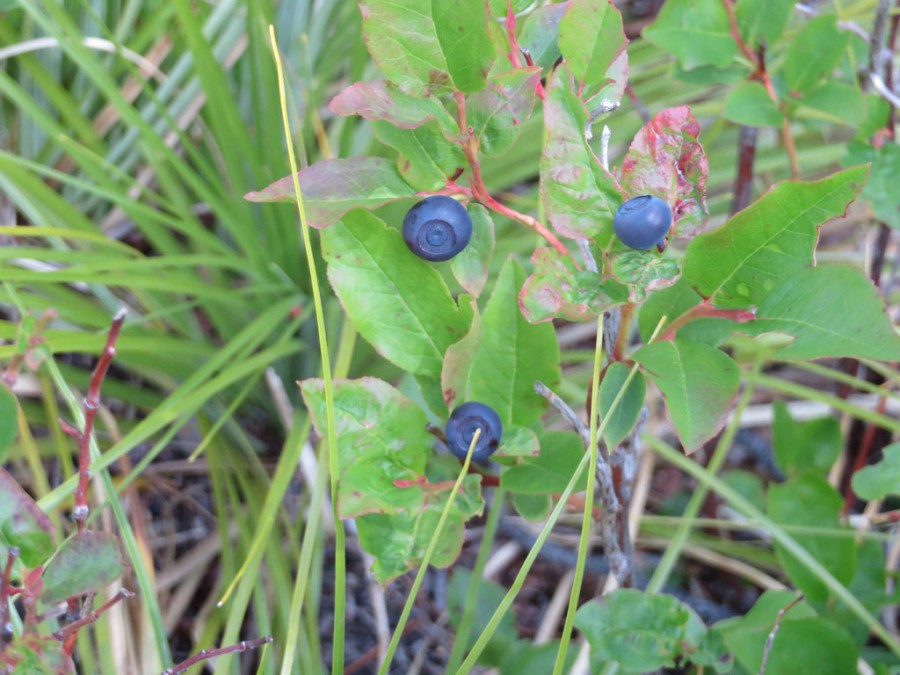
Huckleberries on Moran Creek Trail (T2) in Flathead NF – W. K. Walker
Huckleberries are a keystone food source for many wildlife species and are culturally and economically important to our region. USGS Research Ecologist, Dr. Tabitha Graves will share information about current projects investigating interactions among weather and site conditions that influence huckleberry distribution, productivity, and phenology.
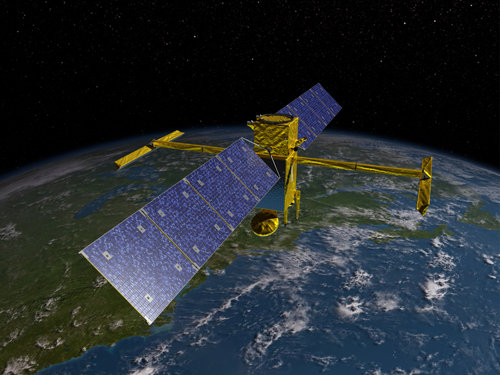
Surface Water and Ocean Topography (SWOT) satellite – NASA/JPL
The North Fork of the Flathead River gets a passing mention in this mildly technical article from Earth and Space Science News discussing a technique to track river flows from space . . .
For hydrologists, everything begins with water. This essential resource drastically alters the land surface and powers the basic cellular respiration underlying all living things.
When water falls on land and begins its slow passage to the ocean, its path almost invariably includes rivers, the most visible veins through which our planet’s lifeblood courses. To best study freshwater systems, we need a fairly precise idea of how much water flows in Earth’s rivers. You might think that we have this precise idea, right? Wrong.
Given the importance of water—especially river water—in ecosystems, industry, and agriculture, this lack of knowledge must be addressed. This issue is far more than academic: Well-documented issues of water data secrecy, toxic water politics, and even water conflict highlight the urgent need to better understand and monitor freshwater fluvial fluxes.
Unless you’ve been hiding under a rock, trying to stay cool, you probably know that just about our entire region is under Stage II fire restrictions.
The short version::
No fires, including campfires.
No smoking except “within an enclosed vehicle or building, a developed recreation site or while stopped in an area at least three feet in diameter that is barren or cleared of all flammable materials.”
No motorized vehicles are allowed off designated roads and trails.
Also, there are “hoot owl” restrictions (prohibited from 1:00 p.m. to 1:00 a.m.) on
Operating any internal combustion engine (e.g., a chainsaw).
Welding, or operating acetylene or other torch with open flame.
Using an explosive.
Additionally a one hour foot patrol in the work area is required following cessation of all “hoot owl” activities.
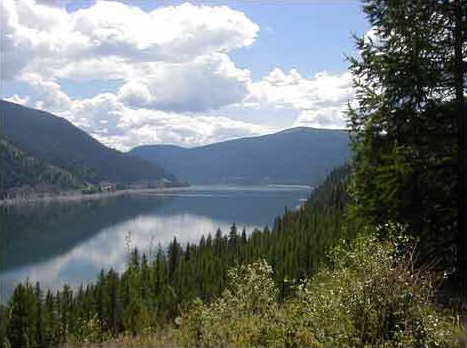
Dave Hadden’s recent op-ed in the Flathead Beacon is yet another reminder of why we really don’t want open pit coal mining in the transboundary Flathead Drainage . . .
The Beacon’s June 20 story detailing Teck Coal’s selenium pollution of Lake Koocanusa was barely off the presses when the company had responded with a letter to the editor (June 25) denying that its water treatment plant is failing. Either the Beacon got its facts wrong, or Teck’s conveying false facts. Which one has the long nose?
This is what Teck said in its letter to the editor: “The water treatment facility at our Line Creek Operations is operating and successfully achieving design specifications for reducing selenium and nitrate concentrations in treated water.”
This is what Teck’s Director of Environmental Performance said recently: “We [Teck] clearly and fully violated the intent of the facility, but we have met the requirements of the permit.”
Translation (and just as claimed in the Beacon article) Teck’s water treatment plant is releasing less selenium, but a chemical variety of selenium that is up to 200 times more available for absorption by aquatic organisms. This means that the water treatment plant has worsened the selenium pollution problem.
It’s hard to figure why Teck continues to claim it has succeeded when it has failed.
Ralph Waldo Emerson remarked in the 1800s that, “The reward of a thing well done, is to have done it.” Teck hasn’t gotten the job done. It hasn’t cleaned up the Elk River, its pollution continues to flow across the border, it continues to mine coal, and the province of British Columbia has rewarded the company for not succeeding by not revoking permits for four new big mines.
At this point in time Montanans can be assured that we’re the settling pond for Teck’s mining in the Kootenai watershed as a consequence of BC inadequate and broken mine evaluation, permitting, and enforcement process.