This is encouraging news. A search at one of the first places in Montana to test positive for invasive mussels last year turned up no evidence of adult mussels last week.
Divers searched for adult aquatic invasive mussels at Tiber Reservoir last week, but found none.
The five divers involved in the effort were from the U.S. Fish and Wildlife Service and coordinated by Montana Fish, Wildlife and Parks. The primary search area was Tiber Dam up to a depth of about 35 feet.
With its rock structure, the dam is good habitat for the invasive mussels, which prefer solid substances, like rocks, to attach to. However, deeper than 35 feet, silt reduced the habitat significantly.
The divers are part of FWP’s monitoring plan for Tiber Reservoir after water samples last year came back positive for aquatic invasive mussel larvae. The monitoring plan also includes an increased frequency of water sampling at the reservoir.
The divers also searched rock outcroppings around Turner Point at Tiber Reservoir. No adult invasive mussels were discovered.
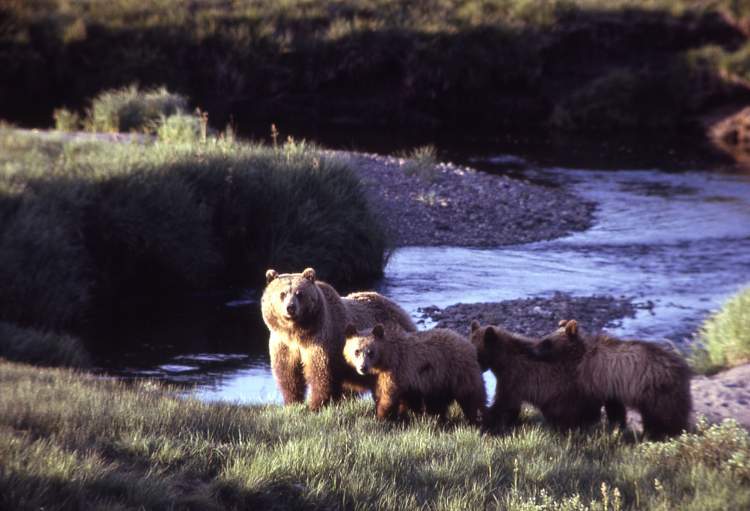
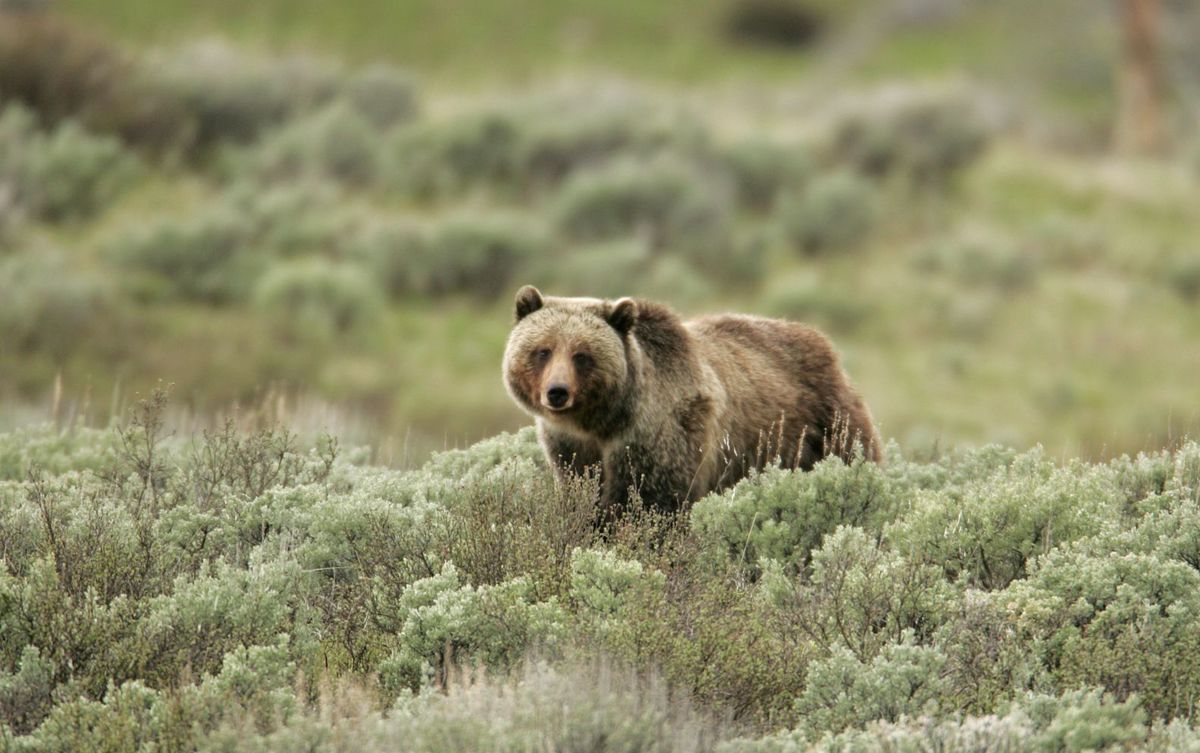
BC is banning trophy hunting of grizzlies. Interestingly, it’s not that too many bears are being killed, but because societal norms no longer favor this type of activity . . .
In a win for conservationists and environmental groups, British Columbia says it will no longer allow the trophy hunting of grizzly bears in the Canadian province starting on Nov. 30.
The new policy blocks all hunting of grizzlies in the Great Bear Rainforest but still allows people to hunt them for food elsewhere in British Columbia.
Of the approximately 15,000 grizzlies in British Columbia, about 250 are killed by hunters annually, according to government figures.
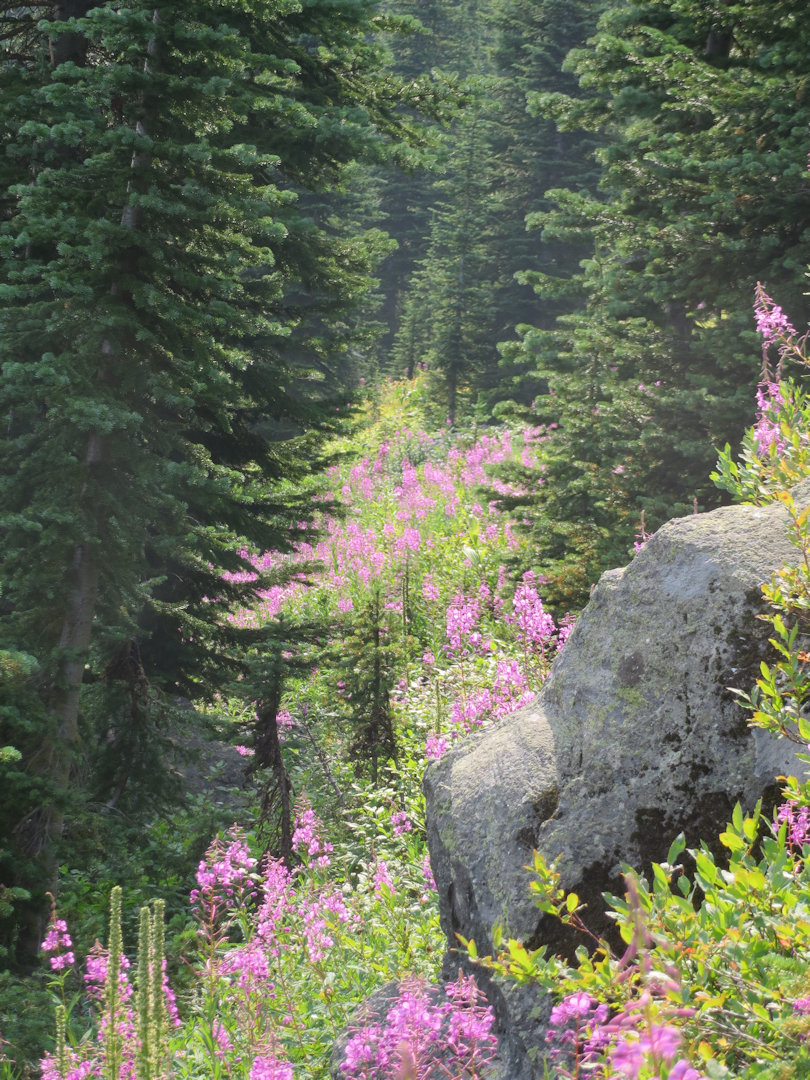
Fireweed below Nasukoin Lake, Aug 12, 2017 – W. K. Walker
We’re getting there, with a near-final version of the Flathead National Forest’s revised forest plan due out in October. Barring any significant further delays, the final version of the whole package should be released around March 2018.
The Flathead National Forest release of the final environmental impact statement and draft records of decision for the revised forest plan and forest plan amendments is now slated for October due to the need to coordinate schedules with the Washington, D.C., headquarters of the U.S. Forest Service.
In addition to addressing the effects of the Flathead National Forest revised forest plan, the final environmental impact statement includes discussion of the environmental consequences of the forest plan amendments to incorporate habitat-related management direction for the Northern Continental Divide Ecosystem grizzly bear population on the Helena-Lewis and Clark, Kootenai, and Lolo National Forests.
The final environmental impact statement and draft records of decision will be subject to a pre-decisional administrative review process, commonly referred to as the objection process. The Forest Service’s objection process provides an opportunity to have any unresolved concerns reviewed by the Forest Service prior to a final decision by the responsible official. Objections will be accepted only from those who have previously submitted substantive formal comments during an opportunity for public participation provided during the planning process and attributed to the individual or entity providing them.
For more information, please call Joe Krueger, plan revision team leader, at 406-758-5243 or visit www.fs.usda.gov/goto/flathead/fpr.
Also, here is a related letter from Chip Weber, Flathead National Forest Supervisor, explaining the reasons behind the delay in this stage of the forest plan revision . . .
Hello,
I would like to update you on the status of the final environmental impact statement for the revised forest plan and the draft records of decision. In addition to addressing the effects of the Flathead National Forest revised forest plan, the final environmental impact statement includes discussion of the environmental consequences of the forest plan amendments to incorporate habitat-related management direction for the Northern Continental Divide Ecosystem grizzly bear population on the Helena-Lewis and Clark, Kootenai, and Lolo National Forests.
We had planned to have the documents out for the pre-decisional administrative review process, commonly referred to as the objection process, in August but because of the need to coordinate schedules with the Washington, D.C., headquarters of the U.S. Forest Service, we now plan to release the documents in October. The schedule on our webpage has been updated to reflect this change.
I appreciate your patience and continued interest in the revised forest plan for the Flathead National Forest as well as the forest plan amendments for the Helena-Lewis and Clark, Kootenai, and Lolo National Forests. I greatly appreciate the commitment of the interested participants who have provided important contributions toward the development of the revised forest plan and amendments.
For further information about the project, contact Joe Krueger, plan revision team leader, at 406-758-5243. Thank you for your continued interest in the management of your public lands.
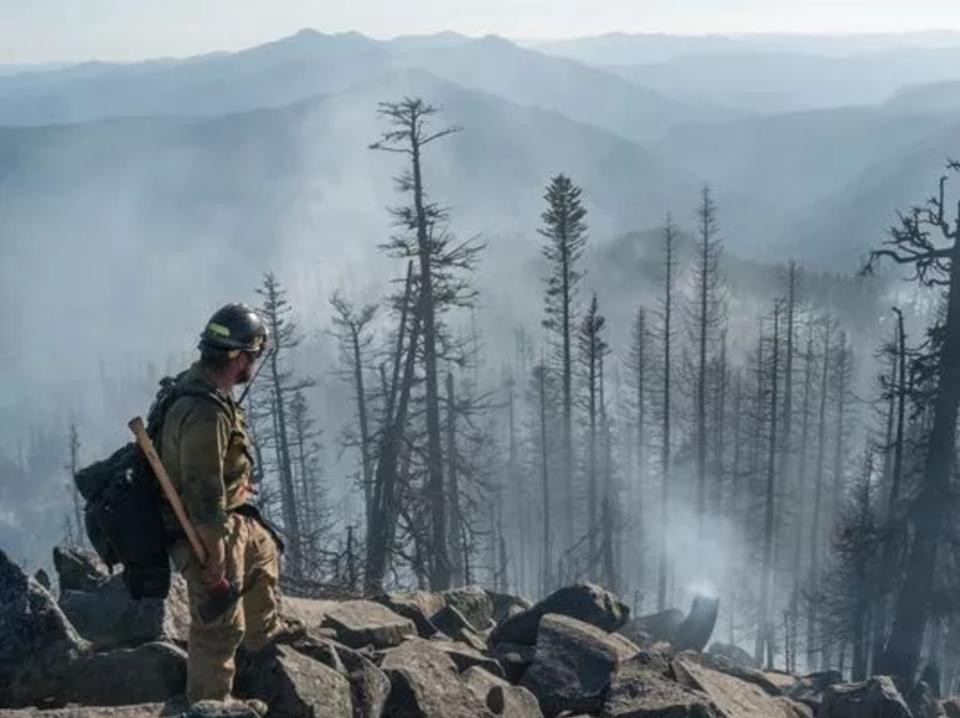
Whitewater Fire, 2017 – Willamette National Forest
The tone is a little overwrought, but this article has some good points about the risks of large crowds gathering along the solar eclipse path during peak wildfire season . . .
At the peak of wildfire season, all it takes is one errant spark to start a blaze, potentially leading to wildfires engulfing thousands of acres. It isn’t just the fire itself that’s dangerous, but also the smoke, the degraded air quality, and the potential closures of roads. In Oregon, in particular, over a million people are expected to travel to the seventy-mile-wide path of totality, in the heart of the hottest, driest part of the year. The entire pacific northwest, including parts of Oregon, Idaho, and Wyoming, has active wildfires going right now, threatening the air, roads, and general safety of residents and tourists alike…
Montana Fish, Wildlife and Parks’ biologists have confirmed a grizzly bear sighting on a ranch in the northern Big Belt Mountains.
The sighting is the second in the Big Belts this summer and is likely two separate bears.
The first sighting was 3-year subadult male northwest of White Sulphur Springs, confirmed through photos taken by FWP trail cameras.
The second sighting was confirmed from a video of the bear on private land in the area between the Missouri River and Hound Creek, south of Cascade. The bear also is a subadult male.
No conflicts with the bear have been reported.
This is the third grizzly bear sighting this year in areas the species has not been present for, perhaps, a century.
In June, a pair of grizzlies apparently came down the Teton River from the Rocky Mountain Front and ended up near Stanford, east of Great Falls. The young bears were captured and euthanized after they preyed on livestock.
In recent years, bears have traveled the river corridors – Sun, Marias, Dearborn and Teton – east from the Rocky Mountain Front looking for natural foods. But the animals can also be attracted to unprotected opportunistic foods, like grain, livestock feed, beehives, livestock, garbage and pet food.
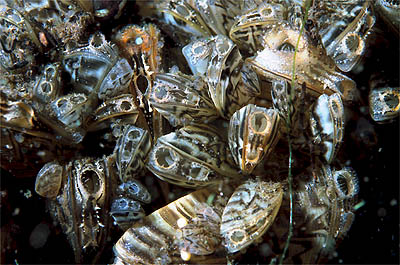
Zebra Mussel Shells Cover a Lake Michigan Limestone Beach in Door County Wisconsin – PJ Bruno
The Daily Inter Lake has an interesting article on a device invented to provide fast, sensitive and mobile detection of invasive mussels . . .
The pristine waters of Flathead Lake that have supported local residents’ way of life for centuries are being threatened by invasive species that have devastated lakes and waterways across the country.
The arrival of the first documented zebra and quagga mussels in Montana could mark the beginning of the end for the crown of the continent’s signature landscape, according to experts at the Flathead Lake Biological Station (FLBS).
These invasive species have infested lakes in almost every state in the U.S., corrupting indigenous ecosystems, clogging drainage and irrigation systems and crashing the economical and recreational value of beaches and harbors.
Here’s a good piece by Chris Peterson of the Hungry Horse News on the progress in grizzly bear management over the last few decades . . .
While tragic, Glacier Park’s Night of the Grizzlies did much to change grizzly bear and human backcountry use. “It was a lightning rod to the core of the Park Service,” said Glacier Park biologist John Waller.
While the Wilderness Act had been passed three years before that tragic night in 1967, there was no Leave No Trace ethic — leaving or burying garbage was common in bear country. Even Roy Ducat and July Helgeson buried the remains of their sandwiches before they camped for the night, a Hungry Horse News story noted.
Philosophy toward bear management changed quickly after the incident. Grizzlies were not nearly as common in Glacier in the late 1960s as they are today. They also weren’t protected, Waller said. The Endangered Species Act was passed in 1973 and grizzlies were listed as threatened in 1975.
Here’s a pretty good write-up on the Interior Department’s revisions to the sage grouse conservation plan put into place a couple of years ago . . .
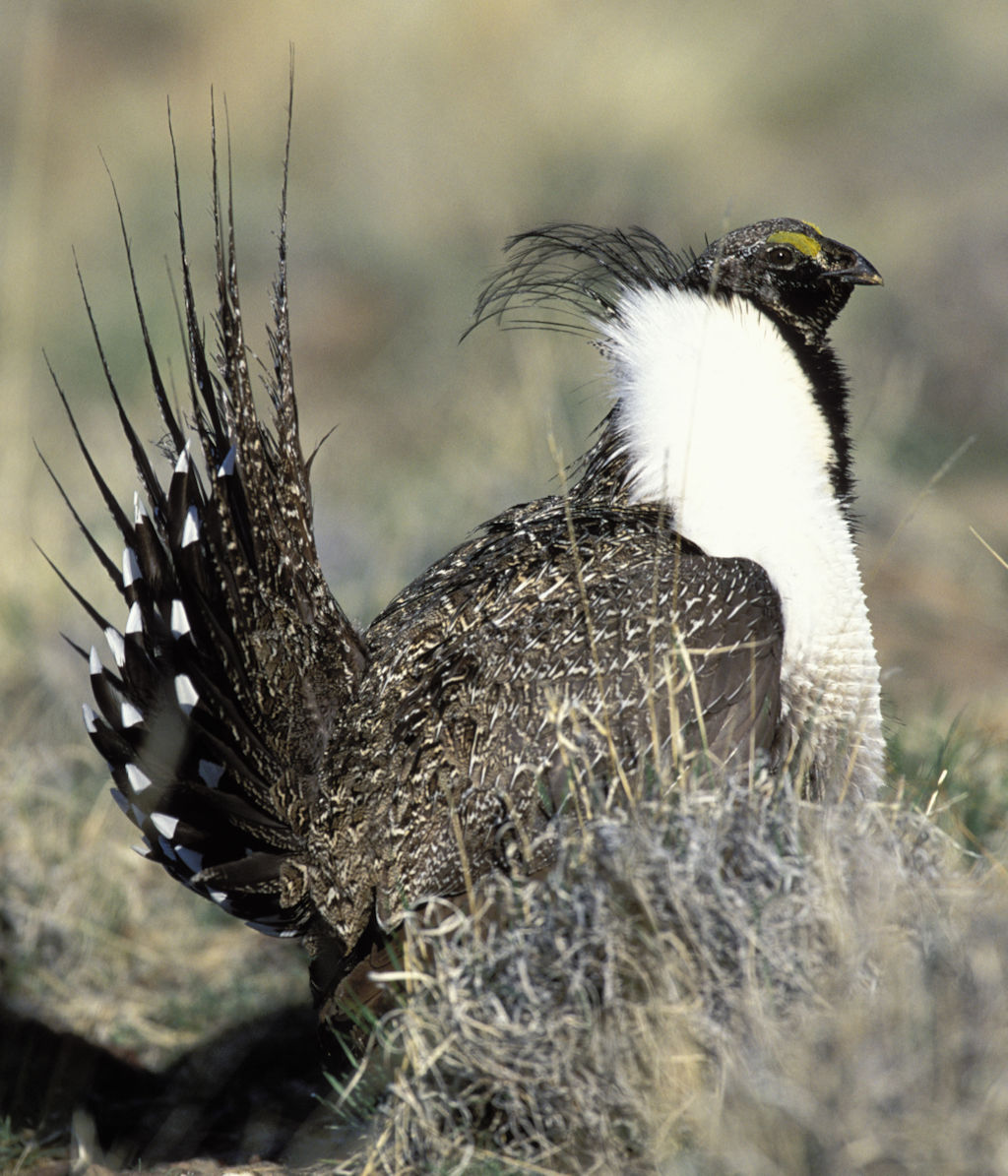
A task force is recommending changes that could loosen protections for the greater sage grouse, a Western bird species renowned for its elaborate mating dance.
The report comes out of a review by the Trump administration of a massive Obama-era conservation plan for the bird which is imperiled by loss of habitat.
The administration says the revisions are aimed at giving states more flexibility. But critics argue that the changes favor mining and petroleum companies and could hurt the bird’s long-term prospects.
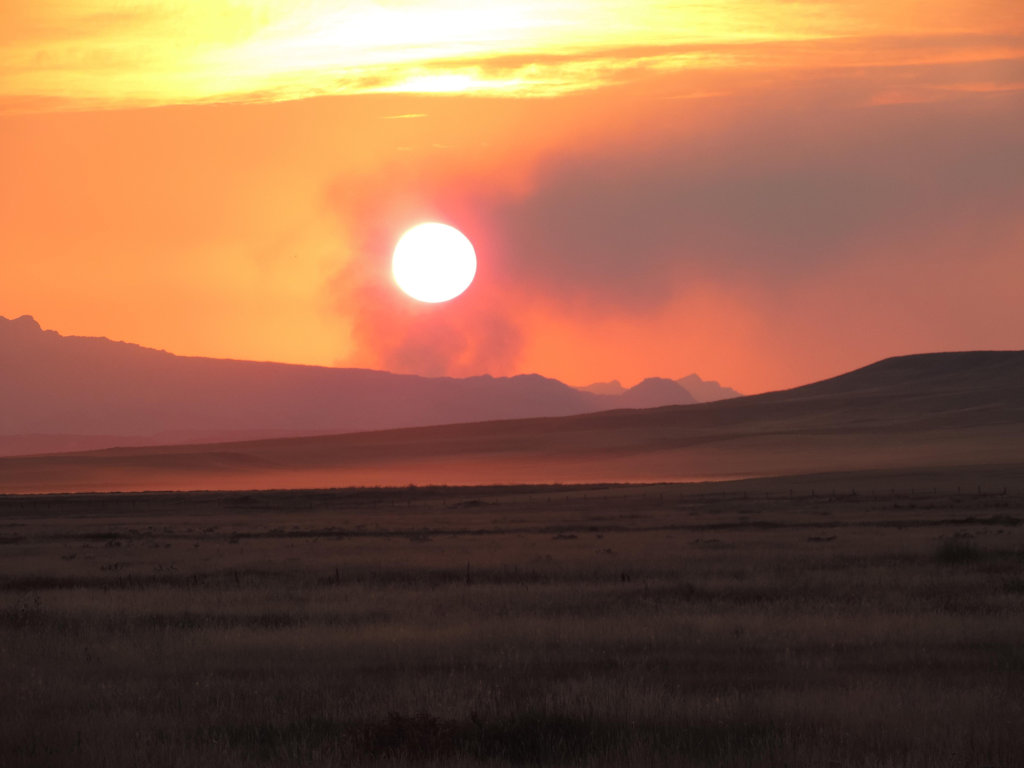
A column of smoke from the Glacier National Park Thompson Fire could be seen rising over the Rocky Mountain Front at sunset Aug. 12, 2015. The remote backcountry fire has burned about 14,900 acres. (Photo by Jonathan Moor)
This article from the New York Times most definitely does not serve as the starting point for an informed discussion on wildfire management. It does, however, highlight some interesting issues . . .
With long strides, Chad T. Hanson plunged into a burned-out forest, his boots kicking up powdery ash. Blackened, lifeless trees stretched toward an azure sky.
Dr. Hanson, an ecologist, could not have been more delighted. “Any day out here is a happy day for me, because this is where the wildlife is,” he said with a grin.
On cue, a pair of birds appeared, swooping through the air and alighting on dead trees to attack them like jackhammers. They were black-backed woodpeckers, adapted by millions of years of evolution to live in burned-out forests. They were hunting grubs to feed their chicks.
Blackfoot River, Lewis and Clark National Historic Trail – BLM Montana
Another nice Sunday spread by the Missoulian. This one, by Rob Chaney, concerns the Blackfoot Clearwater Stewardship Act . . .
Alec Underwood accidentally hooked one of the biggest justifications for passing the Blackfoot Clearwater Stewardship Act as he floated by Belmont Creek last week. A 21-inch bull trout snatched the artificial hopper he’d tied to his tippet in hopes of hitting a cutthroat. The Montana Wilderness Association conservation associate got the raft to shore, jumped in the water and quickly unhooked the fish. It torpedoed back into the cooler depths of the channel.
Without those cold waters, and without those tributary streams, the Blackfoot River would hold no bull trout. As is, the fish known as the grizzly bear of the trout world faces the same challenge as its land-based predatory kin — near extinction due to loss of living space. Anglers must release any bulls they catch, unharmed.
In hopes that one day bull trout might be legal game fish in the Blackfoot again, Underwood and a flotilla of fellow advocates want to build support for the Blackfoot Clearwater Stewardship Act. The bill offered by Sen. Jon Tester, D-Montana, would add about 80,000 acres to the Bob Marshall, Mission Mountain and Scapegoat wilderness areas.