Category Archives: Environmental Issues

Keep heli-skiing out of North Fork

John Frederick’s letter to Nicole Stickney of the Montana DNRC regarding the proposal to conduct heli-skiing on state lands in the Whitefish Range appeared in today’s Hungry Horse News in the Letters section . . .

I can sympathize with the Department of Natural Resources and Conservation in trying to find money through the school trust lands for Montana schools. It is not easy to balance environmental and social concerns while trying to get big bucks for the schools.

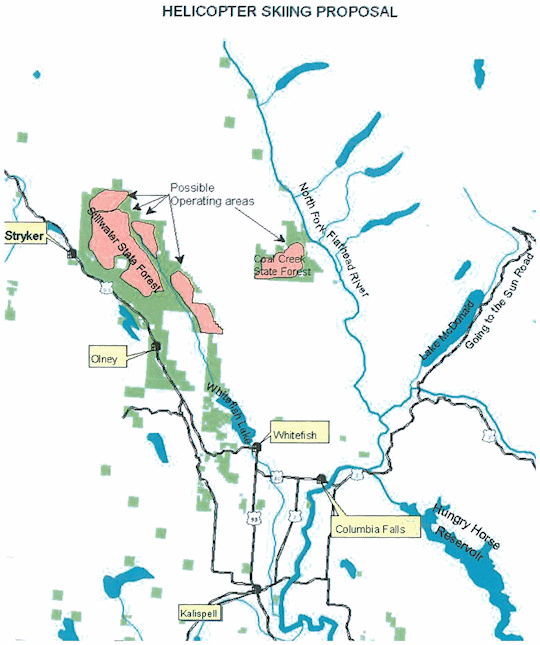
The two proposed locations for heli-skiing in Coal Creek State Forest are rather close to Polebridge. Winona Ridge, one of the proposed landing/skiing sites, is a little less than three and a half miles from Polebridge and roughly parallels the North Fork Road at a distance of 3/8 of a mile to almost a mile away. It is also not a high mountain which means more noise from helicopters. The other proposed, nearby skiing location is Coal Ridge which at the closest point is only four miles southwest of Polebridge.

I hope you can now understand why people become upset about heli-skiing or any frequent use of helicopters any time of the year when it is not an emergency. Most people, both residents and visitors, come to the North Fork for solitude and quiet.

Others have e-mailed you about the strong probability of people and wildlife being harassed by helicopters bringing skiers to places such as Winona Ridge in Coal Creek State Forest. Many other questions remain unanswered about the possibility of local heli-skiing.

What are the models, sizes and occupancies of the helicopters to be used? What are the decibels created by such machines? How far will the sound travel and be heard?

How many flights a day will be allowed? How many skiers? Triple X, one of the applicant helicopter companies, said they flew 260 helicopter flights over Whitefish during the fourth of July weekend. Hardly anyone wants that kind of activity in our state forests.

Would DNRC give permits to other companies who requested a similar permit?

What are the flight patterns? Do the helicopters go directly to the skiing location or do they swing over to Glacier Park for a scenic tour?

Has anyone at DNRC researched the location of bear dens in the vicinity of the flight paths?

How do the skiers return? By snowmobile or helicopter? And what is their route?

How much would you charge the operators of the helicopter skiing for a permit?

Has DNRC researched other locations in Alaska or British Columbia where heli-skiing has already taken place? Are there problems?

Heli-skiing has never been done in the Flathead Valley. Therefore, it might be a good idea to leave the comment period open for a while longer. There is a definite lack of information on the subject at this time.

Look at the Hungry Horse News article last week by Chris Peterson as it reflects the opinions of many North Forkers. There is a link to the article on the North Fork Preservation Association Web site (with new format) at www.gravel.org.

John Frederick of Polebridge is the North Fork Preservation Association president.
Road paving & land development report released

One of the factors in the ongoing road maintenance debate is the impact of paving on increased land development and settlement. Headwaters Economics along with Chris Servheen of the U.S. Fish and Wildlife Service and the University of Montana just released a report titled “Land Use Effects of Paving Rural Roads in Western Montana” that is relevant to this issue. In Chris’s words…

Headwaters Economics and I have partnered to complete a preliminary analysis of the relationship between the paving of rural roads and the development of adjacent private lands.  The report on this work is attached.  We believe this is a useful preliminary analysis and that it sets the stage for a more in-depth and through analysis of this most important issue.  The paving of rural roads in the West and the resulting impacts on adjacent private land development are one of the greatest challenges faced by wildlife managers and county decision-makers.  We hope this report is of value to you.

The report is essentially a series of case studies followed by some carefully qualified observations and conclusions. It’s a bit dry and dusty (sorry, couldn’t resist) in spots, but a worthwhile read.

DOW not happy with heli-skiing proposal

The deadline for public comments on the proposal to allow helicopter skiing on state lands in the Whitefish Range expired today. Overall attitudes appear to range from cautious skepticism to outright hostility. One of the lengthier responses was an 18-page missive submitted by the Rocky Mountain Region Office of Defenders of Wildlife, covering everything from the applicable regulations and agreements to wildlife impact and the potential disturbance to nearby federal and private holdings. The real meat is in the last paragraph:

This letter has described the complex and varied potential effects of the proposed helicopter skiing operations. In order to completely and carefully examine these effects, we believe the preparation of an environmental impact statement is justified and required. We are also concerned that many interested members of the public may not be aware of these proposals. If it were not for an article in the Kalispell newspaper, we would not know about it ourselves. We found no mention of it on the NDRC website, for example. For these reasons, we look forward to participating in the public review component of an EIS process.

They seem annoyed.

Comments regarding heli-skiing proposal

The recent proposal to allow heli-skiing on state lands in the Whitefish Range seems to be getting folks stirred up — enough so that the comment period has been extended to October 10.

A recent article in the Hungry Horse News provides a good overview of the the proposal and the circumstances surrounding it.

Comments should be directed to:

Nicole Stickney
Special Uses Forester
Stillwater State Forest
P.O. Box 164
Olney MT 59927

Or by email to nstickney@mt.gov

A great many of the comments submitted so far are from people concerned about wildlife disruption and other impacts in a particularly sensitive area. The following email, sent by Richard Andersen on September 30, is a good example . . .

Nicole Stickney
Special Uses Forester
Department of Natural Resources and Conservation
Stillwater Unit

Dear Nicole,

As a native Montanan and life-long resident of the Flathead, I am very concerned to know that helicopter skiing is being considered for the Whitefish Range.

Continue reading Comments regarding heli-skiing proposal →

DNA study doubles bear census

Here’s a better article on the recently completed grizzly bear DNA study. Yesterday’s AP write-up was a little thin.

From the Wednesday, September 17, 2008 online edition of the Daily Inter Lake . . .

The estimate is in: There were 765 grizzly bears roaming the Northern Continental Divide Ecosystem during the summer of 2004.

That’s the official result of an ambitious and unprecedented genetic study of the largest grizzly bear population in the lower 48 states. The study will be published in the January edition of the Journal of Wildlife Management.

Read the entire article . . .

Federal Study Says Grizzlies Thriving in Montana

From the Tuesday, September 16, 2008 online edition of the Flathead Beacon . . .

The majestic grizzly bear, once king of the Western wilderness but threatened with extinction for a third of a century, has roared back in Montana…

Researchers with the U.S. Geological Survey announced Tuesday that there are approximately 765 bears in northwestern Montana. That’s the largest population of grizzly bears documented there in more than 30 years, and a sign that the species could be at long last rebounding.

Read the entire article . . .

Flathead Basin Commission hears of new coal mine

From the Friday, August 29, 2008 online edition of the Hungry Horse News . . .

Potential mining projects in the Canadian Flathead seem slowed for now, but a new project just outside the Flathead is in its early stages.

A British Columbia representative last week told the Flathead Basin Commission that little has developed with proposed mining projects. At the same meeting in West Glacier, representatives from a third company explained plans for a mine near the Canadian Flathead.

Read the entire article . . .

Glacier Park: The next century – Threats from all sides

Another in a series of articles about Glacier National Park by Michael Jamison, this one discusses threats to the park, including things like climate change, nearby resource extraction and even road paving. From the Wednesday, August 20, 2008 online edition of the Missoulian . . .

One hundred years ago, when Glacier National Park first became a park, grizzly bears roamed along the spine of the Rocky Mountains, north into Canada, south into Sun River country, west to the Cabinets and east onto lowland plains.

Wolves wandered, too, and wolverines and big bull elk.

They had no idea someone had drawn a new political boundary onto their landscape.

They still don’t.

Read the entire article . . .

Rockies wilderness at risk from latest dash for gas

From the Wednesday, August 6, 2008 online edition of The Guardian, a widely-read British newspaper . . .

It has been called one of North America’s wildest places. Just north of the US-Canada border, the wooded slopes of the Canadian Rockies channel unpolluted water into a valley that remains free of human development. Grizzly bears, cougars and wolverines prowl the banks of the Flathead river. Outside of a national park, there is probably no wilderness like it on the continent.

But outside of a national park could mean outside of legal protection. Somewhere in the workings of the British Columbia government, an application from global energy company BP is working its way around civil servants’ desks. In it, the firm outlines a proposal that has horrified local environmentalists: the installation of up to 1,500 gas wells covering an area of 500 sq km (310 sq miles) amid the lush 1,580 sq km wilderness of the Flathead. Some time during the next six months, officials may give approval to the project.

“There have to be some places on the planet where you don’t go for energy production,” says Jack Stanford, a biologist at the nearby University of Montana. “This is one of them.”

Read the entire article . . .