The saga of Wyoming wolf management continues . . .
Wyoming wolves are back under federal projection after a ruling Tuesday by a federal judge in Washington, D.C.
U.S. District Judge Amy Berman Jackson on Tuesday rejected a Wyoming wolf-management plan that had declared wolves unprotected predators that could be shot on sight in most of the state. Her ruling sided with national environmental groups that had argued Wyoming’s management plan afforded insufficient protection for wolves…
Berman ruled that the U.S. Fish and Wildlife Service was wrong to trust nonbinding promises from the state of Wyoming to maintain at least 100 wolves, including 10 breeding pairs, outside of Yellowstone National Park and the Wind River Indian Reservation.
This probably should be getting more news coverage than it is currently receiving . . .
Native tribes from the U.S. and Canada signed a treaty Tuesday establishing an inter-tribal alliance to restore bison to areas of the Rocky Mountains and Great Plains where millions of the animals once roamed.
Leaders of 11 tribes from Montana and Alberta signed the pact during a daylong ceremony on Montana’s Blackfeet Reservation, organizers said.
It marks the first treaty among the tribes and First Nations since a series of agreements governing hunting rights in the 1800s. That was when their ancestors still roamed the border region hunting bison, also called buffalo.
The Hungry Horse News has a write-up on Brock Evans, who was in the area last week . . .
Decades ago a young man named Brock Evans from Ohio spent two summers working at the Many Glacier Hotel. When he wasn’t at work, Evans was out in Glacier National Park hiking trails and climbing mountains.
Evans went on to establish a distinguished career in the conservation movement. He was awarded lifetime achievement awards by the League of Conservation Voters and the Natural Resources Council of America and the John Muir Award, the Sierra Club’s highest honor.
Growing up in Ohio, Evans had never seen mountains before coming here.
“Glacier Park is where it all started for me,” he said last week.
Over at the Flathead Beacon, Rob Breeding doesn’t think much of this whole idea of devolving federal lands to state control . . .
If your goal is to destroy hunting there’s a clear path to follow: transfer ownership of federal lands to the states. It might take a couple decades, but if you put that ball in motion this is the inevitable result.
Maybe you think I’m exaggerating? Consider the opportunities federal lands offer hunters. Montana has large accessible tracts all over the state that we can enter, without need to seek permission, or the burden of entrance fees, to hunt.
Now imagine Montana without those resources. Understand that the real impetus behind the “transfer” movement is the eventual privatization of these lands. The states will never be able to afford to manage these properties, and once title is transferred to the state, the pressure to sell some or all of these lands will be overwhelming.
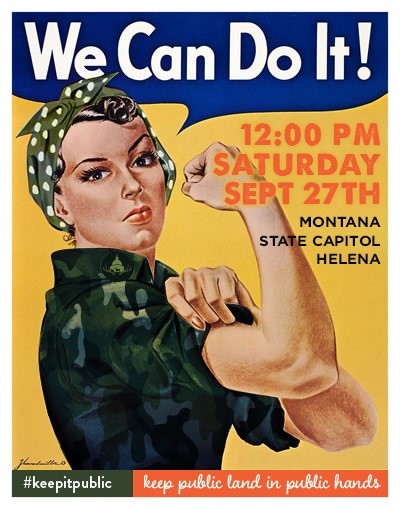
Reminder: As we mentioned here earlier, there is a rally at noon this Saturday, September 27, in Helena to protect access to public lands. The immediate trigger for this event is a movement within Montana to give up federal lands to state control. Such a move would mean a sharp increase in the state bureaucracy, a hefty bump in the tax burden and, more than likely, lead to much of the land being sold off to private interests to help finance the whole mess. Everyone from traditional hunting and fishing groups, to motorized recreation outfits to old-line enviros is pretty wound up about this.
Here are two useful and informative links. Both are recommended reading . . .
Ben Lamb of the Hellgate Hunters and Anglers posted an excellent call to action titled This Land is Your Land.
Earlier this month, the Billings Gazette wrote an excellent, well-reasoned editorial: Putting the rhetoric to the test. This piece includes links to supporting material.
Debo Powers sent in this report on the recent Crown of the Continent Roundtable. Thanks, Debo! . . .
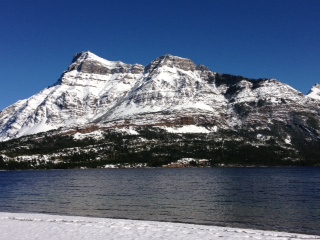
On September 5-7, three NFPA board members (John Frederick, Annemarie Harrod, and Debo Powers) attended the 5th annual Crown of the Continent (CoC) Conference, which was held in Waterton Lakes National Park, Alberta, Canada this year. The conference began with a snow storm that covered Waterton with more than a foot of snow. When the sun appeared on Thursday morning, the surrounding mountains showed the beauty and majesty of the Crown at its best. The CoC Conference brings together a diverse group of people who live and work in the Crown on both sides of the Border to connect with each other and discuss issues facing the Crown.
One highlight was the pre-conference Tribal/First Nations Roundtable to discuss perspectives and initiatives on Tribal lands. All of the presenters and speakers were indigenous people, but observers were welcome to listen and learn.
The organizing theme of this conference was “A Balancing Act.” The conference explored how our businesses, cultures, and communities are taking forward-looking actions to balance values in the face of changing economic, demographic, political, and climatic conditions. During the conference, there were numerous presentations and discussions on a variety of topics. Another highlight of the conference was small group discussions on weeds and invasives management, watershed monitoring and management, geotourism, and forest management practices. Doug Chadwick added his insights and humor during the Thursday dinner presentation where he showed pictures from the new publication “Crown of the Continent: The Wildest Rockies.”
Another federal decision that will leave everyone grumbling . . .
Canada lynx gained federal protections in New Mexico on Thursday, but U.S. wildlife officials again declined to designate critical habitat for the elusive animal in the Southern Rockies, parts of New England and other areas considered non-essential to their survival.
The two-part finding from the U.S. Fish and Wildlife Service means the forest-dwelling wild cat will be protected as threatened throughout the lower 48 states. Lynx that had spread to New Mexico’s San Juan and Sangre de Cristo mountains after being introduced in Colorado previously were not protected.
However, officials decided that potential lynx habitat in the Southern Rockies of New Mexico, Colorado and portions of Wyoming were not areas essential to conservation of the species. As a result, lynx in the region still will be protected from hunting and trapping, but there will be less stringent reviews of human activities that could affect the dense forests they need to survive…
Also left out of the 39,000 square miles of designated critical habitat were portions or all of six national forests in Idaho and Montana, and areas with lynx in northern Vermont and northern New Hampshire.
Steve Gniadek recently submitted the following letter to the Flathead Beacon . . .
The article on the proposed wolf management stamp (Beacon, Aug 20) was succinct and generally accurate. However, one important omission contributed to what I referred to in my comments at the hearing as a raging ignorance among some segments of the public. The article states correctly that “wolves were introduced back into Yellowstone National Park and the central Idaho wilderness in 1995 and 1996 . . .”. By omitting the fact that wolves naturally recolonized Northwest Montana, readers may conclude that wolves in this area are from those reintroductions. In reality, after an absence of 50 years, wolves from Canadian populations began expanding into Northwest Montana more than 30 years ago. They were not relocated here.
Right before the 2010 election I attended a forum on wolves at Flathead Valley Community College sponsored by Montanans for Multiple Use. A biologist from the Fish, Wildlife & Parks Department was scheduled to appear on the panel, but was prohibited from participating due to legal wrangling over the wolf hunt. Thus, there was no one on the panel who could provide an objective view of wolf biology and management, and ignorance ran rampant. Panelists and audience members repeatedly complained that wolves were transplanted to Montana by the feds, ignoring the fact that wolves in our area came in on their own and were not transplanted. This was only one of numerous distortions bandied about at the forum.
Present at the forum were most if not all the local Republican candidates, who tried to outdo one another in their support for the misinformation dispensed by the crowd. In a democracy, we should expect our political representatives to help educate their constituents rather than reinforce ignorance and prejudice. We should expect the same from our media sources.
This short write-up on the acquisition of a conservation easement on F.H. Stoltze Land and Lumber land belies a great deal of behind the scenes work over the past few years . . .
The U.S. Fish and Wildlife Service has awarded the state of Montana $2 million to aid in the acquisition of a conservation easement on Haskill Basin near Whitefish.
The 3,000-acre-plus property, located next to Whitefish Mountain Resort, is the source of 75 percent of Whitefish’s municipal water supply and vital habitat for grizzly bears and Canada lynx.
F.H. Stoltze Land and Lumber Co. owns the property.
Legislatures, both state and federal, have a long history of giving serious consideration to bad ideas. The latest in the list as far as Montana is concerned is the movement to demand that federal lands be turned over to state control. The states, in turn, would auction management of these lands off to private control.
Yep, that’s right. They’re talking about privatizing your public lands. Someone has been smoking that wacky terbaccy, I guess.
There are several things you can do about this.
Get hold of your local state senator and representative and explain that you really don’t like the idea of giving away to private ownership the lands where you work and recreate.
Read John Gatchell’s excellent “Public Lands in Private Hands?” article. Follow the links and instructions he provides to comment on the spurious land privatization “study” the legislature has posted for public comment. The deadline for comments is September 16.
The Montana Wilderness Association (who has really taken the point on this land privatization issue), along with a bunch of other organizations, is holding a rally in Helena on September 27, which just happens to be both National Public Lands Day and National Hunting and Fishing Day. Show up and help folks explain to our legislature that giving away our public lands to private concerns is a Really Bad Idea. For more information, see the National Public Lands Day Rally Facebook page.