Category Archives: Environmental Issues

Elusive wolverine photographed in Montana

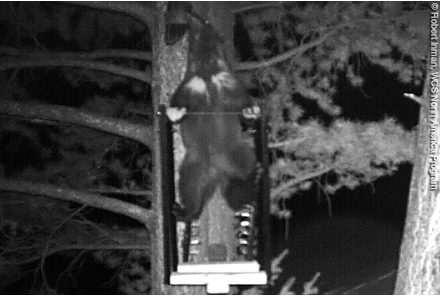
The Wildlife Conservation Society snagged a camera trap photo of a Wolverine recently. No word on where in Montana it was photographed. Here’s the original image and press release . . .

BOZEMAN (February 29, 2012) – A baby bear on stilts, perhaps? Nope. Conservationists with the Wildlife Conservation Society recently released this camera-trap photo of a wolverine retrieving bait placed in a tree in Montana. The frame upon which the animal climbs is designed so that the unique markings on the underside of the wolverine are revealed to the motion-sensing camera. Scientists use these markings to identify individual animals and document their distribution and range. WCS’s eight-year study of wolverines in the Greater Yellowstone Ecosystem has led to a better understanding of wolverine ecology and will help inform conservation strategies so that this rare species can survive despite the 21st century conservation challenges it faces. An estimated 250-300 wolverines remain in the “lower 48,” where they occupy about half of their former range in high alpine peaks of the western United States.


Grizzlies beginning to stir in Yellowstone area

It’s that time again. A few grizzly bears are up and about near Yellowstone National Park and we’ll likely see the same around here soon . . .

Reports of grizzly bear sightings at lower elevations east of Yellowstone National Park have begun to trickle in to wildlife officials, and food storage regulations on several national forests went into effect on Thursday.

Continue reading . . .

Despite hunt, Montana wolf population rose 15 percent in 2011

Posted yesterday evening to the Missoulian . . .

The number of wolves in Montana increased by 15 percent to at least 653 animals despite the state’s efforts to reduce the population with an extended hunting season, state wildlife officials said Wednesday.

Montana Fish Wildlife and Parks officials said 87 more wolves were counted at the end of 2011 than were in the state a year before. There were 130 verified packs and 39 breeding pairs counted, also increases from 2010 numbers.

Continue reading . . .

Montana DNRC, North Fork landowners to reduce fire hazard

There’s a nice bit of money in the pot for fuels reduction work this year . . .

A deal between the Montana Department of Natural Resources and Conservation and the North Fork Landowners Association will keep the North Fork buzzing with chainsaws this spring in an effort to reduce flammable fuels throughout the area.

According to forester Bill Swope, nearly two-thirds of the area along the North Fork Road, between Camas Creek and the Canadian border, have been scorched by wildfire since 1988. Now much of that is regrowing and he said efforts must be made to thin underbrush, which will be the focus of a $100,000 grant from DNRC.

Continue reading . . .

Glacier Park seeks comment on Quartz Lake invasive species fish barrier

Glacier Park is trying to keep non-native lake trout out of Quartz Lake . . .

Glacier National Park officials are seeking public comment on a project that would modify and improve a fish barrier designed to stem the invasion of lake trout in Quartz Lake.

Considered one of the last best strongholds for native fish in the entire Columbia River Basin, Quartz Lake’s native fish populations include bull trout, which are classified as a threatened species under the Endangered Species Act, as well as westslope cutthroat trout and mountain whitefish.

Native fish populations in Glacier National Park have been compromised by the invasion of non-native fish species into the park’s lakes and streams, and lake trout are being targeted as the chief culprit.

Continue reading . . .

Further reading: official Glacier Park press release.

Superintendent discusses future challenges for Glacier National Park

Today’s Flathead Beacon has a pretty good write-up on a recent talk by Chas Cartwright, the Superintendent of Glacier National Park . . .

As the superintendent of Glacier National Park, Chas Cartwright has his eyes on the future, as well as the challenges it could hold for conservation and construction in the Crown of the Continent.

Cartwright spoke on Feb. 23 at an event hosted by the Glacier National Park Fund at Grouse Mountain Lodge in Whitefish, discussing the major issues the park currently faces and how he envisions those issues playing out.

Continue reading . . .

USFS officials expect improved efficiency, legal defense will speed forest work

From yesterday’s Missoulian . . .

Speeding up the pace of work on national forests should mean more wood for Montana sawmills – but it won’t mean more money for the agency, U.S. Forest Service officials said on Thursday.

That’s going to happen through a combination of more efficient project planning and better legal defenses, according to Agriculture Department Undersecretary for Natural Resources and the Environment Harris Sherman, who oversees the Forest Service. It won’t involve a lot more federal money.

Continue reading . . .

Public forum on ecological value of Waterton-Glacier Park to be held March 12

(Text and images shamelessly stolen from the latest Headwaters Montana newsletter. . .)

Leading Scientists to Talk about Griz,
Critters with Teeth, and Wet-and-Wild River Things

 ~ Please Join Us for an Informative Evening ~

_____________________________________________

When: Monday, March 12, 2012, 7-9pm
Where: Grouse Mountain Lodge, 2 Fairway Dr., Whitefish
Cost: $10 suggested donation
Cash Bar / Seating Limited ~ come early!

____________________________________________

Headwaters Montana is co-sponsoring an important science forum on the ecological value of Waterton – Glacier International Peace Park and the importance of completing Waterton Park by expanding the park into British Columbia.

Three leading researchers will make presentation on transboundary grizzly bear populations, aquatics, fisheries, ungulates and predator wildlife species.

The three researchers will focus on recent scientific discoveries and insights made in the vicinity of Waterton-Glacier International Peace Park.

  • Dr. Richard Hauer is director of the recently formed Montana Institute on Ecosystems of the University of Montana, will speak about the biological richness of the transboundary Flathead River (aka the North Fork Flathead River), and make the case that the Flathead River system is one of the most ecologically intact rivers in the Lower 48.
  • Dr. Michael Proctor is the Principal Investigator for the Trans-Border Grizzly Bear Project based in British Columbia.  Dr. Proctor recently published a ground-breaking study published in the Wildlife Monographs that documents the challenges facing grizzly bears in the transboundary region of the Rocky Mountains between Montana and British Columbia.

Headwaters Montana is co-sponsoring the event with Wildsight, National Parks Conservation Association, Canadian Parks and Wilderness Society, Yellowstone to Yukon Conservation Initiative, and Sierra Club BC.

Recent study shows beetle-killed pine needles burn 3 times faster than live needles

That beetle-killed trees burn faster than live ones seems rather obvious, but it’s good that someone has come up with some hard numbers . . .

A recently study should put to rest the notion that green lodgepole pine needles burn as fast as red ones.

But more than that, Matt Jolly said, the study could help open firefighters’ eyes to the dangers lurking in mountain pine beetle-infested forests where the trees still look to be alive and doing well.

Continue reading . . .

Extended Montana wolf hunting season ends with 163 killed

The wolf hunting season wrapped up with about 74% of the quota taken . . .

Hunters in Montana have shot about 160 wolves as the season comes to a close, falling short of the state’s 220-animal quota.

State wildlife commissioners are considering extending the season in the Bitterroot Valley near the Idaho border in response to complaints about declining elk numbers.

But for most of Montana the season ends after sunset Wednesday. The 163 wolves killed through Tuesday equals almost 75 percent of the statewide quota.

Continue reading . . .