The Flathead National Forest has a series of public ‘open house’ meetings scheduled to provide information about the proposed Forest Plan revision. The first is on March 17, 5:30-7:30 p.m., at the Flathead NF Supervisors Office, 650 Wolfpack Way, Kalispell MT 59901.
These “community meetings are planned to provide additional information and address questions related to the Flathead NF plan revision and the amendment proposed action. The open houses will provide an opportunity for you to meet with subject matter specialists (wildlife biologist, forester, recreation specialist, fish biologist) and ask questions about the proposed management direction. There will not be any formal presentations at the open houses so stopping by at any time between 5:30 and 7:30 is fine.”
As befits a document that will have quite an impact on this little corner of Montana, the proposed Flathead National Forest Plan revision is big — some 499 pages of text and figures. The grizzly bear amendment, describing how the forest will coordinate grizzly bear management with other agencies and jurisdictions across the entire Northern Continental Divide Ecosystem (NCDE), adds another 64 pages to the pile.
If you’re the sort of person who likes to go straight to the source documents, here’s how to get them:
Flathead National Forest proposed Forest Plan revision web page – This is the go-to page for anything regarding the Forest Plan. It has links to download the full set of documentation, as well as a schedule of informational meetings and information on how to submit comments.
If you wish to read the entire Flathead National Forest Plan proposal, including the grizzly bear amendment, you’ll have to wade through better than 550 pages of text and figures. If you’d prefer to start with something easier to digest, the recent press coverage offers a pretty good overview of the main points . . .
Here’s a good summary of the just-released draft of the new Flathead National Forest management plan . . .
The revised guidebook for managing the Flathead National Forest is ready for public review.
Several years of workshops, surveys, debates and deliberations came to a head late last week when forest officials published the draft version in the Federal Register.
Now, anyone interested in the Flathead’s snowmobiling, wilderness, downhill skiing, river floating, timber cutting, trail hiking, wildlife research and huckleberry picking has 60 days to add their opinions.
Arlene Montgomery of Friends of the Wild Swan gets a very nice write-up in CounterPunch this week. Her accomplishments are quite impressive . . .
If you wanted to locate the frontlines for the battle to protect the future of wild nature in the lower-48 states, you could do worse than tuning your Google map to the Swan Range in northwestern Montana. This rugged and remote swath of the Northern Rockies rambles from the border of Glacier National Park southward for nearly 100 miles. Bounded on the west by the Mission Mountains and Flathead Lake and the vast Bob Marshall Wilderness to the west, the valleys, alpine slopes and forests of the Swan Range retain much of the natural character of the Rockies at the time when Lewis and Clark first encountered the Salish people in 1805.
The landscape looks roughly—very roughly, from some vantages—the same. And most of the wildlife the Corps of Discovery saw, described and often shot as they crossed the Continental Divide, is still present, though in greatly reduced numbers. The Swans still harbor populations of wolves, lynx, mountain goats, wolverines, bobcats, moose, elk and grizzlies. In short, the Swan Range is one of the last redoubts of wild America, one of those rare places that still has most, if not all, of its key ecological parts, from the top of the food chain on down to newts and salamanders, forest lichens and glacial wildflowers.
The Hungry Horse News has an interesting article on logging activity north of the border in the headwaters of the North Fork . . .
A large timber harvest in the headwaters of the North Fork of the Flathead River has raised concerns with biologists in Montana.
University of Montana researcher Ric Hauer said thousands of acres of forest land have been logged by Tembec in McEvoy Creek in the Canadian Flathead. The area was previously unroaded, and McEvoy Creek is the “premier spawning stream in the entire Flathead,” he said.
Tembec gave him a tour of their operation as they logged and followed best management practices, he said, but he openly questioned whether that would sufficiently protect the area, based on the size and scale of the logging. He said the logging started in 2010 and is now completed.
Gray wolves seem to be making a steady recovery in Eastern Washington . . .
The state says Washington’s wolf population grew by more than 30 percent last year and formed four new packs.
The annual survey by the Washington Department of Fish and Wildlife found at least 68 gray wolves in the state through Dec. 31, 2014. That was up from at least 52 wolves counted in 2013.
The state also found there are now 16 wolf packs and at least five successful breeding pairs.
A reminder from Montana Fish, Wildlife and Parks . . .
Some of Montana’s hibernating black bears and grizzly bears are beginning to stir.
Adult males usually emerge first from winter dens in mid-March. When bears emerge from their dens they are physically depleted and food is a priority.
Bears are often tempted to go where raccoons and domestic dogs are getting into garbage. If these animals are already causing problems nearby, consider it an early warning that food attractants are available and need to be removed.
Montana Fish, Wildlife & Parks’ bear experts stress that conflict prevention steps can greatly reduce the chances of attracting black and grizzly bears.
FWP recommends bear resistant bins in communities and on ranches; electric fence systems to protect bee yards and sheep bedding grounds; random redistribution of livestock carcasses each spring; and educational programs in schools and communities.
FWP’s Be Bear Aware website at fwp.mt.gov is an easy way for homeowners and landowners to assess what they need to do now to prevent bear conflicts. Go there for tips and tools on obtaining and using bear spray, safe camping and hiking, access to bear resistant products and a guide to other items that attract bears to a property.
As promised, the Flathead National Forest released the “proposed action” for their Forest Plan revision yesterday. Translating from bureaucrat-speak, this means they published the draft version of how they plan to run the Flathead National Forest for the next 15 years. This affects all areas of forest management, including logging, recreation, travel and wildlife management. And, yes, they are recommending some new wilderness in the North Fork and other areas.
Flathead National Forest Releases Proposed Action for the Revision of the Forest Plan and Amendments for Grizzly Bear Conservation Strategy
Release Date: Mar 6, 2015
KALISPELL, MONTANA – March 5, 2015
The Flathead National Forest is releasing for public comment the proposed action for the revision of the land and resource management plan (forest plan) as directed by the National Forest Management Act. The proposed action for the revised forest plan includes management direction to support a variety of proposed and possible actions that may occur on the plan area over the next ~15 years, or life of the plan. Acting Forest Supervisor Sharon LaBrecque commented that “the proposed action reflects the overall theme of the 2012 planning rule by its integration of ecological, social, and economic sustainability as equally important components formanagement of NFS lands.”
The proposed action describes the Flathead National Forest’s distinctive roles and contributions within the broader landscape and details forest-wide, management area, and geographic area desired conditions, objectives, standards, and guidelines. The management direction in the proposed action focuses on maintaining and restoring ecosystem and species diversity, and managing for forests that are resilient to disturbances and stressors, including climate change. The purpose is to provide for long-term sustainability of ecosystem values and desired ecosystem services. The proposed action identifies suitable uses of National Forest System lands and estimates of the planned timber sale quantity and long-term sustained yield for the Forest. The proposed action identifies priority watersheds for restoration, and includes the evaluation of wilderness inventory areas and eligible wild and scenic rivers.
The Flathead National Forest is concurrently releasing an amendment to integrate the Northern Continental Divide Ecosystem (NCDE) Grizzly Bear Conservation Strategy (“strategy”) into the forest plans for the Helena, Kootenai, Lewis and Clark, and Lolo National Forests. The Flathead National Forest is incorporating the relevant portions of the strategy as part of its plan revision process. The proposed amendment provides grizzly bear habitat-related management direction within the portions of each forest that lie within the NCDE. This is a prerequisite for eventual delisting of the NCDE grizzly bear population under the Endangered Species Act. The Forest Service will prepare a single environmental impact statement (EIS) for its revised forest plan and the amendments.
The following community meetings are planned to provide additional information and address questions related to the revision and amendment proposed action:
March 17, 2015, 5:30–7:30 p.m., Flathead National Forest Supervisors Office, 650 Wolfpack Way, Kalispell MT 59901
March 19, 2015, 5:30–7:30 p.m., Riverstone Family Lodge, 6370 US Hwy 93N, Eureka, MT 59917
April 7, 2015, 5:30–7:30 p.m., Seeley Lake Community Center, Seeley Lake, MT 59868
April 8*, 2015, 5:30–7:30 p.m., Northern Rockies Mtn. Heritage Center (Ft. Missoula), 3255 Fort Missoula Road, Missoula, MT 59804
April 9*, 2015, 5:30–7:30 p.m., Superior Ranger Station Conference Room, Superior, MT 59872
April 14*, 2015, 5:30–7:30 p.m., Lincoln Community Hall, 404 Main St., Lincoln, MT 59639
April 15*, 2015, 5:30–7:30 p.m., Stage Stop Inn, 1005 Main Ave. North, Choteau, MT 59422
*Meetings in Missoula, Superior, Lincoln and Choteau will primarily address the amendment proposed action.
The Flathead National Forest plan revision website provides the full proposed action text for the revision, describing preliminary desired conditions, objectives, standards, guidelines, and other plan content; the 2014 Assessment; summaries of the public meetings and public meeting materials, and public comments. The revision component of the proposed action is located at www.fs.usda.gov/goto/flathead/fpr. The amendment component of the proposed action can be found at www.fs.usda.gov/goto/flathead/gbamend. Links to the 2012 planning rule and the draft NCDE Grizzly Bear Conservation Strategy can be found on these websites as well.
Project leader Joe Krueger noted, “The release of the proposed action initiates the scoping process. We are seeking public input to guide the development of the environmental impact statement and to further develop and refine the Flathead NF revised plan and grizzly bear habitat management for the four amendment forests.” For further information about the project, contact Joe Krueger, Forest Planner, Flathead National Forest, 650 Wolfpack Way, Kalispell, Montana 59901, (406) 758-5243, or at flatheadplanrevision@fs.fed.us.
Being responsive to the public collaborative processes that have been undertaken on the Flathead National Forest over the past few years was a key consideration in development of the proposed action. More specifically, the proposed action:
Emphasizes front country recreation opportunities by identifying areas around Lakeside, Bigfork, and Whitefish for additional recreation opportunities.
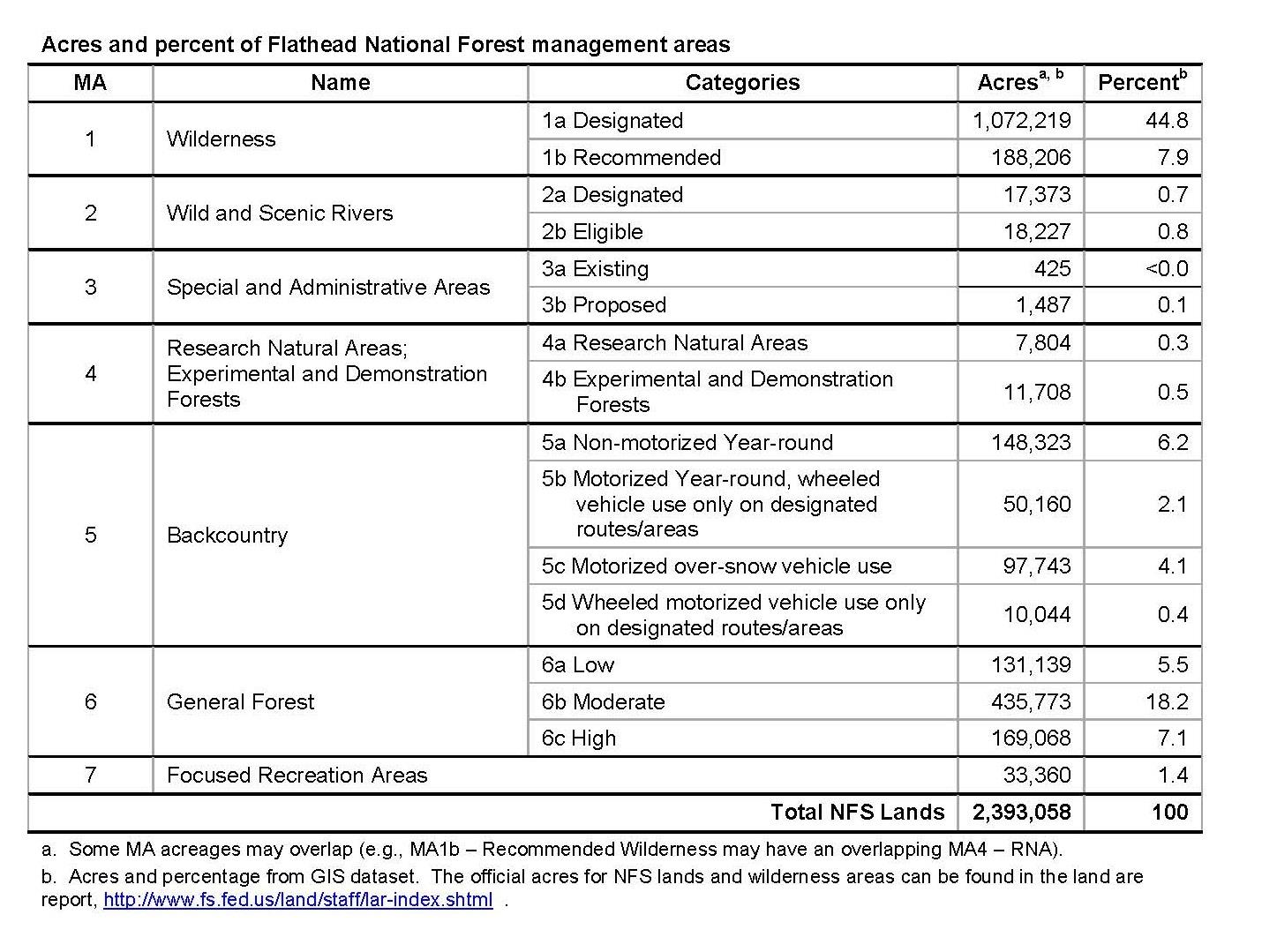
Recommends 188,000 acres for inclusion into the National Wilderness Preservation System including the Jewel Basin and the Tuchuck-Whale areas as well as additions to Mission Mountain, Bob Marshall, and Great Bear Wilderness areas.
Continues management standards for riparian habitat conservation areas (RHCAs), but with modifications that provide more flexibility to treat vegetation within RHCAs to achieve desired conditions.
Identifies changes in areas suitable for over-snow vehicle use based on the public’s desire to open some areas and close others. The proposed action increases suitable acres open to over-snow vehicle use in the lower end of Big Creek from McGuinness Creek to the North Fork Road, south to Canyon Creek while decreasing an equivalent amount of acres open to over-snow vehicle use in the upper end of Sullivan Creek, Slide Creek and Tin Creek. The proposed changes would need to undergo subsequent site-specific analysis in order to be implemented.
Continues management standards for lynx habitat, but with some important clarification and consideration of long-term desired conditions at a landscape level.
Identifies 22 rivers as eligible for inclusion into the National Wild and Scenic Rivers System.
Places an increased emphasis on social and economic sustainability, while maintaining ecological sustainability. Many of the changes in the plan, such as increases in suitable base acres (over the 2006 planning effort), more flexibility in where and how to conduct vegetation management, and additional motorized and non-motorized recreation opportunities, have the potential to provide additional jobs and income in the Flathead valley.
Increases recognition of the importance of the suite of ecosystem services provided by the forests, beyond those typically thought of such as timber, grazing, and recreation, water quality and quantity, clean air, tribal and cultural uses, and huckleberries.
Increases recognition of partnerships with federal and non-federal entities in helping to achieve desired conditions and improve overall resources management. Partnerships, such as the Whitefish Range partnership, and/or collaborative processes within the local communities fosters relationships that help accomplish projects in the communities’ and Flathead NF’s shared interest.
The Flathead NF, in consultation with MTFWP and other experts, screened a lengthy list of species, and developed a list of 9 potential wildlife Species of Conservation Concern (SCCs), 2 potential aquatic SCCs, and 13 potential botanical SCCs. The Regional Forester will make a decision on which species are carried forward as final SCC.
Provides for timber outputs that move vegetation toward desired conditions while considering multiple resource objectives. Initial modelling efforts indicate a Projected Timber Sale Quantity (PTSQ) of approximately 28 million board feet annually. The Projected Wood Sale Quantity (PWSQ) (all wood products) is estimated at approximately 30-34 million board feet annually.
Ensures that habitat protections specific to the grizzly bear are consistent on key National Forest System lands within the Northern Continental Divide Grizzly Bear Ecosystem (NCDE), by incorporating the relevant habitat management direction from the grizzly bear conservation strategy.
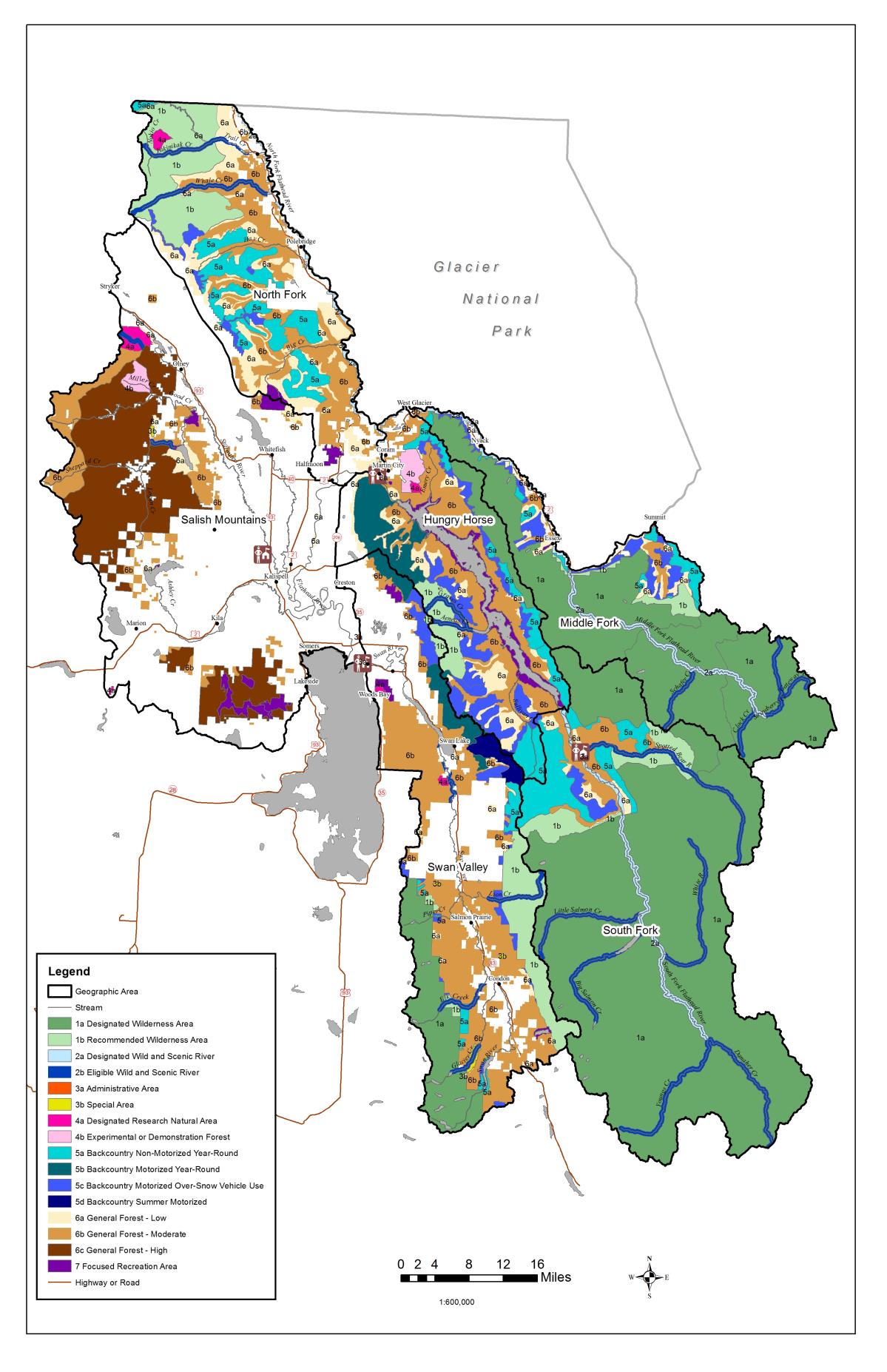
Management areas in the proposed action
The National Forest System land within the Flathead National Forest boundary has been divided into seven management areas (MA), each with a different emphasis which is intended to direct management activities on that particular piece of land. MA allocations are specific to areas across the Forest with similar management needs and desired conditions. Table and map follow.
Acres and Percent of Flathead National Forest Management AreasFlathead National Forest Management Areas
A previous post on the Winter North Fork Interlocal meeting held February 11 at Glacier Park’s Community Hall linked to several articles on issues discussed at the meeting.
Here are a couple of additional articles published this week: