Besides the flood threat, heavy snowpack in the mountains means that bears emerging from hibernation are foraging further down-valley for food. Bear managers have had a busy time of it dealing with nuisance bears. The Daily Inter Lake surveys the situation . . .
With too much snow at higher elevations and an abundance of food attractions in the valleys, grizzly bears and black bears have been stirring up trouble lately.
Here’s the Associated Press write-up on the looming flood threat for Montana. The story includes statements from Gov. Brian Schweitzer putting a somewhat positive spin on the matter . . .
More flood threats loom for Montana as an already-deep mountain snowpack increases and a cool spring brings more moisture.
River basins in the mountains are nearly double their average snowpack levels, and eastern Montana has already dealt with some rivers and flooding in places. The National Weather Service said flood threats could persist into early July due to the cool weather.
“It is going to be a big flood year,” said Gina Loss, a hydrologist with the National Weather Service. “There is not any part of the state void of any chance of flooding.”
Everyone is waiting for the real start of the spring runoff. Of particular concern is the forecast arrival of rain toward the end of the week. The Missoulian has the story . . .
Much of western Montana continued Monday to play a waiting game with its gravest flooding dangers this spring, thanks to cooler-than-normal temperatures.
A prolonged warming trend will release massive moisture still contained in mountain snowpacks. When it comes, officials say it will be the start of a “pretty prolonged flood season.”
But it’s more precipitation, not hot weather, the National Weather Service has its immediate eye on.
Things aren’t really rolling yet, but issues with rising waters are beginning to appear within Flathead County and the surrounding region. The Daily Inter Lake surveys the situation . . .
High water has started to cause some problems at the outset of a flood season that is expected to last for weeks.
The Montana Department of Transportation put machinery to work Monday removing downed trees from the Stillwater River to prevent damage to a bridge crossing on Twin Bridges Road west of Whitefish.
“It was a debris removal just to prevent them from obstructing the bridge,” department spokeswoman Lori Ryan said Monday afternoon.
The Stillwater River that flows through Kalispell nearly reached its 7-foot action stage Monday, just shy of its 7.5-foot flood stage.
Last week, WildEarth Guardians cut a deal with the U.S. Fish and Wildlife Service to clear the long-neglected backlog of candidates for the Endangered Species List. Today, the Center for Biological Diversity entered the fray . . .
An environmental group asked a federal judge on Monday to delay action on a proposed legal settlement that would require the government to consider new protections for hundreds of imperiled animals and plants.
The Center for Biological Diversity filed court documents in Washington, D.C., seeking to put the settlement agreement on hold. The Tucson, Ariz., group said the deal was hatched in secret and suffers from serious flaws.
Announced last week, the agreement between the Obama administration and Denver-based WildEarth Guardians received strong praise from many conservation groups.
Here’s a good survey of river conditions and general flood forecasting from the Missoulian . . .
Now that the rivers have your attention, spend the next week getting ready for the real western Montana flood season.
While the Yaak and Fisher rivers around Eureka and Libby are nearing flood stage, the Clark Fork, Flathead and Bitterroot drainages may hold back another week before they really let go, according to National Weather Service warning coordinator Marty Whitmore.
Saturated soils and a delayed spring runoff are causing a lot of problems in the Flathead National Forest. In the North Fork, for instance, Hay Creek Road is closed due to a slump. Today’s Daily Inter Lake has the story . . .
Warming temperatures and snow melt are contributing to increased water levels in rivers and lakes, and saturated soils across the Flathead National Forest, especially on roads and trails.
Forest officials urge all forest users to use caution when encountering deep snow, downed trees, blocked roads and trails, wet and muddy conditions, or high and fast-moving water.
“We encourage all forest users to contact a local Forest Service office to obtain current information about road and trail conditions, access, and ideas for alternate travel routes,” said Denise Germann, the forest’s public affairs officer. “Recreationists on or near a river, stream or lake should use extreme caution as water levels may fluctuate quickly.”
Today’s Daily Inter Lake joins the chorus of folks saying nice things about Jack Potter on the occasion of his retirement . . .
Some reporters over the years have affectionately called him “Jack Pot,” because Jack Potter is a treasure trove of information for anything related to Glacier National Park.
Any type of animal, any plant, any place, any trail, any aspect of the park, Potter pretty much knows it all after a 41-year career in the park that came to an end with his recent retirement. But it really won’t come to an end, because Potter and his wife, Rachel, intend to carry on with volunteer work in the park for years to come.
“I just wanted to do something different,” said Potter, who was the park’s chief of science and resource management. “I just wanted to go out at a time when I was still enthusiastic about the job and still making a contribution.”
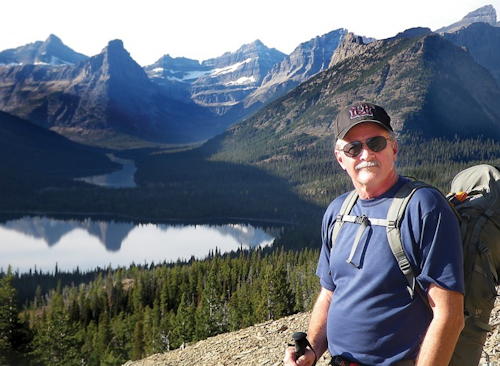
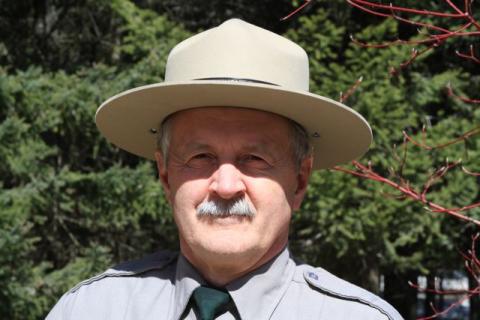
As mentioned earlier this month, Jack Potter, Glacier National Park’s Chief of Science and Resources Management, retired on May 2 after 41 years with the Park Service. Recently, Headwaters Montana posted a very nice article discussing Jack’s career and accomplishments . . .
On May 2 of this year, Jack Potter retired after 41 years with Glacier National Park, one of the few National Park Service employees to spend his entire professional career in one place. To many of us on the ‘outside’ of Glacier’s internal operations, Jack has been the conscience of the bureaucracy for Glacier’s safekeeping. The future challenges and threats facing Glacier are many and Jack’s vigilance and integrity will be hard to replace. It is fair to ask, “Who will be the next Jack Potter for Glacier?”
Referenced in the above article was a lengthy Park Science profile published last March, shortly before Jack’s retirement . . .
Resource managers who stay in one national park for their entire career, building and refining their knowledge of the place, exercising judgment, sharing insights, and defending park values are a rare thing in the National Park Service. Thus, we explore the long-tenured career of Jack Potter in Glacier National Park, Montana, as a way to learn from his experience, help preserve institutional memory, and celebrate his special contribution to the National Park Service.
According to an article in today’s Daily Inter Lake, some rivers in Northwest Montana are expected to reach or exceed flood stage this weekend. (The North Fork isn’t on the list, although the stage forecast for a week from now is suggestive.) . . .
Flooding is expected to start this weekend on some Northwest Montana rivers, but the National Weather Service is warning that it is just a beginning, with the highest flows on all rivers yet to come.
The forecast calls for continued warm weather over the weekend, with rain Sunday night and Monday and cooler weather next week that should level off flows on most rivers in the region, said Marty Whitmore, the warning coordination meteorologist in Missoula.