Tag Archives: Whitefish Range

Frank Vitale: Montana Faces New Threat to Its Wildest Lands

Several Types of Public Lands
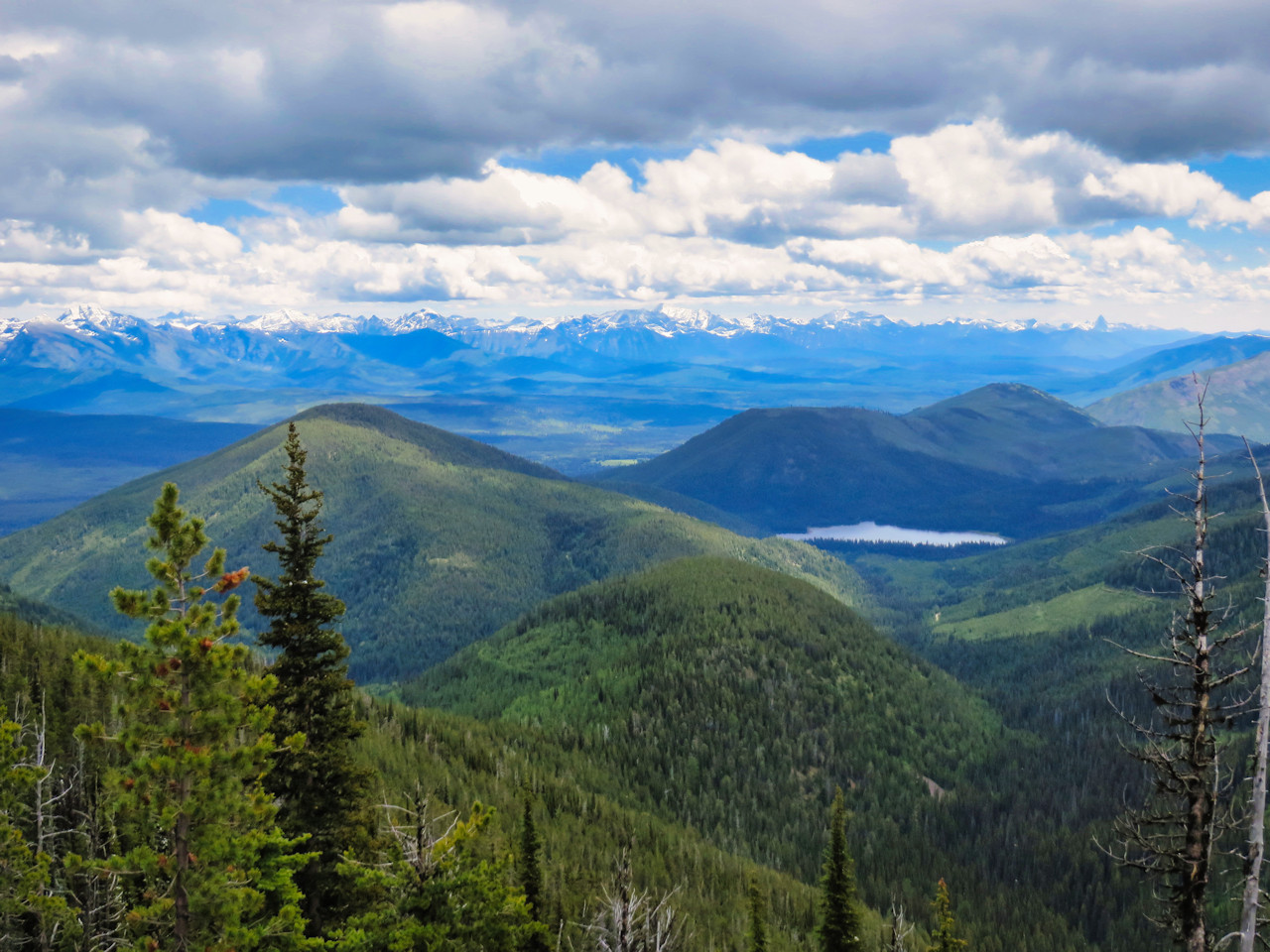
Several types of public lands: Flathead National Forest is in the foreground, left and right; Montana’s Coal Creek State Forest, including Cyclone Lake, is in the middle distance; Glacier National Park stretches across the background.

Founding NFPA member Frank Vitale gets some virtual ink with this well thought out opinion piece appearing in several newspapers, including the Flathead Beacon . . .

It was early summer in 1992, in the northern Whitefish Range. Four riders were moving slowly along the narrow rocky ridge on Trail to where it joined Trail , and eventually up to the top of Tuchuck Mountain. I was told that the name “Tuchuck” in the Kootenai language means “the thumb.”

It was a beautiful sunny day with a light westerly breeze. Wildflowers were in full view everywhere. Some of the open subalpine slopes looked as if they were rototilled with clumps of dirt overturned and rocks strewn everywhere. Obviously, grizzly bears were working over the slopes and digging up the succulent roots of glacier lilies, biscuitroot, sweet vetch and other favorite plants in these subalpine meadows.

I was one of those four riders, trailing one of my young mules. I’d ridden and hiked this trail many times before, and in some hunting seasons, packed out elk. I know this country well. Although it’s been a number of years since I led a packstring up into the northern Whitefish Range, I remember the view from our vantage point on that day. Looking east, from north to south, one could view the start of the Canadian Rockies clear over to the high peaks in southern Alberta, and the whole western expanse of Glacier National Park clear down to the Great Bear Wilderness and the Middle Fork of the Flathead River.

Looking northwest, one could see clear into the rugged peaks of southeastern British Columbia, and south all the way down to the Cabinet Mountain Wilderness and beyond.

I reflect back on my many years and many miles in the saddle leading a packstring of mules across some of the wildest country left in the Northern Rockies. This includes the Bob Marshall Wilderness, Badger-Two Medicine, Rocky Mountain Front, Scapegoat, Great Bear, wild Swan, and the Whitefish Range. This country has been the center of my universe for nearly 50 years.

Fast forward to September 2012. A diverse group of folks from different backgrounds, viewpoints and interests were invited to sit down and form a citizen’s advisory to help the Flathead National Forest update and revise a portion of their new management plan for the Whitefish Mountain Range on the Glacier View Ranger District. That group, in which I was asked to participate, was officially named the Whitefish Range Partnership Agreement. A total of 30 people made up this collaborative. They represented motorized recreation, mountain biking, hiking, landowners, business owners, Confederated Salish and Kootenai Tribes, Montana Logging Association, Stoltz Lumber, wildlife organizations, Backcountry Horsemen, hunting and fishing groups and wilderness organizations.

The Forest Service provided the framework in which we could work, and they gave us the support, expertise, and encouragement to see this collaborative succeed. This dedicated bunch of people stayed together until the collaborative reached consensus in 2018. Remarkably, the Forest Service adopted nearly 95 percent of what the group recommended to incorporate into the new Forest Plan Revision.

The partnership had its ups and downs and disagreements, but in the end, everyone walked away feeling good about what could be accomplished when people sit down, roll up their sleeves, and have meaningful conversations on what’s important.

For me, it was folks who ordinarily would have never supported wilderness in the North Fork, but in the end came together to support protection in some of the last unroaded wildlands left in the Whitefish Range.

So fast forward to 2026. Recently, the Senate Energy Natural Resource Committee (SENRC) voted on S140 – the Wildfire Protection Act of 2025. Attached to this bill is a provision to repeal the Roadless Rule, the very rule that protected the North Fork proposed wilderness that the Whitefish Range Partnership worked so hard and for so long to reach a consensus.

Do you remember a senator from Utah by name of Mike Lee? He chairs the SENRC, and just last year he introduced a bill to sell off large swaths of our public lands. Another name to remember is Steve Daines, one of Montana’s senators who has been trying for years to undo protections for some of our wildest landscapes in Montana. Every Republican on the SENRC voted to repeal a landmark decision created back in 2001, that had remarkable bipartisan support with the vast majority of Americans supporting it.

When the Roadless Rule was first developed, it was the most extensive public engagement process in the history on management of public lands in the United States. When talk of a possible recission of the Roadless Rule was being announced by the Trump Administration, nearly 99 percent of the comments were in favor of keeping the Roadless Rule intact.

Steve Daines and Mike Lee are clearly out of step on this issue. Some of our best unprotected wild country could very well be on the chopping block. This includes places like the North Fork Wildlands, Badger-Two Medicine, wild Swan Range, and the Rocky Mountain Front.

These wildlands are the source of our clean water, clean air, abundant fish and wildlife. They’re a place where we can experience wild nature and they make us better people.

For me, the seeds of conservation and the love of wild nature were sown as a young boy with pant legs rolled up, with fishing pole in hand, wading clear mountain streams catching wild brookies.

I’d like to end with a quote from Aldo Leopold’s memoir, A Sand County Almanac:

“To those devoid of imagination, a blank place on the map is a useless waste; to others, the most valuable part.”


MWA sponsors day of exploring Whitefish Range

The Montana Wilderness Association has organized a free guided tour of the Whitefish Range . . .

On Saturday, July 13, guide Brian Baxter will lead a day of exploring the Whitefish Mountain Range as part of the Montana Wilderness Association’s free “Flora, Fauna, Footprints, Fur and Feathers” educational program.

Baxter has spent countless hours searching for wolverine and other wildlife species in this area as well as doing forestry and botanical surveys. Baxter has degrees in both forestry and wildlife management, and over 38 years of experience in the field. He also leads winter tracking classes in the Flathead Valley.

Participants will learn about vegetation and wildflowers and study an overall wildlife outlook, animal tracking, furbearer overview including lynx and wolverine, and birds of prey in this unique habitat.

Continue reading . . .

“From where I stand there’s not enough wilderness”

NFPA board member Frank Vitale took strong issue with some of the statements in Larry Wilson’s last column in the Hungry Horse News. Here’s his response . . .

August 20, 2012

To the Editor:

I would like to respond to Larry Wilson’s North Fork Views.

First, I didn’t realize the North Fork Preservation Association was considered a “moderate” environmental organization. If anyone out there has any idea how many classifications there are for environmental organizations, please let me know. Is it on a 1-10 scale; 1 being “least moderate” and 10 being “extremely moderate?”

Larry states that he is opposed to any Whitefish Range Wilderness. His opposition to it is fine with me. He is entitled to voice his likes and dislikes. That’s the way it should be in a free society.

I’d like to propose a challenge to Larry, and extend it to all North Fork landowners. The challenge would be to list 10 reasons why we should or should not have wilderness in the Whitefish Range. I would propose to have this discussion atop Mt Thompson-Seton. I would even supply the transportation to and from.

You see, Larry, we stand on different sides of the “divide.” Your side thinks there is too much wilderness. From where I stand there’s not enough wilderness. The spoilers have had a heyday tearing most of it up. They ain’t making any more.

Years ago, Bob Marshall said, “Wilderness is disappearing like a snow field on a hot July day.” A while back on one of my many packing gigs deep in the wilderness below Scapegoat Mountain, I lead my string of mules off the high plateau call Halfmoon Park. As we crossed the Continental Divide down the west slope a momma grizzly and two cubs of the year shot out below me faster than any race horse out of the starting gate. Before I knew it they made it across the canyon and up the opposite ridge like three rockets. As they crested the ridge top, they stopped and looked back toward the pack string slowly moving down the switchbacks. It was then I realized there’s no compromise up here.

Men like Cecil Garland fought like hell to keep the spoilers out of the Lincoln Backcountry. When push came to shove, there was no compromise. Now it’s called the Scapegoat Wilderness. And what a wilderness it is. One of the best I’ve seen.

I don’t know how to classify Cecil Garland. Which end of “moderate” is he? Which end of “moderate” do we place other men like Bob Marshall, Aldo Leopold, Andy Russell, John Muir? The list could go on.

When the push came to shove they didn’t quit. There was no compromise.

So Larry and other North Fork Landowners who think we have too much wilderness – take the challenge and let’s hear all your reasons. My mules are ready to go.

On a final note, the irony to Larry’s column was that it was next to Pat William’s guest editorial, “Two Rivers Run Through Montana.” This scrappy working class Irish kid from Butte, Montana made it all the way to the halls of congress. The spoilers tried to get Pat Williams voted out. They had their bumper sticker crowd with slogans like, “No wolves, no wilderness, no Williams,” but they failed. Pat gracefully retired from congress after a long, successful career. His only regret was that the wilderness dispute never got resolved, and we are still fighting the good fight many years later, one wilderness battle at a time.

Sincerely,

Frank Vitale

North Fork offers more remote experience at Montana’s Glacier National Park

Susan Gallagher did a nice Associated Press piece about the North Fork that is getting national and world-wide distribution today. Just for fun, the “continue reading” link below sends you to New Zealand to read the rest of her article . . .

The Blackfeet Tribe named the greater Glacier National Park ecosystem “the backbone of the world.” Use the park’s remote, northwestern entrance and the bumpy access road will have you feeling like you drove over each vertebra. But you’ll be grateful you made the trip.

For an out-of-the-mainstream take on America’s 10th national park, go to its northwestern expanse, the North Fork. It invites “a more self-reliant visitor,” the National Park Service says in its Glacier literature.

The North Fork doesn’t have the grand old lodges like those near Glacier’s principal gateways, but this piece of paradise isn’t without comforts. Rustic, marvelously tasty and memorable, they are in Polebridge, a mile (1.6 kilometre) from the park’s northwestern entrance. This off-the-grid community increasingly reliant on solar power is the hub for an area where the summer population numbers maybe a few hundred, up from five to 10 in the winter.

Continue reading . . .

Web site offers good guide to climbing and hiking in the Whitefish Range

Rachel Potter passed along a link to a rather thorough write-up on the Whitefish Range or, rather, the entire mountain corridor, starting in Montana and running up into Canada. Lightly edited, here are her notes/comments: ‘This is a very interesting site.  Lots of hike descriptions in the Whitefish Range.  It’s a “peak bagger” site, but lots of walk-ups listed.  The intro to the range is okay, but not 100%accurate.’

Link: Whitefish Range(MT/BC) page at summitpost.org.

Crews gain ground against new local fires, older burns remain stable

From the Daily Inter Lake (with photos) . . .

Firefighters continued to tangle with a new fire east of Stryker while two fires in the Bob Marshall Wilderness were mostly unaffected by stiff winds Tuesday.

Soon after the Fitzsimmons Fire was detected Monday near the confluence of Fitzsimmons Creek and upper Stillwater Creek, it grew to 60 acres in steep, timbered terrain.

“They do have it 75 percent lined,” said Brian Manning, manager of the Stillwater State Forest. “The fire behavior was moderate enough that they could work on it directly today with some air support.”

The fire raises concerns about the potential for it to move upslope into the Whitefish Range.

Continue reading . . .

FWP plans to reintroduce mountain goats to Whitefish Range

Montana Fish Wildlife and Parks wants to reintroduce mountain goats to the Whitefish Range where they were pretty much hunted out by the 1960s. The plan is to capture an initial population of about 15 goats from a large herd in the Crazy Mountains near Big Timber and release them near Stryker Mountain on the west side of the Whitefish Divide. The project is scheduled to start this January.

For more information, see the write-up in this week’s Hungry Horse News, as well as the story in the Daily Inter Lake.

Check out the draft environmental assessment for project-specific details. If you want to put your oar in, the project is open for public comment through Wednesday, Nov. 3.

Helicopter skiing proposal rejected — for now

From the Thursday, December 11, 2008 online edition of the Daily Inter Lake . . .

The Stillwater State Forest, citing considerable public opposition, has denied a request to allow helicopter skiing on parts of the Whitefish Mountain Range.

Brian Manning, manager of the Stillwater and Coal Creek state forests, said his office received 316 comments, most of them opposed to helicopter skiing.

“Their concerns mainly include the noise and effects to winter recreation; the adverse effects to various wildlife species; low-flying aircraft effects to adjacent landowners and the potential for trespass on federal lands,” Manning wrote in a letter to Triple-X Helicopter and Valhalla Adventures, two Whitefish businesses that proposed helicopter skiing operations on specific parts of the Coal Creek and Stillwater forests.

Commercially guided ski trips were proposed at Winona, Coal and Stryker ridges on the two state forests.

Read the entire article . . .

Keep heli-skiing out of North Fork

John Frederick’s letter to Nicole Stickney of the Montana DNRC regarding the proposal to conduct heli-skiing on state lands in the Whitefish Range appeared in today’s Hungry Horse News in the Letters section . . .

I can sympathize with the Department of Natural Resources and Conservation in trying to find money through the school trust lands for Montana schools. It is not easy to balance environmental and social concerns while trying to get big bucks for the schools.

The two proposed locations for heli-skiing in Coal Creek State Forest are rather close to Polebridge. Winona Ridge, one of the proposed landing/skiing sites, is a little less than three and a half miles from Polebridge and roughly parallels the North Fork Road at a distance of 3/8 of a mile to almost a mile away. It is also not a high mountain which means more noise from helicopters. The other proposed, nearby skiing location is Coal Ridge which at the closest point is only four miles southwest of Polebridge.

I hope you can now understand why people become upset about heli-skiing or any frequent use of helicopters any time of the year when it is not an emergency. Most people, both residents and visitors, come to the North Fork for solitude and quiet.

Others have e-mailed you about the strong probability of people and wildlife being harassed by helicopters bringing skiers to places such as Winona Ridge in Coal Creek State Forest. Many other questions remain unanswered about the possibility of local heli-skiing.

What are the models, sizes and occupancies of the helicopters to be used? What are the decibels created by such machines? How far will the sound travel and be heard?

How many flights a day will be allowed? How many skiers? Triple X, one of the applicant helicopter companies, said they flew 260 helicopter flights over Whitefish during the fourth of July weekend. Hardly anyone wants that kind of activity in our state forests.

Would DNRC give permits to other companies who requested a similar permit?

What are the flight patterns? Do the helicopters go directly to the skiing location or do they swing over to Glacier Park for a scenic tour?

Has anyone at DNRC researched the location of bear dens in the vicinity of the flight paths?

How do the skiers return? By snowmobile or helicopter? And what is their route?

How much would you charge the operators of the helicopter skiing for a permit?

Has DNRC researched other locations in Alaska or British Columbia where heli-skiing has already taken place? Are there problems?

Heli-skiing has never been done in the Flathead Valley. Therefore, it might be a good idea to leave the comment period open for a while longer. There is a definite lack of information on the subject at this time.

Look at the Hungry Horse News article last week by Chris Peterson as it reflects the opinions of many North Forkers. There is a link to the article on the North Fork Preservation Association Web site (with new format) at www.gravel.org.

John Frederick of Polebridge is the North Fork Preservation Association president.