Category Archives: Environmental Issues

Federal bull trout recovery plan released for public comment

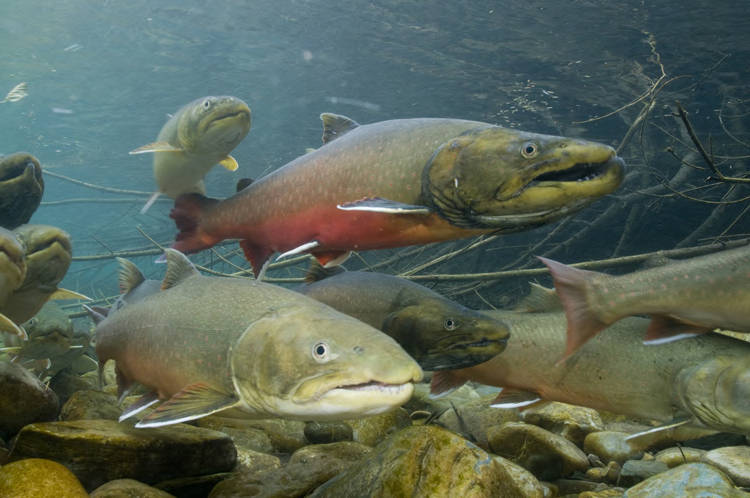
Bull Trout
Bull Trout

The feds released a draft version of their plan for bull trout recovery yesterday, starting the clock on a 45-day recovery period . . .

The draft master plan for removing bull trout from Endangered Species Act protection was released at 12:01 a.m. Tuesday, after 16 years of work and protracted legal battles.

“What we’ve tried to do with this approach over previous approaches is focus on what we believe are the highest priority conservation actions that need to occur,” said U.S. Fish and Wildlife Service bull trout recovery planning coordinator Steve Duke. “It won’t make the best life possible for bull trout, but where we know something will have an impact, we’ll react to that.”

The FWS plan is out for 45 days of public comment. It must meet a court-ordered settlement deadline for acceptance by Sept. 30. Two previous plans developed in 2002 and 2004 were deemed inadequate.

Read more . . .

Additional reading: Draft Bull Trout Recovery Planning Documents

Researchers start their Spring round of grizzly bear trapping

Personnel from Montana Fish, Wildlife and Parks will be live-trapping and collaring a couple of grizzly bears in the North Fork area over the next few days. So, if you see the warning signs, stay clear of the sites. . .

Here’s what Rick Mace had to say . . .

The grizzly bear population monitoring team would like to capture and radio collar a couple grizzly bears in the NF Flathead River starting in the next few days. We would be working both on Forest Service and private lands.  All of the Forest Service sites would be off of the existing open road system as we have done in the past. All sites will have approved signs and we will obviously avoid any active timber sales and trail heads.  Most of our sites have been used now for many years without incident.  We anticipate capture sites in Trail, Red Meadow,  and Moose Creeks. Also we may work off the main North Fork Road near Mud (Garnet) Lake going towards the border.  We would like to run the capture program for a maximum of about 10 days depending on success, starting later this week.

Feds unveil 10-state sage grouse conservation plan

The federal government rolled out their sage grouse conservation plan to considerable debate . . .

Interior Secretary Sally Jewell revealed plans Thursday to preserve habitat in 10 Western states for an imperiled ground-dwelling bird, the federal government’s biggest land-planning effort to date for conservation of a single species.

The proposal would affect energy development. The regulations would require oil and gas wells to be clustered in groups of a half-dozen or more to avoid scattering them across habitat of the greater sage grouse. Drilling near breeding areas would be prohibited during mating season, and power lines would be moved away from prime habitat to avoid serving as perches for raptors that eat sage grouse.

Some will say the plans don’t go far enough to protect the bird, Jewell said. “But I would say these plans are grounded in sound science — the best available science,” she said at a news conference on a ranch near Cheyenne.

Read more . . .

Cabinet-Yaak grizzly numbers small, but rising

Scientists continue to struggle to establish a good population of grizzly bears in the Cabinet-Yaak Ecosystem . . .

Spring has brought bears back into action, and it’s also energized biologists overseeing the remote population of grizzlies in the Cabinet-Yaak mountains of northwest Montana.

“We were in negative territory, but as of this year, after several years of low mortality we’re seeing some improvement,” said Wayne Kasworm, the U.S. Fish and Wildlife Service recovery coordinator in Libby. “Now we have a projected growth rate of 1.4 percent. That’s compared to the Northern Continental Divide Ecosystem and Greater Yellowstone Ecosystem, where it’s roughly 3 percent.”

While those two huge areas each have close to 1,000 grizzlies, the Cabinet-Yaak Ecosystem struggles to stay around 50. It does so with about a quarter of the NCDE’s territory, which stretches from the southern tip of the Rattlesnake Wilderness north of Missoula up to Glacier National Park.

Read more . . .

Celebrating the Rocky Mountain Front Heritage Act

Debo Powers has a nice post up at the NF News site regarding a recent celebration near Choteau of the Rocky Mountain Front Heritage Act . . .

On Saturday, May 23, there was a celebration near Choteau for Congressional passage of the Rocky Mountain Front Heritage Act.

In the afternoon, about 50 people gathered at the trailhead for Headquarters Pass into the Bob Marshall Wilderness to place a new sign designating the new boundary. Among other things, the Heritage Act created new wilderness areas that have been added to the Bob Marshall Wilderness complex. This is a significant achievement since it is the first addition to Montana wilderness in 31 years. After the sign was raised, Gloria Flora, former Forest Supervisor on the Lewis and Clark Forest, spoke about the importance of protecting wilderness for future generations. Her profound words moved the crowd with her assertion that “the Forest Service stands for the unborn……..of every species.”

Read more at NF News . . .

Government releases wildfire strategy aimed at protecting sage grouse

The feds have developed a wildfire strategy they hope will help protect sage grouse . . .

A federal wildfire strategy released Tuesday aims to protect the West’s sagebrush country that is home to a struggling bird species and to help prevent the sage grouse from being classified as threatened or endangered later this year.

Interior Secretary Sally Jewell was in Boise to announce the plan making greater sage grouse habitat a priority for fire prevention and response, focusing mainly on the Great Basin region of Idaho, Utah, Nevada, Oregon and California.

The plan comes as the federal government and Western states scramble to implement plans meant to halt the decline of sage grouse populations and habitat. The U.S. Fish and Wildlife Service is under a court order to decide by Sept. 30 whether the sage grouse merits protections from the Endangered Species Act.

Read more . . .

Motorists hauling watercraft must stop at AIS inspection stations

Montana really doesn’t want folks importing aquatic invasive species. From the official press release . . .

Montana Fish, Wildlife & Parks officials reminded private and commercial boaters yesterday that state law requires all motorists hauling watercraft—from trailers with motorboats or inflatable rafts to canoes and kayaks perched atop cars and pick-up trucks—to stop at inspection stations.

The annual education and enforcement effort, which this year includes multiple chances to win prizes from an array of local sponsors, is to further curb the risk of aquatic invasive species from attaining a foothold in Montana waters.

Seventeen well-marked inspection stations will again be in operation beginning Thursday, May 21 through September at key border crossings, along major highways, and on heavily used water bodies. Motorists who stop will have their equipment checked—and cleaned if needed—and get information on how to enter a raffle for prizes to be awarded throughout the boating season.

Montana law requires private motorists and outfitters and guides hauling watercraft—including motorboats, sailboats, kayaks, canoes, rowboats, rafts, jet skis and even small kick boats popular among some anglers—to always stop at AIS watercraft inspection stations for a brief interview and equipment check. Most inspections take fewer than five minutes but failure to stop could lead to a $135 fine.

Last year, nearly 35,000 watercraft were inspected at Montana’s roadside stations. A total of 54 motorboats and three non-motorized watercrafts were found to have been fouled by zebra mussels and other AIS contaminants and hundreds more contained standing water or noninvasive vegetation.

Read more . . .

Flathead Forest Forest Plan Revision receives more than 19,000 comments

Joe Kreuger and his staff at the Flathead National Forest have got their work cut out for them. The proposed Forest Plan triggered a lot of feedback . . .

The Flathead National Forest received over 19,000 public comment submissions for its proposed revision of the forest plan, according to the agency.

Forest officials are still sorting through reams of emails and letters following the May 15 deadline for public comment.

Joe Krueger, project leader and forest planner for the Flathead National Forest, said his team continues to count the number of submissions that were filed and some that were postmarked by last Friday may still be arriving.

Read more . . .

Montana looking at tighter trapping restrictions near Glacier and Yellowstone

Montana FWP wants to tighten trapping rules near national parks to protect Canada Lynx . . .

Montana wildlife officials are considering stricter regulations in an effort to reduce the chances of Canada lynx being caught in traps set for other animals outside Glacier and Yellowstone national parks.

The plan presented to the state Fish and Wildlife Commission on Thursday is part of a settlement agreement in a lawsuit filed in 2013 by three environmental groups over trapping in the threatened species’ habitat.

Several of the settlement’s statewide restrictions are already in place, but additional changes are needed in special zones near Yellowstone National Park and a wider area outside Glacier National Park in northwestern Montana, Fish, Wildlife and Parks attorney Aimee Fausser said.

Read more . . .

Montana wishes to cut bobcat quotas

Montana FWP wants to cut back on the Bobcat take . . .

Montana wildlife officials are considering cutting bobcat quotas across a broad swath of central and northern Montana.

John Vore of Fish, Wildlife and Parks says agency officials have seen a drop in bobcat numbers in those areas. He attributes the decline to a cyclical population shift, but says the agency doesn’t want to exacerbate the drop through hunting and trapping.

Read more . . .