Category Archives: News

Senate Natural Resources Committee approves aquatic invasive species bill

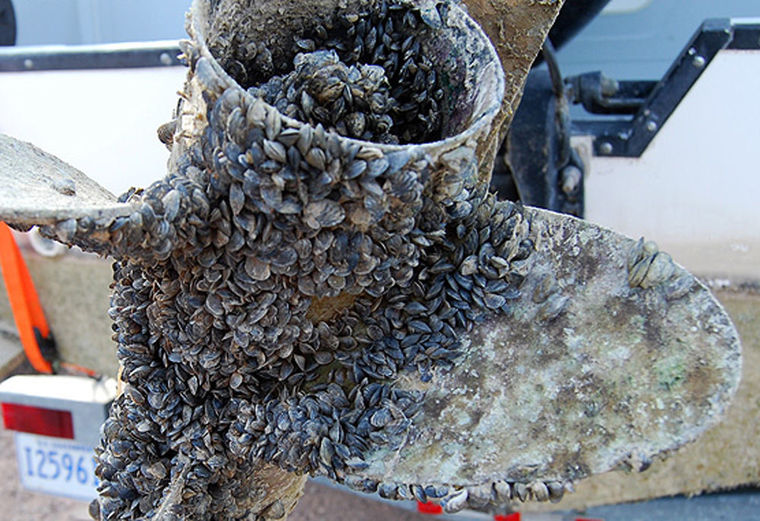
Zebra Mussel Shells Cover a Lake Michigan Limestone Beach in Door County Wisconsin - PJ Bruno
Zebra Mussel Shells Cover a Lake Michigan Limestone Beach in Door County Wisconsin – PJ Bruno

Here’s the latest on the state bill to fight invasive mussel species in Montana’s waters . . .

The Senate Natural Resources Committee unanimously approved a bill to bolster the defense against aquatic invasive mussels, which were detected in Montana waters for the first time in the state’s history last fall.

However, a proposed amendment granting full rule-making authority to the Flathead Basin Commission to oversee a local inspection program was not successful.

The Senate Natural Resources Committee on April 7 reviewed House Bill 622, a measure introduced by four Northwest Montana legislators: Republicans Mike Cuffe, of Eureka; Bob Keenan, of Bigfork; Mark Noland, of Bigfork; and Al Olszewski, of Kalispell. All 12 members of the committee voted to advance the bill to the Senate, which is scheduled to consider it April 11.

Read more . . .

Hilary Cooley is region’s new grizzly bear recovery coordinator

Dr. Hilary Cooley, U.S. Fish and Wildlife Service grizzly bear recovery coordinator - Jackson Hole News & Guide
Dr. Hilary Cooley, U.S. Fish and Wildlife Service grizzly bear recovery coordinator – Jackson Hole News & Guide

They finally brought someone in to take Chris Servheen’s old job. Dr. Hilary Cooley is the U.S. Fish and Wildlife Service’s new grizzly bear recovery coordinator . . .

The federal official charged with leading the U.S. polar bear program has departed Alaska for Missoula, Montana, to oversee grizzly bear recovery in the Lower 48.

Hilary Cooley, the U.S. Fish and Wildlife Service’s new grizzly bear recovery coordinator, has stepped into the job vacated by 35-year veteran Chris Servheen. Cooley will have the opportunity to finish what Servheen started: seeing through the Endangered Species Act “delisting” process for Yellowstone-area grizzlies, which turns over jurisdiction from Fish and Wildlife to Wyoming, Montana and Idaho.

The Greater Yellowstone Ecosystem’s grizzlies, she said, are ready to be managed by the states.

Read more . . .

Grizzly delisting inches through fed bureaucracy

Grizzly Bear - Thomas Lefebvre, via Unsplash
Grizzly Bear – Thomas Lefebvre, via Unsplash

The grizzly bear delisting process is making its way through the federal bureaucracy.

It’s a lot like watching paint dry . . .

The work of crafting a draft final rule to delist the Greater Yellowstone Ecosystem’s grizzly bears is complete, and now the plans must navigate the many layers of federal bureaucracy.

The timeline for publishing the rule is unclear, in part because of the transition of presidential administrations and the U.S. Fish and Wildlife Service’s own influx status, said Jodi Bush, the agency’s Montana Ecological Field Office supervisor.

“We’ve had all of our packages stopped in headquarters lately,” Bush said in an interview at the Interagency Grizzly Bear Committee’s Yellowstone Ecosystem Subcommittee meeting held in Jackson last week. “They want to look at stuff. With the [recently protected] bumblebee it took an additional 39 days for them to get through it.”

Read more . . .

Mountain lion kitten cause for excitement and concern

Mountain lion kitten P-54 - Santa Monica Mountains National Recreation Area - NPS photo
Mountain lion kitten P-54 – Santa Monica Mountains National Recreation Area – NPS photo

This is a seriously cute photo, but the attached story offers a lesson in habitat isolation and its worrisome effects on genetic diversity . . .

Admit it. You only clicked on this story because of the photo of that insanely cute mountain lion kitten. You just wanted to gaze into her (yes, it’s a her) milky blue eyes.

That’s fair.

But there’s more to the story of this kitten. Researchers have named her P-54. She’s no more than a few months old. And – this is the sad part – it’s likely that she’s the product of inbreeding.

The kitten was born amidst the urban sprawl of Southern California in Santa Monica Mountains National Recreation Area, the largest urban national park in the country. The recreation area is bordered by the Pacific Ocean, agricultural fields and greater Los Angeles.

Read more . . .

Plan to restore grizzlies to the North Cascades a step closer

Grizzly Bear Sow and cubs - NPS photo, Tim Rains
Grizzly Bear Sow and cubs – NPS photo, Tim Rains

A couple of years ago, the U.S. Fish and Wildlife Service and National Park Service started taking public comments on a plan to restore the grizzly population of Washington’s Cascade Range. Now, they are a step closer to a plan that will include using some of Montana’s grizzlies to seed a new population in the North Cascades . . .

In a few years, some grizzly bears from Northwest Montana could have new homes in the North Cascades Ecosystem of Washington and British Columbia. The U.S. Fish and Wildlife Service and the National Park Service earlier this year released a draft environmental impact statement to reintroduce the iconic species back to the Cascades. At least some of the bears would come from Northwest Montana if the project comes to fruition.

The 6.1 million acre North Cascades have a smattering of grizzlies in Canada and in the U.S., the last known breeding female was seen in the early 1990s. The bears were hunted and trapped to near extinction by the Hudson Bay Co. about 200 years ago, noted Park Service spokesman Jack Oelfke.

Isolated by both geography and human barriers like highways and railroads, the bears have little chance of re-establishing populations on their own.

Read more . . .

Researchers looking at Montana’s cutthroat trout population

Native westslope cutthroat trout and bull trout stranded in a pool in Ole Creek. Courtesy Jonny Armstrong USGS

A group of researchers just published a thorough study of the effects of hybridization on Montana’s cutthroat trout population . . .

Cutthroat trout, a prized and legally protected fish species in Montana, are increasingly threatened by a growing trend of hybridization with non-native rainbow trout, according to research published last month in the scientific journal Global Change Biology.

A group of researchers from the University of Montana, the U.S. Geological Survey, Montana Fish, Wildlife and Parks and the University of Alaska analyzed Montana’s historical fish-stocking records and 35 years’ worth of genetic data collected by state biologists, finding that hybridization between the two species is increasing across remaining geographic range for genetically pure cutthroats.

For decades, fisheries managers in Montana and elsewhere in the Western U.S. stocked rivers and lakes with non-native rainbow trout, a popular sport fish that easily established breeding populations in the state’s waterways. The state abandoned the practice in 1969, but interbreeding between rainbows and the closely related cutthroats has resulted in a proliferation of hybrids and has eroded the native fish’s genetic pool throughout most of its range.

Read more . . .

Scientists report continued expansion of US grizzly bear range

Grizzly on ranch east of Yellowstone - Wyoming Game and Fish Department
Grizzly on ranch east of Yellowstone – Wyoming Game and Fish Department

This article really should have been longer; there’s a lot to think about here. Still, it’s worth reading . . .

Grizzly bears continue to expand their range amid an ongoing effort to turn over management of the bears from the U.S. Fish and Wildlife Service to the states of Wyoming, Montana and Idaho, a federal official said.

“We’ve seen an 11 percent change in increasing range in just a couple of years,” Frank van Manen, head scientist of the Interagency Grizzly Bear Study Team, said last week at a meeting in Jackson.

Since coming under the protection of the Endangered Species Act, grizzlies have steadily expanded their habitat outward from the population’s core in Yellowstone National Park.

Read more . . .

Proposed Montanore mine undergoes another court challenge

Southern Cabinet Mountains, as seen from Swede Mountain, near Libby

It’s not over yet. This past week saw another court hearing challenging the development of the Montanore copper and silver mine on the edge of the Cabinet Mountains Wilderness . . .

The question of whether a proposed mine on the edge of the Cabinet Mountains Wilderness should be judged on its predicted impact or its ongoing development went before a federal judge Thursday.

“If this is not the point where the (U.S. Fish and Wildlife) Service has to determine the straw that breaks the camel’s back, where is it?” Earthjustice attorney Timothy Preso asked U.S. District Judge Don Molloy. “By then, we’re in a world where it’s far too late to do anything about it.”

Montanore Minerals Corp. attorney Mark Stermitz retorted that the whole point of a permitting process was to evaluate a project’s impact over time, as new information develops.

Read more . . .

Environmental groups file lawsuit to preserve moratorium on new coal leases

The Trump administration’s attempt to lift the existing moratorium on new coal leases triggered an immediate lawsuit on behalf of the Northern Cheyenne Tribe, Sierra Club, and Center for Biological Diversity . . .

Environmental groups that vowed to fight President Donald Trump’s efforts to roll back his predecessor’s plans to curb global warming made good on their promises Wednesday, teaming up with an American Indian tribe to ask a federal court to block an order that lifts restrictions on coal sales from federal lands.

The Interior Department last year placed a moratorium on new coal leases on federal lands to review the climate change impacts of burning the fuel and whether taxpayers were getting a fair return. But Trump on Tuesday signed a sweeping executive order that included lifting the moratorium, and also initiated a review of former President Barack Obama’s signature plan to restrict greenhouse gas emissions from coal-fired power plants.

Environmentalists say lifting the moratorium will worsen climate change and allow coal to be sold for unfairly low prices.

Read more . . .

Also read: Zinke orders rollback of coal moratorium, adds royalty review (Missoulian)

Diane Boyd, the Jane Goodall of wolves

Diane Boyd, Lone Pine State Park, Feb. 13, 2017 - Greg Lindstrom, Flathead Beacon
Diane Boyd, Lone Pine State Park, Feb. 13, 2017 – Greg Lindstrom, Flathead Beacon

Wow! North Forker and NFPA member Diane Boyd has a very nice write-up in the Flathead Beacon titled “The Jane Goodall of Wolves” . . .

In 1979, Diane Boyd left her native Minnesota and headed west to begin tracking the first radio-collared gray wolf from Canada to recolonize the Western U.S., where humans had effectively eliminated the species by the 1930s through hunting, poisoning and habitat loss. Boyd, a 24-year-old wildlife biology graduate student at University of Montana, was fueled by optimistic idealism and boundless energy. When she pulled up to her new home, deep in northwestern Montana’s rugged North Fork Flathead River valley, it was apparent she would need both.

“It was like, ‘Wow,’” Boyd recalls of seeing the cabin, which had no plumbing, electricity or means of communicating with the outside world. “I’d spent a lot of time outdoors, but this was true isolation.”

Though wolves had been extirpated statewide, reports of sightings and shootings started trickling in during the 1960s and ‘70s, leading University of Montana professor Bob Ream to launch the Wolf Ecology Project in 1973, the same year that Northern Rocky Mountain gray wolves were listed under the Endangered Species Act. It was through the Wolf Ecology Project that researcher Joe Smith trapped a female wolf, dubbed Kishinena, on April 4, 1979 in the North Fork drainage along the northwestern edge of Glacier National Park.

Read more . . .