Parks Canada and the U.S. National Park Service will host the 13thannual Waterton-Glacier Science and History Day at the Falls Theatre (near Cameron Falls) in Waterton Lakes National Park on Tuesday, July 26, 2016. This international event, held annually on the last Tuesday in July, is free of charge with park entry fees.All are encouraged to attend.
Science and History Day is an incredible way for people to learn about the latest research directly from the scientists and historians working in and around the Waterton-Glacier International Peace Park. Experts will discuss their work in a non-technical style, with presentations grouped into themes of aquatic resources, landscapes, history and wildlife.
Some of this year’s subjects include: the threats facing salamanders, cross-boundary work on climate change, the parks’ lesser-known past, and how remote cameras are used to track wildlife movement.
Jeff Mow, Glacier National Park Superintendent, said “The peace and friendship of the Peace Park is captured in the many cooperative projects carried out in our scientific community.”
“Science and History Day is an outstanding opportunity for all people to learn about some of the research in the Peace Park and personally connect with our environment and history,” commented Ifan Thomas, Waterton Lakes National Park Superintendent. “We look forward to welcoming everyone to Waterton for this special learning oppo
rtunity.”
The program celebrates the U.S. National Park Service’s Centennial with a viewing of the 1954 film “Wardens of Waterton” featuring cooperative work with Glacier National Park’s Rangers. Science and History Day provides participants with an excellent opportunity to learn about their national parks and connect with the heritage of their protected places. Attendees are encouraged to bring a sack lunch for the 45-minute lunch break, so as not to miss the film viewing at 12:45 p.m.
The US Fish and Wildlife Service hopes to use drones to inoculate black-footed ferrets against sylvatic plague . . .
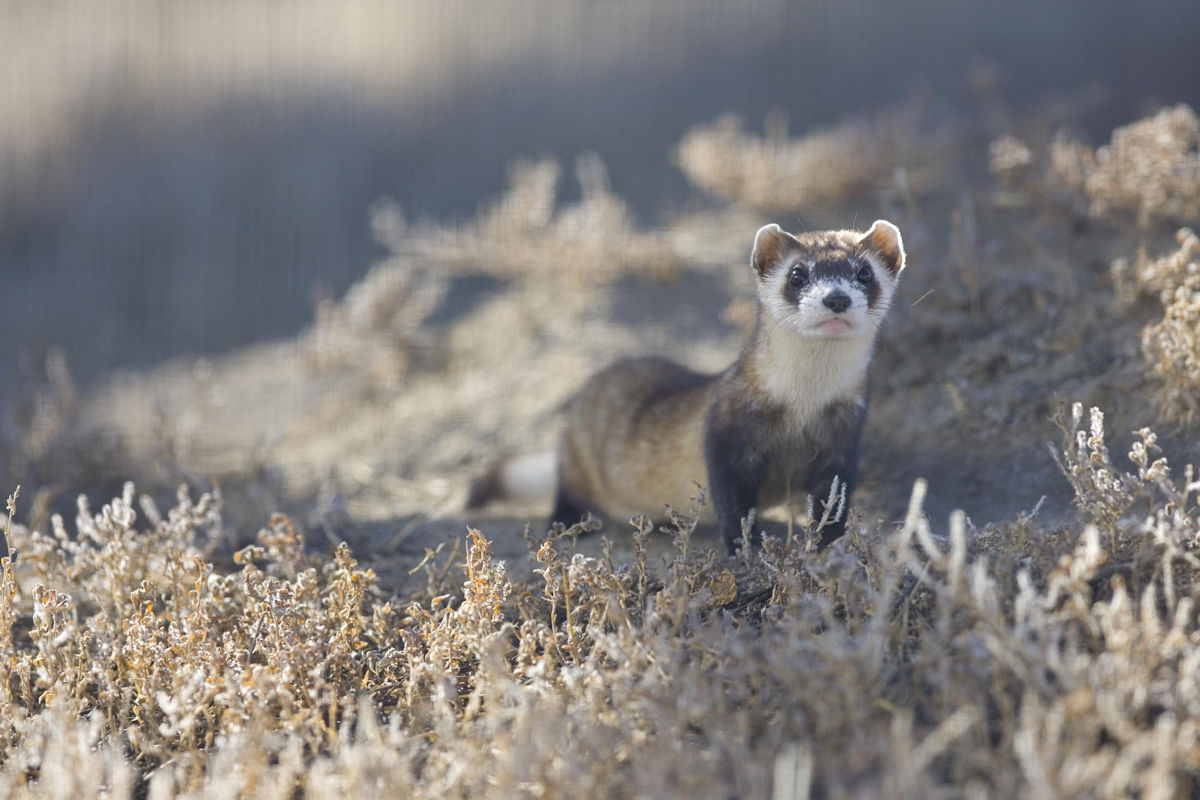
The US government is set to unleash drones that fire vaccine-laced pellets in a bid to save the endangered black-footed ferret, a species that is facing a plague epidemic across America’s great plains.
The US Fish and Wildlife (FWS) has developed a plan to bombard ferret habitat in Montana with the vaccine, which will be administered via specially designed drones that will be able to shoot pellets in three directions simultaneously.
The vaccines will be targeted at the prairie dog population at the UL Bend National Wildlife Refuge in north-eastern Montana. Black footed ferrets – North America’s only native ferret – are completely dependent upon prairie dogs, which are a type of burrowing rodent, for their food and shelter.
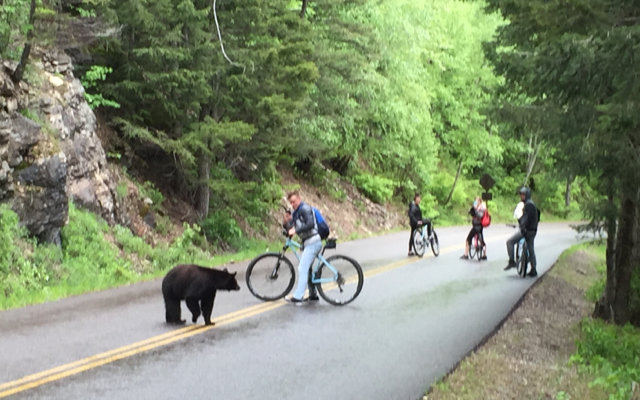
A biker on Glacier Park’s Going-to-the-Sun Road photographs a black bear, May 2016 – Butch Larcombe
Here’s a pretty good article by Rob Chaney of the Missoulian on the issue of ‘high speed recreation’ in backcountry areas. Despite the title, it’s not just about mountain bikes . . .
Two weeks before a Kalispell man died in a bicycle collision with a bear near Glacier National Park, an ultra-marathon runner in New Mexico was mauled by a bear she encountered on a New Mexico trail…
On Thursday, an estimated 2,500 people paid their respects to Brad Treat at a memorial service in Kalispell’s Legends Stadium on Thursday. The 38-year-old Forest Service law enforcement officer died on June 29 after colliding with a bear on his bicycle while pedaling on a trail near Halfmoon Lake.
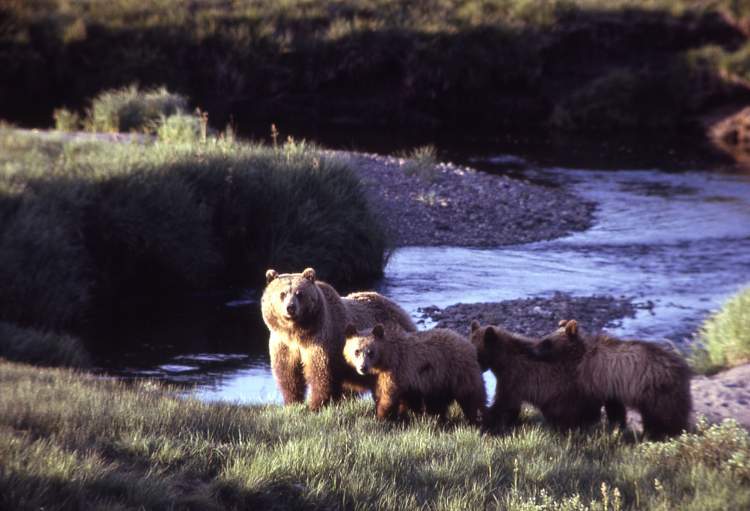
That same Thursday in Missoula, grizzly bear advocates were warning U.S. Fish and Wildlife Service acting Grizzly Bear Recovery Coordinator Wayne Kasworm about the dangers posed by high-speed recreation in bear habitat.
For those of you who can’t wait on the mail, the North Fork Preservation Association Summer 2016 Newsletter is now available online in the “Newsletters” section of the website. Enjoy!
Here’s a partial table of contents:
Watershed, Wilderness and Wildlife (President’s letter)
Working Group Reports:
– Watershed Issues
– Wildlife Issues
– Wilderness Issues
Room for Debate: Grizzly Delisting (two exceptional essays)
Website Report: Wildlife, Land Management and a Long Fire Season
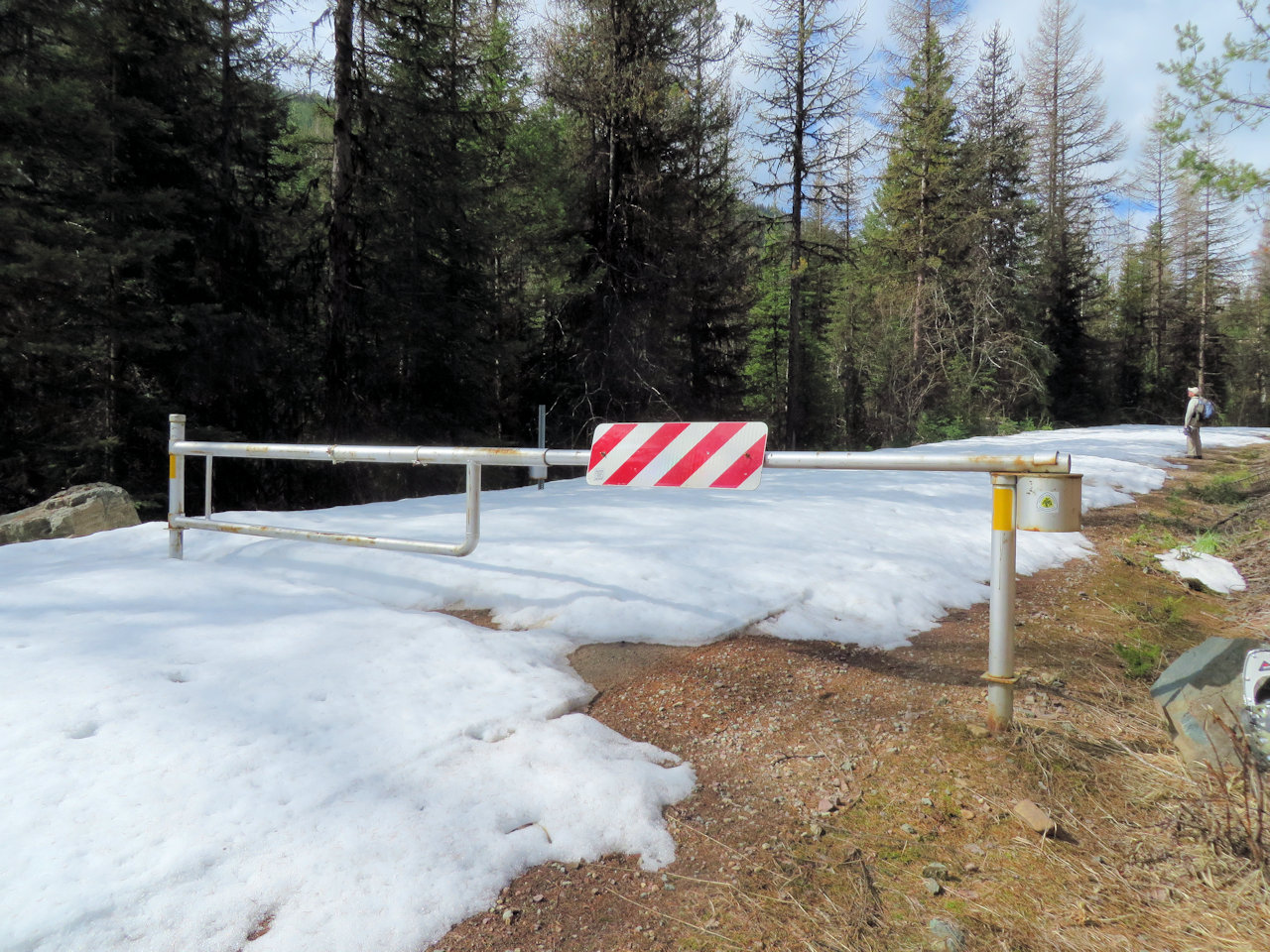
Gate Across Hay Creek Rd, Flathead NF, April 16, 2016 – W. K. Walker
Even something as commonplace as roads is a hot topic in the new forest plan . . .
The Flathead National Forest will likely change the way it manages its roads when a new Forest Plan is adopted and at least one environmental group isn’t happy with the change.
Three of the four alternatives listed in a recently released draft forest plan will not utilize provisions in Amendment 19, the controversial standard that has resulted in the closure of more than 700 miles of roads across the forest in the past couple of decades.
Under Amendment 19, biologists divided the Forest habitat into grizzly bear subunits and in each subunit, the Forest was to strive for a formula that allowed for 19 percent open roads, 19 percent total roads, and 68 percent core grizzly habitat with no roads.
Grizzly bear recovery is still a contentious issue . . .
A listening session on future grizzly bear management in northwest Montana drew lots of criticism from both bear advocates and livestock proponents.
“While the (U.S. Fish and Wildlife) Service claims it will maintain bear habitat security levels that existed in 2011, it is instead lowering the goal posts on what is considered secure bear habitat,” Keith Hammer of Swan View Coalition said in Missoula at Thursday’s workshop. He accused FWS of “lying” about grizzly population recovery to justify removing the bear from federal Endangered Species Act protection.
From the other direction, Montana Board of Livestock member Nina Baucus said the agency wasn’t doing enough to protect people from a growing population of grizzlies.
The Crown of the Continent Research Learning Center at Glacier National Park has announced an invasive plant BioBlitz, an opportunity for the public to help with early detection of invasive plants along park trails. The event will be held on Tuesday, July 19, from 10:00 a.m. to 4:00 p.m. The event begins at the park’s Community Building in West Glacier and will be followed by an afternoon spent pulling invasive plants along park trails. Participants will learn to identify five targeted invasive plants, and how to use a GPS unit and the free iNaturalist app to mark invasive plant locations while hiking along park trails.
Participants are asked to bring gloves for hand pulling, hiking footwear, and plenty of drinking water. Glacier National Park Conservancy will provide a free lunch for all attendees.
Since 2005, the Glacier National Park Citizen Science Program has utilized trained citizen scientists to collect population data on species of interest in the park. Training provided to participants serves to inform them on threats to native plants and animals that may result from human disturbance, climate change, and invasive species. The Citizen Science Program not only provides valuable data to park managers, but it helps create an informed group of visitors involved in active stewardship of Glacier National Park.
Funding and support for the Crown of the Continent Research Learning Center’s Citizen Science Program is provided by the Glacier National Park Conservancy. For more information on the Citizen Science Program or to attend the Invasive Plant BioBlitz event call 406-888-7986 or e-mail e-mail us.
This event is one of four BioBlitzes at Glacier National Park that are part of the National Park Service’s Centennial Year celebration of biodiversity in national parks. For more information on other events in the National Park Centennial BioBlitz series follow this link:
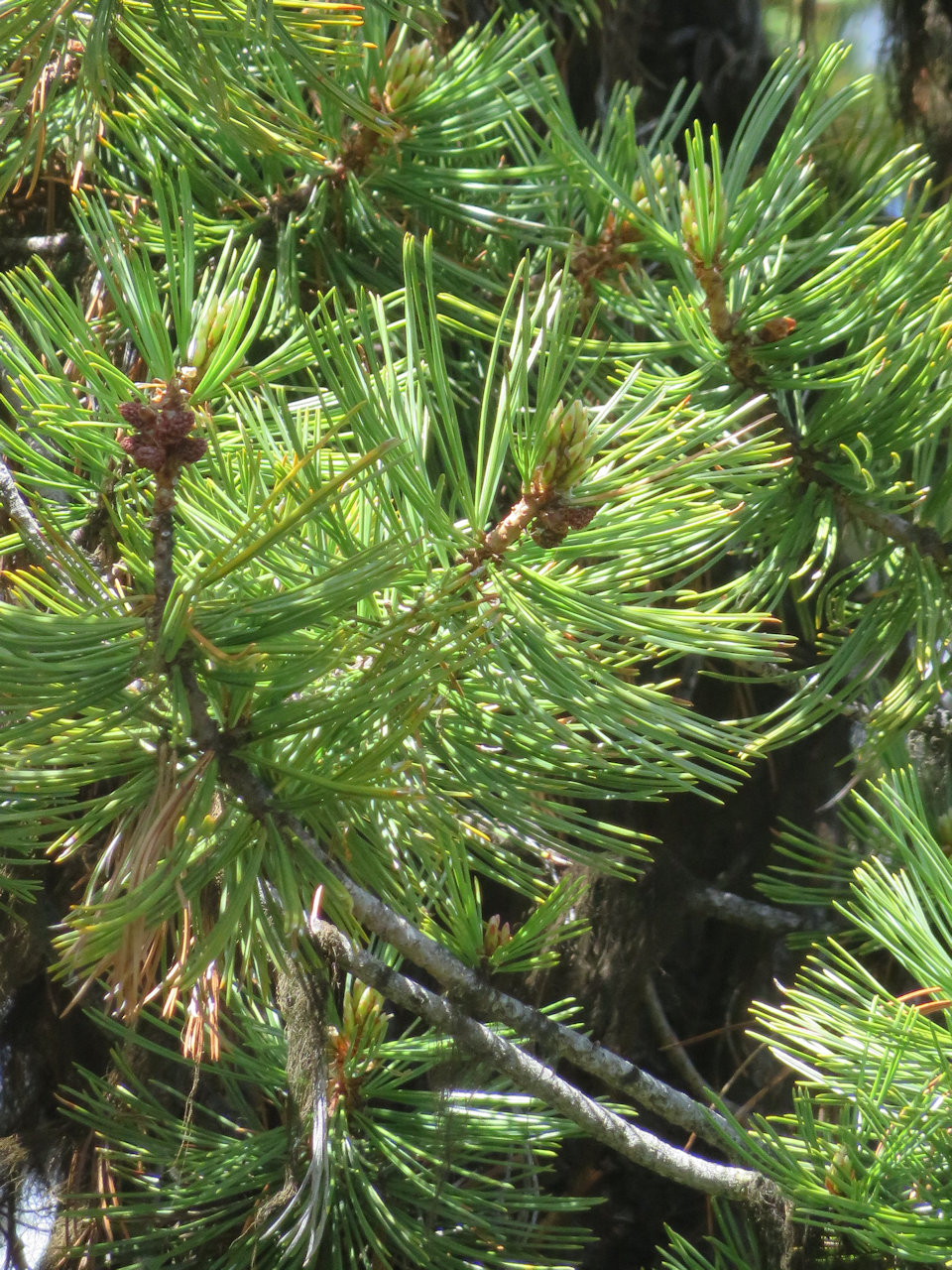
Here’s a very interesting article about the diminishing whitebark pine population . . .
Even the living whitebark pine trees look tragic.
Each living tree points gnarled limbs at 10 dead fellows on this mountain pass in the Bob Marshall Wilderness. They bend and twist the way the wind shrieks along the Continental Divide, implying a mix of pain and defiance. They adapted to grow on the most hostile ground in Montana. But they’re failing.
Diana Six calls them “ghost forests.” At the edge of the tree line, beyond where the Ponderosa pine and spruce and alpine fir can survive, the whitebark pine used to rule. The University of Montana forest entomologist seeks them out on the slopes of Ch-paa-qn Mountain west of Missoula, in the Beaverhead Mountains above the Big Hole Valley, and the high ridges of the Bob Marshall. Her search gets harder every year.
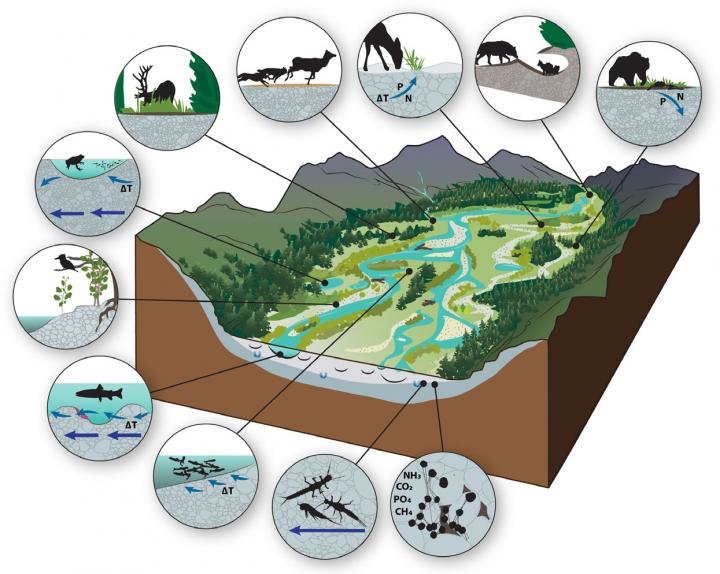
Scientific illustration shows the complexity of organisms that benefit from gravel-bed river floodplain ecosystems – credit: Ric Hauer
Here’s a very interesting study led by Ric Hauer of the University of Montana. Recommended reading . . .
Gravel-bed river floodplains are some of the most ecologically important habitats in North America, according to a new study by scientists from the U.S. and Canada. Their research shows how broad valleys coming out of glaciated mountains provide highly productive and important habitat for a large diversity of aquatic, avian and terrestrial species.
This is the first interdisciplinary research at the regional scale to demonstrate the importance of gravel-bed rivers to the entire ecosystem.
University of Montana Professor Ric Hauer, director of the Center for Integrated Research on the Environment, leads a group of authors who looked at the full continuum of species and processes supported by gravel-bed rivers, from microbes to bull trout and from elk to grizzly bears.