All posts by nfpa

11th Annual Backcountry Film Festival this Friday, Feb 12

Annual Backcountry Film Festival

The Montana Wilderness Association just passed along this reminder . . .

Produced by the Winter Wildlands Alliance, the Backcountry Film Festival celebrates human-powered winter recreation with films from around the globe. Now in its 11th year, this year’s festival includes nine short films, including “The Weight of Winter” by Ben Sturgulewski, “Japan by Van” by Sweetgrass Productions, and “55 Hours in Mexico” by Joey Schusler. After the screening of their film “Shifting Ice,” guest speakers Martha Hunt of Whitefish and KT Miller of Bozeman will share stories from the making of the film.

Friday, February 12
6 – 9 p.m.
O’Shaughnessy Center
1 Central Ave., Whitefish

Click here to see a trailer of the festival.

Tickets are on sale now at Rocky Mountain Outfitter, Runner-Up Sports, and Great Northern Brewing Company. Tickets are $5 in advance and $10 at the door.

Wolverine case probes if feds made rational decision

Wolverine (Gulo gulo, female, born 1996) at the Helsinki Zoo

Here’s the latest on the fight over adding wolverines to the endangered species list. (Bonus fact: The judge has actually seen three of them.) . . .

In a room packed with wolverine legal experts, U.S. District Judge Dana Christensen may have had the best brief. He actually saw the rare carnivore on three separate occasions.

“I don’t know what the odds are of seeing a wolverine three times,” Christensen told the attorneys, “but there’s no reason for any of you to explain it’s a member of the weasel family with large feet that eats marmots. I’ve seen that.”

Christensen added he also had read the scientific reports on the wolverine’s habitat and population, was aware of how elusive the animal is and how hard it is to study. What he wanted to know in the case of Center for Biological Diversity et. al. v. Interior Secretary Sally Jewell was whether an agency decision denying Endangered Species Act protection to wolverines was reasonable or arbitrary.

Read more . . .

U.S. Forest Service strategy document paints bleak picture

The Forest Service has had a conflicting set of goals for the last few decades but, for Region 1 at least, things seem to be coming to a head . . .

A new strategy for managing public lands for recreation, heritage and wilderness paints a bleak picture of the U.S. Forest Service’s own ability to tackle the job.

“You could say this looks like a D-minus report card,” said George Bain, Forest Service Region 1 director of recreation, lands, minerals, heritage and wilderness. “To us, this is how it is. We wanted to take a good, hard look and develop a strategy for how to work in that world. We don’t have all the money we’d want. We don’t have all the workforce we’d want. We don’t have the ability to take care of everything the way we’d like. This is the landscape we’re working in. Let’s see how to address this.”

The 50-page document released last August got little notice outside the Region 1 Missoula headquarters. But it had been more than a year in the drafting, and it has been signed by Regional Forester Leanne Marten, her deputies and the supervisors of all 10 national forests that report to her.

Read more . . .

See also: The Northern Region Sustainable Recreation, Heritage, Wilderness (RHW) Strategy 2015-2020 (1.68MB, PDF)

Climate impacting trout populations worldwide

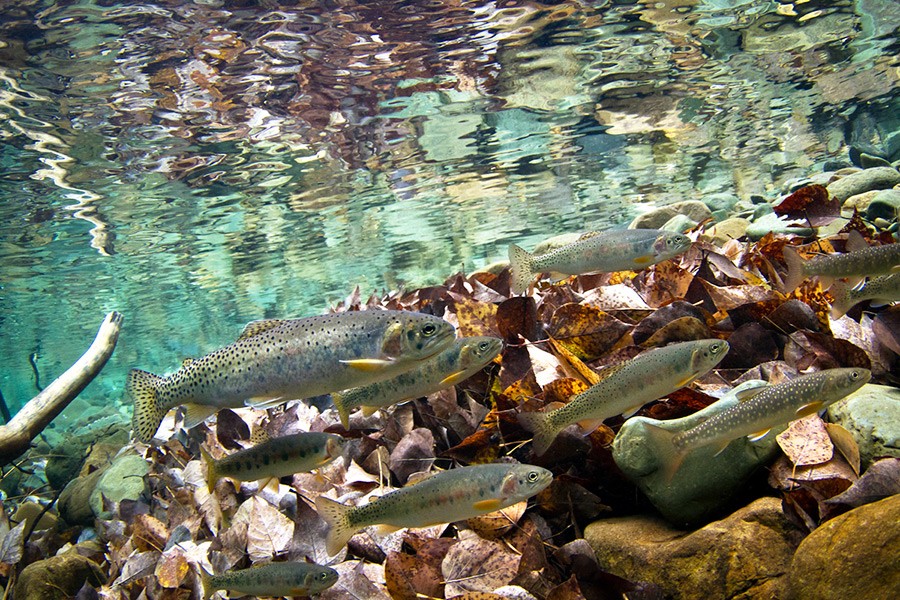
Native westslope cutthroat trout and bull trout stranded in a pool in Ole Creek. Courtesy Jonny Armstrong  USGS
Native westslope cutthroat trout and bull trout stranded in a pool in Ole Creek. Courtesy Jonny Armstrong USGS

Rising water temperatures and general problems with access to clean, fast running water are affecting trout populations globally . . .

Temperature-sensitive trout thrive in water that is cold, clear and abundant – not exactly groundbreaking news. But a recent study tracking the relationship between warming climes and the adverse effects on global trout populations is the first to establish a scientific connection.

A team of researchers with the U.S. Geological Survey – including two researchers based at Glacier National Park – found that climate directly and consistently influences trout populations worldwide, and published their finding recently in the international quarterly journal “Reviews in Fish Biology and Fisheries.”

In the study, titled “Impacts of Climatic Variation on Trout: A Global Synthesis and Path Forward,” lead author Ryan Kovach and his colleagues provide the first global synthesis of trout responses to climate change over time. Despite the economic, cultural, and ecological value of trout, Kovach said long-term data comparing the health of trout populations to changes in streamflow and water temperature are surprisingly limited.

Read more . . .

Bear hibernation linked to changes in gut microbes

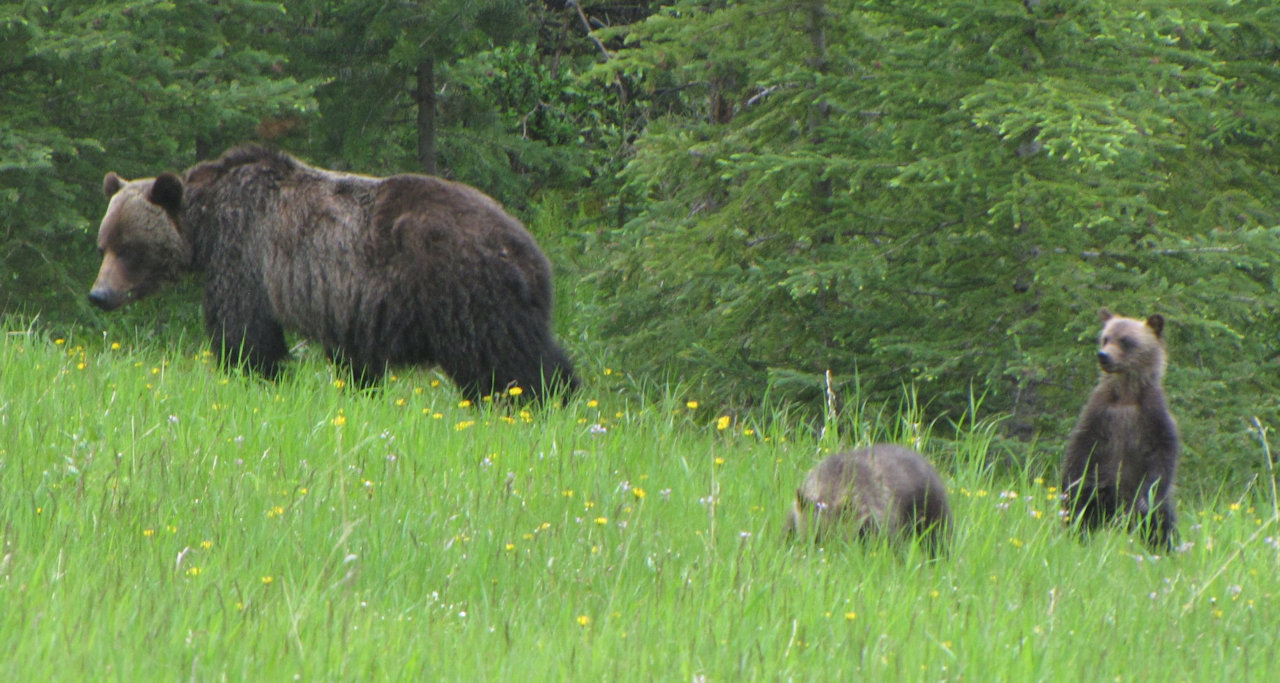
Grizzly Bear - Thomas Lefebvre, via Unsplash
Grizzly Bear – Thomas Lefebvre, via Unsplash

Two years ago, we mentioned the weird stuff that goes on when bears hibernate. Here’s another article along those lines . . .

Each year, bears hibernate for the winter. They gorge themselves on food to pack on fat, but somehow avoid health consequences. Now, scientists have found that the bears’ shifting metabolic status is associated with significant changes in their gut microbes.

“The restructuring of the microbiota into a more avid energy harvester during summer, which potentially contributes to the increased adiposity gain without impairing glucose metabolism, is quite striking,” said Fredrik Backhed, one of the researchers, in a news release.

The composition of gut microbiota can influence the amount of energy harvested from the diet. In fact, microbiota shifts in people who are obese and in those with type 2 diabetes.

In this latest study, the researchers collected fecal samples from wild bears during hibernation and in the active period. Then, the researchers analyzed the microbes living within these sample. The scientists found reduced diversity in the hibernation microbiota…

Read more . . .

Montana state senator new CEO of lands privatization group

Montana state Sen. Jennifer Fielder, a Republican representing Thompson Falls, is the new CEO of the American Lands Council.  The ALC is one of the point organizations behind the movement to demand that federal lands be turned over to state control. The states, in turn, would auction management of these lands off to private control.

What we have here, folks, is a serious conflict of interest what with her being a legislator involved in public land study/bills and being CEO of a group that wants public lands to be transferred to states. Senator Fielder has already had issues with a legislative staffer being a paid lobbyist of ALC and other groups.

You just can’t make this stuff up.

The Salt Lake Tribune has more details . . .

Edward Monnig: Wilderness and Collaboration

Hiking in GNP

Here’s an outstanding op-ed posted yesterday to the Flathead Beacon web site. Recommended reading . . .

In preface to commenting on Stewart Brandborg’s opinion piece on wilderness issues (Dec. 16 Beacon: “Today’s Wilderness Challenge”), I would like to acknowledge with gratitude the service that he and others like Howard Zahniser, Mardy and Olaus Murie, and Aldo Leopold rendered in establishing the framework of our National Wilderness Preservation System. These men and women fought for decades to establish a legacy that benefits all Americans from active users to passive appreciators. Nonetheless, I must offer an alternative perspective to Stewart’s injunction to “resist the fuzzy, fuzzy Neverland of collaboration” when addressing critical wilderness issues.

The Wilderness Preservation System certainly made my career with the U.S. Forest Service immeasurably more rewarding. In my final career assignment, I was supervisor of the Humboldt-Toiyabe National Forest, a forest of 6.3 million acres, including 1.2 million acres of congressionally-designated wilderness. In addition, the H-T has about 3 million acres of roadless areas, de-facto wilderness as it were, that was the subject of intense battles to determine what part should be formally included by Congress in the Wilderness Preservation System.

Managing wilderness is also challenging and much more than a passive exercise in “let it be.” Stewardship of designated wilderness areas is bound by the mandates of the 1964 Wilderness Act. And therein lie many of our management challenges. The introductory section of the 1964 Wilderness Act is inspiring and oft-quoted: “an enduring resource of wilderness…where earth and its community of life are untrammeled by man…” But as a counterpoint to these two paragraphs of poetic vision the Wilderness Act concludes with two pages of exceptions allowing various non-wilderness practices to continue. A cynic might say “Yeah right, untrammeled by man except for multiple airstrips, irrigation reservoirs and ditches, livestock grazing, mineral exploration and mining” – all allowed under the 1964 Act.

Continue reading Edward Monnig: Wilderness and Collaboration

Dispute over Badger-Two Medicine drilling leases still simmering

Badger-Two Medicine Region

The Hungry Horse News has a nice summary of the battle over drilling leases in the Badger-Two Medicine . . .

The battle over oil and gas leases in the Badger-Two Medicine will continue. The Department of Interior and Solonex, the company that owns the leases had asked U.S. District Court Judge Richard Leon to suspend the case so the two parties could negotiate a settlement in the 30-plus year battle. But those talks have fallen apart.

Now Solonex, in a brief to the court on Jan. 19, claims that any attempt to cancel the leases by the DOI would be arbitrary and contrary to federal law. Solonex is represented by the Mountain States Legal Foundation, a nonprofit that often takes up private business and citizens issues in land use disputes in federal court.

The DOI in December said it tentatively planned on canceling the leases altogether, claiming the U.S. Forest Service never did a proper examination of the impacts on Blackfeet Tribe cultural resources when it sold the leases in 1981.

Read more . . .

North Valley working on climate change solutions

cc_meeting_01

A report from Debo Powers, NFPA President, on last Monday’s community climate solutions project meeting . . .

On Monday, concerned citizens met at the Whitefish City Hall to explore a possible community climate solutions project. A diverse group of thirty-four stakeholders attended the meeting which included people working on fire and water issues, tourism and recreation, economic development/ Chambers of Commerce, high schools, local food and renewable energy. Four members of the North Fork Preservation Association attended the meeting in a packed conference room.

Steve Thompson spoke about what other Montana communities are doing to understand and adapt to climate change. One of the questions that Steve asked the group was whether this project should be for just Whitefish or for the entire North Valley, including Columbia Falls and the North Fork. The meeting featured two guest speakers from Missoula: Chase Jones from the City of Missoula and Amy Cilimburg from the Missoula Community Foundation who spoke about the new Climate Smart Missoula project. This exemplary project is focused on reducing Missoula’s carbon footprint, promoting energy conservation and renewable energy, and pursuing climate-smart economic opportunities.

Immediately following this meeting, the Whitefish City Council met for a more formal work session. In April 24, 2014, the city council set a goal of developing a climate solutions plan and this was the council’s first detailed conversation about the possibilities.

cc_meeting_02……….cc_meeting_03

Meeting about road draws North Fork crowd

Debo Powers sent in this report on the traffic management meeting at the Columbia Falls city hall last week . . .

On January 28, many North Fork winter residents braved a foggy morning and icy roads to drive to Columbia Falls to attend a 9:00 am meeting at the Columbia Falls City Hall where officials would be discussing paving the North Fork Road to Camas Creek. North Forkers on both sides of the issue attended the meeting, but no one from the audience was allowed to speak.

Participating in the discussion was Montana State Senator Dee Brown, Columbia Falls City Manager Susan Nicosia, Flathead County Commissioner Phil Mitchell, Columbia Falls Mayor Don Barnhardt, Public Works Director Dave Prunty, and Flathead County Road and Bridge Superintendent Ovila Byrd.

The officials discussed traffic congestion that will occur in 2017 when the new bridge over the South Fork is constructed on Highway 2 near Hungry Horse. Although a temporary bridge will carry traffic, the construction will most likely cause delays in travel. The two detours that were discussed were the North Fork Road to Blankenship Road or the North Fork Road to Camas Creek Road.

Since a proposal to pave the North Fork Road to Camas Creek would have to clear many legal and procedural hurdles, as well as major opposition from many landowners and conservation groups, paving the road by 2017 to provide a detour for construction on Highway 2 is not a viable option. However, the meeting showed that the paving issue is still alive and well in many people’s minds. The North Fork Preservation Association, founded in 1982 to oppose paving the North Fork Road, has vowed to fight any proposal to pave any section of the road.

Information about the road and other North Fork issues will be presented at the Winter Interlocal Meeting on February 17.