Category Archives: Environmental Issues

Wolverine, other animals jump to top of endangered review list with recent agreement

Here’s an excellent article by Rob Chaney posted to today’s Missoulian. Recommended reading . . .

In part because they’re so good at evading biologists, Montana’s elusive wolverines nearly escaped a bureaucratic roundup – and a chance at earning federal Endangered Species Act protection.

Now they’re at the top of the “to-do” list.

Continue reading . . .

Montana sets quota of 220 wolves for Fall hunt

From an AP article posted in today’s Flathead Beacon . . .

Hunters will be able to shoot as many as 220 gray wolves in Montana this fall under rules adopted Thursday by state wildlife commissioners.

The hunt is scheduled to begin in early September and is expected to reduce the predator’s Montana population by about 25 percent to 425 wolves.

A wolf hunt is also planned in Idaho, where officials have not proposed statewide harvest targets or quotas.

Wolves were taken off the endangered species list in an unprecedented move by Congress this spring in Montana, Idaho and parts of Utah, Washington and Oregon.

Continue reading . . .

Numerous bear problems

Montana Fish Wildlife and Parks has been pretty busy recently dealing with various bear encounters and some long-term nuisance bears, including one dropped of on the North Fork. The Daily Inter Lake has a summary . . .

A man escaped mostly unscathed after coming face to face with a black bear Friday morning…

Fish, Wildlife and Parks biologists captured grizzlies near Eureka and Ferndale Thursday and trapped and killed one grizzly near Ferndale…

Continue reading . . .

Grizzly bear population rising in Northwest Montana

Probably not a big surprise to long-term residents, but it’s nice to have some recent numbers on the increased griz population. From yesterday’s Flathead Beacon . . .

The number of grizzly bears in Northwest Montana is on the rise, according to the National Park Service.

John Waller, wildlife biologist for Glacier National Park, said data being collected in the area of the northern continental divide – approximately 7 million acres between Missoula and the Canadian border – shows the bear population has risen by 3 percent annually since 2004, when there were 765 grizzly bears. Today the number is estimated to be about 950.

Continue reading . . .

Federal officials to visit Wyoming to talk wolves

Looks like Wyoming is slowly edging towards a deal with the feds on wolf management. From today’s Missoulian . . .

Interior Secretary Ken Salazar is headed to Wyoming to meet with Gov. Matt Mead and others to discuss removing wolves from the endangered list in the state.

Sen. John Barrasso says Daniel Ashe, President Barack Obama’s nominee to lead the U.S. Fish and Wildlife Service, also will be traveling to Wyoming.

Continue reading . . .

The North Fork Bear News is out! ‘Patti Bear’ at risk

The North Fork Bear News is out! If you are on the mailing list, you should have it now or be getting it soon. If you are not on the mailing list, or just don’t want to wait, you can read it online here (in color, no less).

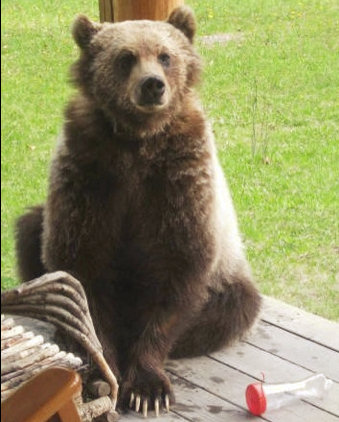
This year’s issue has lots of good content about bears, but its primary motivation is the (unnecessary) risk to “Patti Bear,” a young female North Fork grizzly. Here’s what the Bear News people have to say . . .

Patti Bear & hummingbird feeder

Dear Fellow North Forkers:

A few of us have resurrected the North Fork Bear News in response to Tim Manley’s warning at the winter Interlocal meeting that he may have to remove Patti Bear this summer if she gets another food reward. We don’t want to see that happen, and we’re confident the rest of the North Fork community doesn’t want to see it happen either. So we’ve decided to get the word out, and we invite you to do the same.

It’s been a long time since the North Fork has lost a bear because of human food rewards, and we have a good reputation for keeping our camps clean and our bears safe. Patti Bear’s story isn’t over yet – Manley says she can still learn to stay out of trouble and he’s made it clear that the last thing he wants to do is kill a bear. But now more than ever, her survival is up to us.

Preventing Patti or any other bear from getting a food reward is simple, and most of us know the drill: don’t leave food or garbage out where bears can get to it. But if it’s so simple and we know the drill, why is a grizzly bear’s life on the line because of human food rewards?

It’s a question each of us needs to ask ourselves if we are serious about the welfare of bears on the North Fork. And it’s not a stretch to say that the welfare of our neighbors and their property is at stake, too. Most of us know what a food conditioned grizzly bear can do to a cabin, or to a person.

Putting up electric fencing, cleaning up dog food or garbage, or removing dead ground squirrels from the yard can be inconvenient, and everyone enjoys seeing birds at a birdfeeder. The question ultimately becomes whether a bear’s life is worth a little extra cleanup or giving up our birdfeeders. We think it is. With a little extra effort on all our parts, Patti Bear can stay wild, free, and alive.

Continue reading the North Fork Bear News . . .

“Bear fair” to be held at the Polebridge Mercantile July 9th

From the just-published North Fork Bear News . . .

The U.S. Forest Service in cooperation with Montana Fish, Wildlife and Parks, Glacier National Park and others is sponsoring a community bear fair on July 9th from 10 a.m. to 4 p.m. at the Polebridge Mercantile. The event will feature educational talks, booths and displays (including a culvert trap to check out in case you’ve been curious…), great food (of course!) and an opportunity to learn more about bears and how to keep them safe. There will even be pots of flowers to give away to those who renounce their hummingbird feeders and a fushsia raffle for a couple of lucky winners. Come join the fun!

Glacier National Park participates in long-term grizzly monitoring study

An interesting press release posted to Glacier Park’s web site yesterday . . .

Glacier National Park is participating in a long-term interagency program to monitor the trend of the grizzly bear population in the Northern Continental Divide Ecosystem. Bait stations, automated cameras, and traps will be used to capture and monitor grizzly bears within the park. The program attempts to maintain a sample of up to 10 radio-marked female grizzly bears out of an estimated population of 300 grizzly bears living in the park.

Bait stations and trap sites will be marked with brightly colored warning and closure signs. For safety reasons visitors are reminded to heed and comply with these signs and not enter areas closed for baiting or trapping. A man died last year seven miles east of Yellowstone National Park after he wandered into a capture site and was attacked by a grizzly bear. Trapping efforts will continue at various locations throughout Glacier National Park beginning June through October. For further information, please contact park bear biologist, John Waller, at (406) 888-7829.

Griz study off to good start

From today’s Daily Inter Lake . . .

An ongoing grizzly bear population trend study got off to a good start this year with three bears being captured and fitted with radio collars in the North Fork Flathead drainage.

But that’s just the start of trapping efforts that will carry on for the next few months throughout the Northern Continental Divide Ecosystem, which stretches from the mountains of southern Alberta to the southern end of the Bob Marshall Wilderness Complex.

Continue reading . . .

Three grizzly bears captured as part of the NCDE monitoring effort; other grizzly bear news

This Montana Fish, Wildlife and Parks press release, posted today on the Flathead Beacon web site, is a North Fork-specific follow-up on the grizzly bear monitoring effort announced three weeks ago:

Grizzly bear population capture efforts for monitoring in the Northern Continental Divide Ecosystem (NCDE) have concluded in the North Fork Drainage. Three bears were captured and fitted with radio transmitters during the effort. FWP Biologists will closely follow the bears’ movements.

FWP Biologist Rick Mace notes that the successful capture operation will enable FWP to monitor the survival and reproduction of grizzly bears in this important area of the NCDE. It was recently concluded that the grizzly bear population in the NCDE is growing at a rate of 3 percent per year, based on an analysis and publication by Mace and his colleagues in an upcoming edition of The Journal of Wildlife Management. Grizzly bear monitoring capture efforts now move to other areas of the NCDE. The project is primarily funded by FWP and the U. S. Forest Service.

In other grizzly bear news, an adult female grizzly and her yearling were captured in the Blankenship Bridge area of the North Fork of the Flathead Drainage on June 13. The two grizzlies were released today in the Coal Creek area. The bears were grazing on green grass at private residences. The move was a pre-emptive measure to avoid conflicts with residents.