HELENA – In Montana, grizzly bear populations have expanded in both number and in distribution along both sides of the Continental Divide and in the Greater Yellowstone area. In many instances, grizzly bears are expanding into areas they haven’t been in more than a century.
With this expansion comes an increased focus by Montana Fish, Wildlife & Parks to help people and communities stay safe and avoid conflicts. Across Montana’s bear country, FWP staff are working hard to respond to conflicts, provide tools to landowners and communities to prevent conflicts, and to educate people on how to stay safe.
As part of that effort, FWP unveiled a new Grizzly Bear Conflict Dashboard as a resource for information on where FWP staff are helping landowners and communities with conflicts and the types of conflicts people are experiencing.
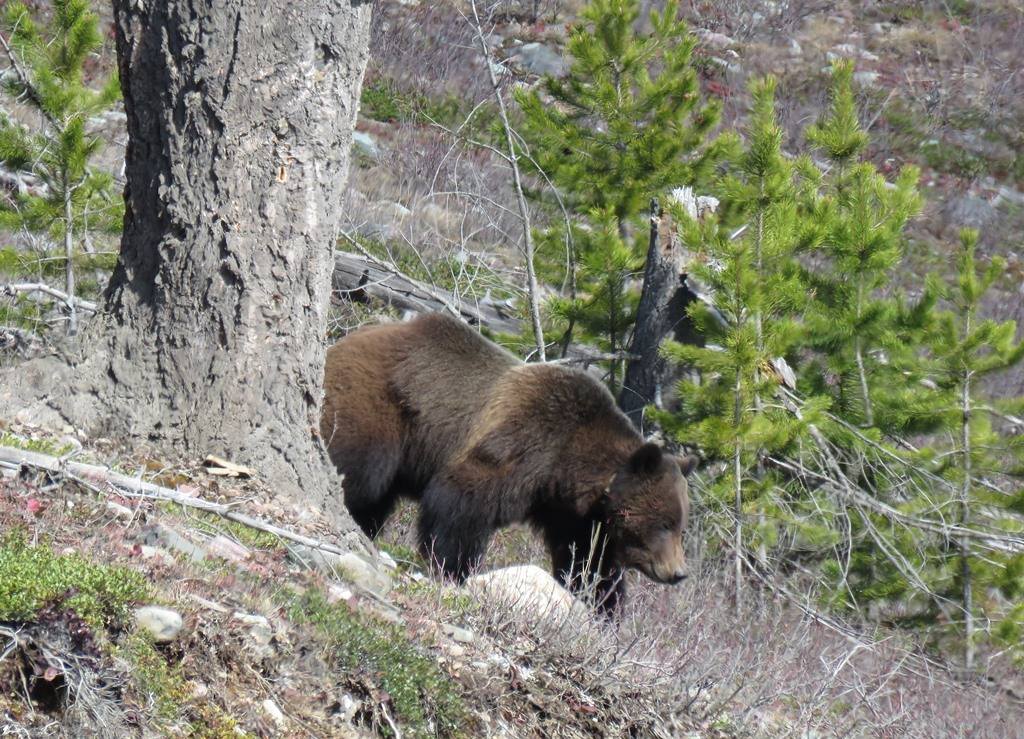
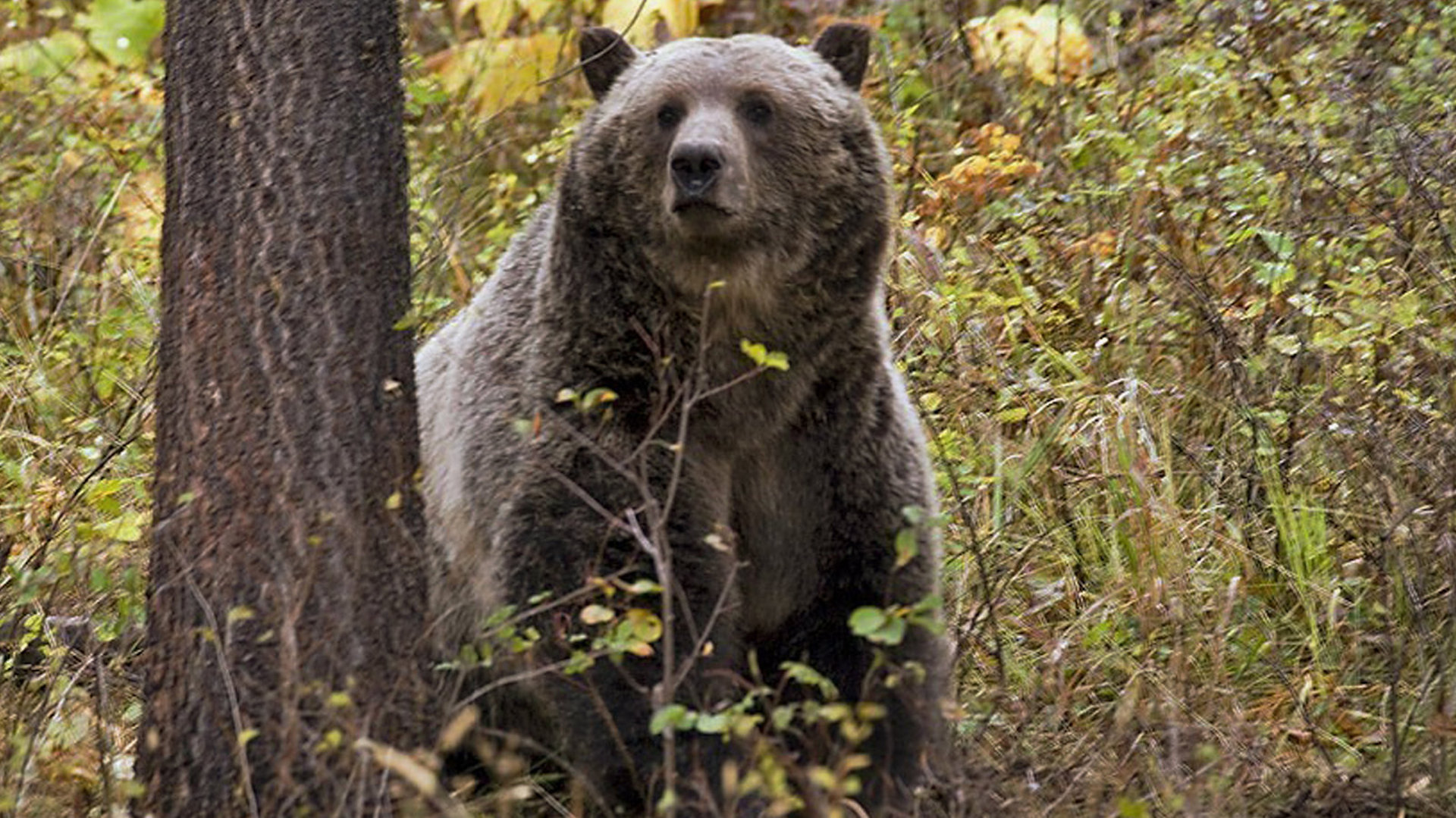
Grizzly bear near Trail Creek in North Fork Flathead region, Montana. April 11, 2017 – by Diane Boyd
Local grizzly specialist Justine Vallieres is featured in this excellent article on human-bear conflict management efforts this year. A couple of North Forkers and the Bear Smart program get a mention, too . . .
Even though grizzly specialist Justine Vallieres responded to fewer human-bear conflict calls in northwest Montana this year compared to last, she filled what little downtime that afforded her by ramping up her education and outreach curriculum.
“We’re pushing preventative measures and trying to set as few traps as possible,” Vallieres, a wildlife conflict management specialist for Montana Fish, Wildlife and Parks (FWP), told members of the Interagency Grizzly Bear Committee (IGBC), who gathered for their annual winter meeting on Dec. 3 and 4 in Choteau. “I can set trap after trap after trap, but if the unsecured attractants are still there, the problem will keep recurring.”
For Vallieres, pushing preventative measues meant installing more electric fences, observing that residents seem more willing to entertain the idea of non-lethal conflict prevention as a means to secure their livestock and grain. She also delivered 18 talks and attended six educational events, all the while keeping up with a steady stream of conflict calls related to grizzly and black bears.
Here’s the latest on Montana’s plan for managing grizzlies at the state level. Detailed plan information is located at the FWP’s “Grizzly Bear Management and Conservation” page.
HELENA – Montana Fish, Wildlife & Parks has released a final Environmental Impact Statement (EIS) analyzing potential environmental impacts from the statewide management of grizzly bears.
Issuing the final EIS is a key step in a process that started in December of 2022, when FWP originally released the draft EIS for two months of public comment. The draft EIS went out for an additional 30 days of public comment in February of this year to ensure partner agencies, affected county governments, and tribal agencies had a chance for review.
“We’ve been intentionally very thorough in our process and review of the impacts to the human environment of statewide grizzly bear management,” said FWP Director Dustin Temple. “This is a crucial process step that yet again shows the state and FWP are ready to take over grizzly bear management ensuring the future viability of grizzlies in Montana.”
FWP analyzed two alternatives in the final EIS. Alternative 1, the “no action” alternative, would represent the status quo. Under this alternative, managing the ever-increasing number of bears statewide, and particularly in areas outside identified recovery zones, would continue to lack a coordinated approach.
Under Alternative 2, FWP’s proposed alternative, FWP would adopt and implement the 2024 Statewide Grizzly Bear Management Plan, which would provide needed clarity about where grizzly bear presence is a management objective and address issues related to connectivity between core grizzly bear recovery zones. If approved, the statewide plan would guide grizzly bear management across Montana. This includes grizzly bears located in recovered ecosystems, grizzly bears in areas not yet recovered, and the places in between.
The final EIS addresses issues and concerns raised during the public comment period. All new information and analysis supplied during the comment period were used to prepare the final EIS and FWP’s response to comments received on the draft EIS.
Montana grizzly bear managers had a lot to discuss and many stories to tell . . .
Bear managers across the state relayed plenty of grizzly bear stories during the Northern Continental Divide Grizzly Bear Ecosystem Subcommittee meeting earlier this month.
Region 2 bear specialist Jamie Jonkel spoke briefly about the fatality this summer of a bicyclist who was camping in Ovando and was killed by a grizzly bear that came into town.
Leah Davis Lokan, 65, of Chico, California, was killed when a bear attacked her in her tent . . .
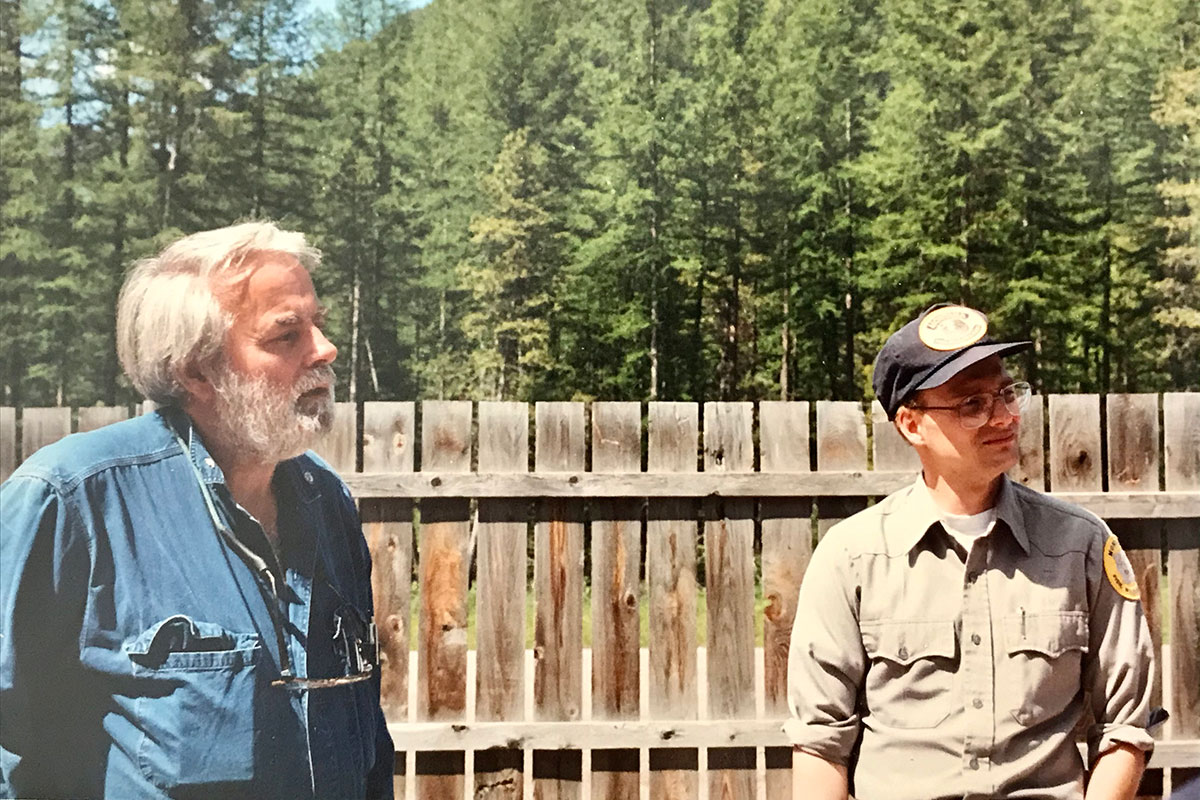
Here’s an excellent article about Tim Manley. Unlike several others this week, this one, by Tristan Scott of the Flathead Beacon, is not hiding behind a paywall . . .
When renowned grizzly bear biologist Tim Manley began his role as Montana Fish, Wildlife and Parks’ (FWP) Grizzly Bear Management Specialist for Northwest Montana, a position he’s held since 1993, the work was funded by BNSF Railway, which faced legal mandates requiring the company to mitigate grizzly bear mortality due to its railroad operations in the region — grain spills, for example, were a lethal temptation for grizzlies browsing food sources along the Middle Fork Flathead River corridor.
Today, the human-wildlife interface is so expansive that points of conflict emerge much closer to home — quite literally in our backyards — but they’re more often the result of bird feeders, barbecue residue, chicken coops, garbage cans, and other unsecured attractants than industrial mishaps such as train derailments.
After a celebrated 37-year career with FWP, Manley recently announced his plan to retire, but it’s not for a lack of grizzly bear work to keep him busy. In fact, it’s quite the opposite, with more bears and people roaming the same landscape than ever before.
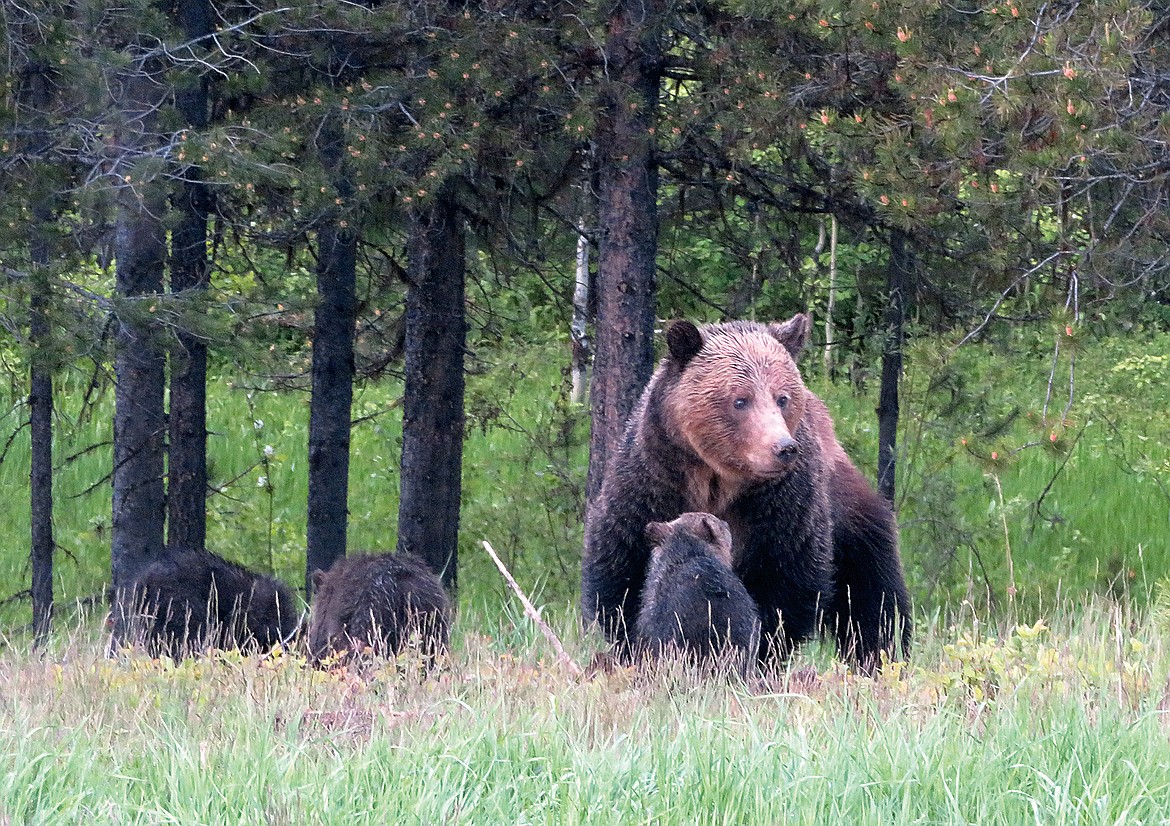
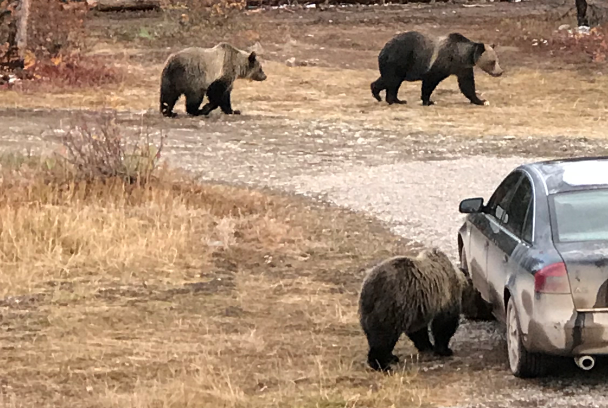
Monica with three cubs, June 8, 2020 – W. K. Walker
The Flathead Beacon has a good article by Tristan Scott discussing the loss of Monica and her three cubs, as well as the general North Fork community issues surrounding living with wildlife . . .
Twenty years ago, new arrivals to the remote North Fork Flathead River community of Polebridge were likely to hear some version of the following when asking for directions — just head north and hang a right at the pile of bear scat.
Situated on the doorstep of Glacier National Park, which merges with the Bob Marshall Wilderness to create the largest intact natural ecosystem in the Northern Rockies, the North Fork’s resident grizzly bear population has historically outnumbered its year-round residents, as evidenced by the prominent distribution of scatological droppings along the area’s trails and roadways. Still, the human interlopers who do call this wild chunk of country home have, more or less, learned how to coexist with their mammalian neighbors, reaching an accord that just comes with the territory in bear country.
And yet in recent years, due in part to the increased visitation at Glacier National Park, whose western boundary is defined by the North Fork Flathead River, as well as the expansion of commercial services in and around the community of Polebridge — leading to the development of “work camps” to house a growing number of seasonal workers — human-wildlife conflicts have been on the rise.
There is quite a bit of interest in Governor Bullock’s grizzly bear advisory panel . . .
More than 150 people have applied to sit on an advisory committee to come up with recommendations on how to manage Montana’s grizzly bears.
Randy Arnold, a regional supervisor with Montana Fish, Wildlife and Parks, tells The Missoulian the application process has been “flooded,” and the committee will probably consist of fewer than 20 people.
Gov. Steve Bullock announced in March he would appoint the committee, a move that came shortly after a judge restored federal protections for grizzlies in and around Yellowstone National Park. Bears from Yellowstone and in northwestern Montana have been spreading into new areas, triggering conflicts with ranchers, hunters and others.
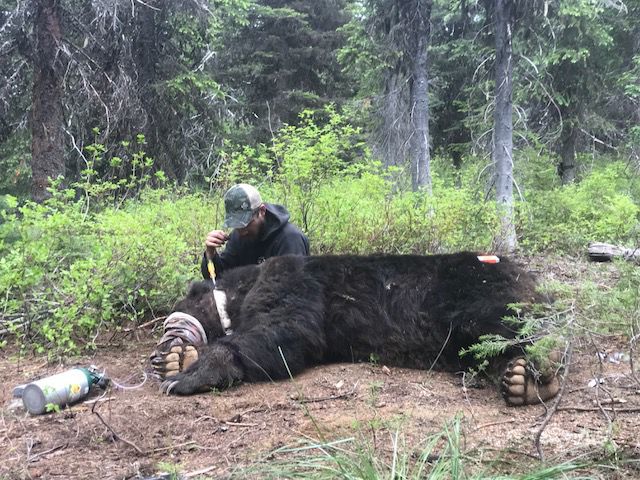
Eleven year old, 476 pound grizzly bear captured west of Pend Oreille River in early October 2018 – USFWS
Montana’s grizzly bears are not just wandering out onto the high plains east of the Divide, they are also showing up in neighboring states to the west . . .
As Montana grizzly bears have pushed beyond their usual mountain strongholds into the Bitterroot and Judith Basin areas, Washington state residents got a surprise visit this fall from a 476-pound grizzly west of the Pend Oreille River.
“That was an eye-opener for the state of Washington,” said Wayne Kasworm, U.S. Fish and Wildlife grizzly manager in Libby. “It was an unusual movement, like the bear in Stevensville and the bears showing up east of the Rocky Mountain Front. That was well outside of its expected range.”
The fall update of the Cabinet-Yaak/Selkirk grizzly activity released on Friday raised another new grizzly issue. A two-year-old male grizzly that was transplanted in the Cabinet Mountains last July got spotted prowling around a black-bear bait site in the Idaho Panhandle. FWS officials captured it and released it back in Montana around the south fork of the Bull River, but it returned to the bait site in September and now is believed to be crisscrossing the border near Huron.
This year’s “a fed bear is a dead bear” lesson: Those grizzlies attracted to the Polebridge area by the oats in the hay field south of town eventually forced management action by Montana Fish, Wildlife and Parks. Two are dead; one was relocated to Glacier Park . . .
It’s an active season for bears as they prepare to den for winter. Fish, Wildlife and Parks officials say they’ve euthanized two yearlings that had become habituated to humans, and captured two others.
From the FWP press release:
Yearling Grizzly Bears Captured Near Polebridge, Euthanized
On Sunday, Oct 21, 2018, Montana FWP staff captured two yearling grizzly bears north of Polebridge and euthanized the animals.
Landowners reported that the yearlings were ripping into a yurt, broke into a cooler, got into garbage, tried to get into bear-resistant garbage containers, and attempted to break into cars and trailers. The adult female was observed with the yearlings but mostly stayed in the background. The yearlings were very food-conditioned and habituated to human presence.
Here’s a pretty good summary of Montana’s proposed management plan for grizzly bears in the northwest section of the state . . .
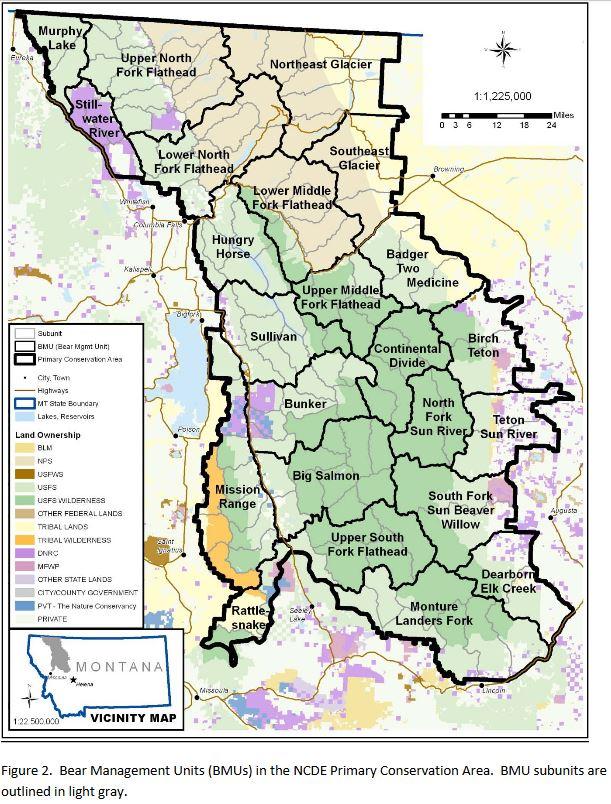
Wildlife officials endorsed a plan Thursday to keep northwestern Montana’s grizzly population at roughly 1,000 bears as the state seeks to bolster its case that lifting federal protections will not lead to the bruins’ demise.
The proposal adopted on a preliminary vote by Fish, Wildlife and Parks commissioners sets a target of at least 800 grizzlies across a 16,000-square mile (42,000-square kilometer) expanse just south of the U.S.-Canada border.
However, officials pledged to manage for a higher number, about 1,000 bears, to give the population a protective buffer, said Dillon Tabish with Montana Fish, Wildlife and Parks.
 From the FWP press release . . .