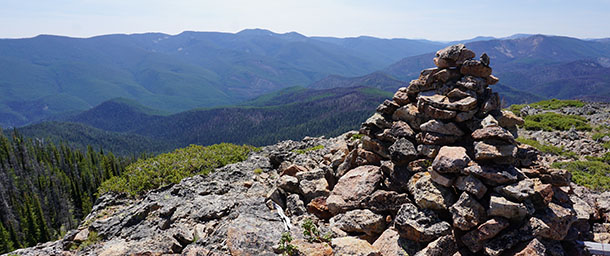
Kent Peak in the Sapphire Wilderness Study Area – photo by Sally Carlson
Congressman Gianforte is trailing along with Senator Daines in proposing to eliminate quite a few Montana wilderness study areas . . .
Montana U.S. Rep. Greg Gianforte has drafted two bills proposing to release almost 690,000 acres (279,000 hectares) of wilderness study areas in Montana.
One of Gianforte’s bills echoes Montana Sen. Steve Daines’ bill introduced in the Senate late last year. It proposes to release 449,500 acres (182,000 hectares) of wilderness study areas all on national forest lands.
The Billings Gazette reports that Gianforte also authored a separate act to release an additional 240,000 acres (97,000 hectares) of Bureau of Land Management wilderness.
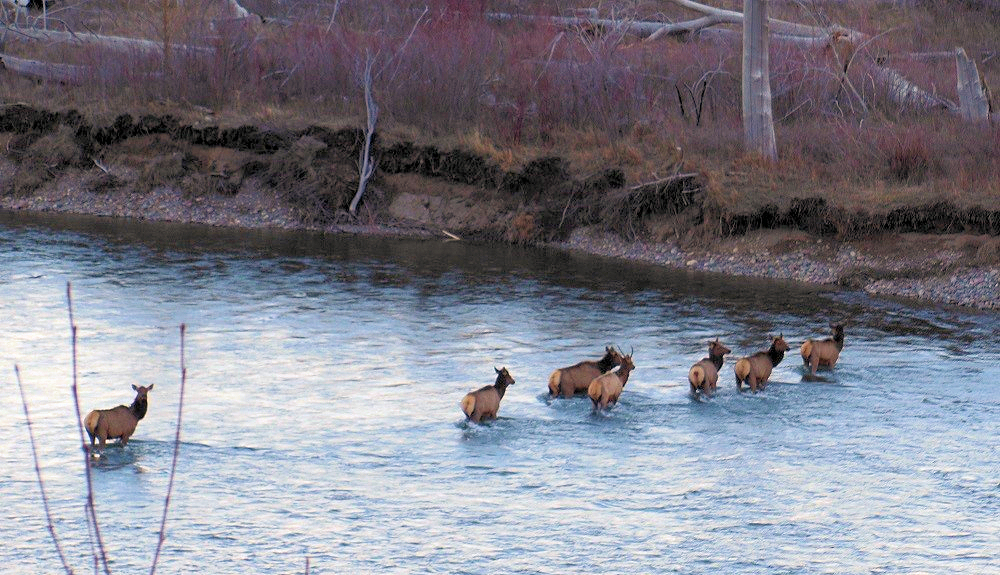
Elk Crossing North Fork of Flathead River, north of Camas Bridge, March 4, 2016 – Greg Evans
The first public meeting on development of a Comprehensive River Management Plan for the three forks of the Flathead River is on March 6, 6:00pm, at Cedar Creek Lodge in Columbia Falls. This is a pretty big deal given the steep increase in recreational traffic over the past few years. The current plan is dated, at best.
Here’s the text of Flathead Forest’s press release, which does a good job of summarizing the issues at hand . . .
The Flathead National Forest, in coordination with Glacier National Park, has begun the process to prepare a Comprehensive River Management Plan (CRMP) for the 3-Forks of the Flathead River.
The river and surrounding lands offer recreational opportunities and access to outstanding resources for a variety of public lands users. The CRMP will address the current status of these resources, outline goals and desired conditions, determine user capacities, and create a monitoring strategy and plan to carry forward. The public is encouraged to contribute to this planning effort that will secure the outstanding remarkable values of the 3-Forks of the Flathead River for future generations. The planning team will be reaching out to the public to provide information on background of the statutory requirements of a CRMP under the Wild and Scenic Rivers Act, describe the need for change from the current river management plan and to gather public input on management issues for the CRMP. The first public meeting introducing the project will be held on March 6th from 6 to 8 pm at the Cedar Creek Lodge Conference Room in Columbia Falls, Montana. Additional meetings will follow allowing for further participation and opportunities to comment, that will help develop the CRMP.
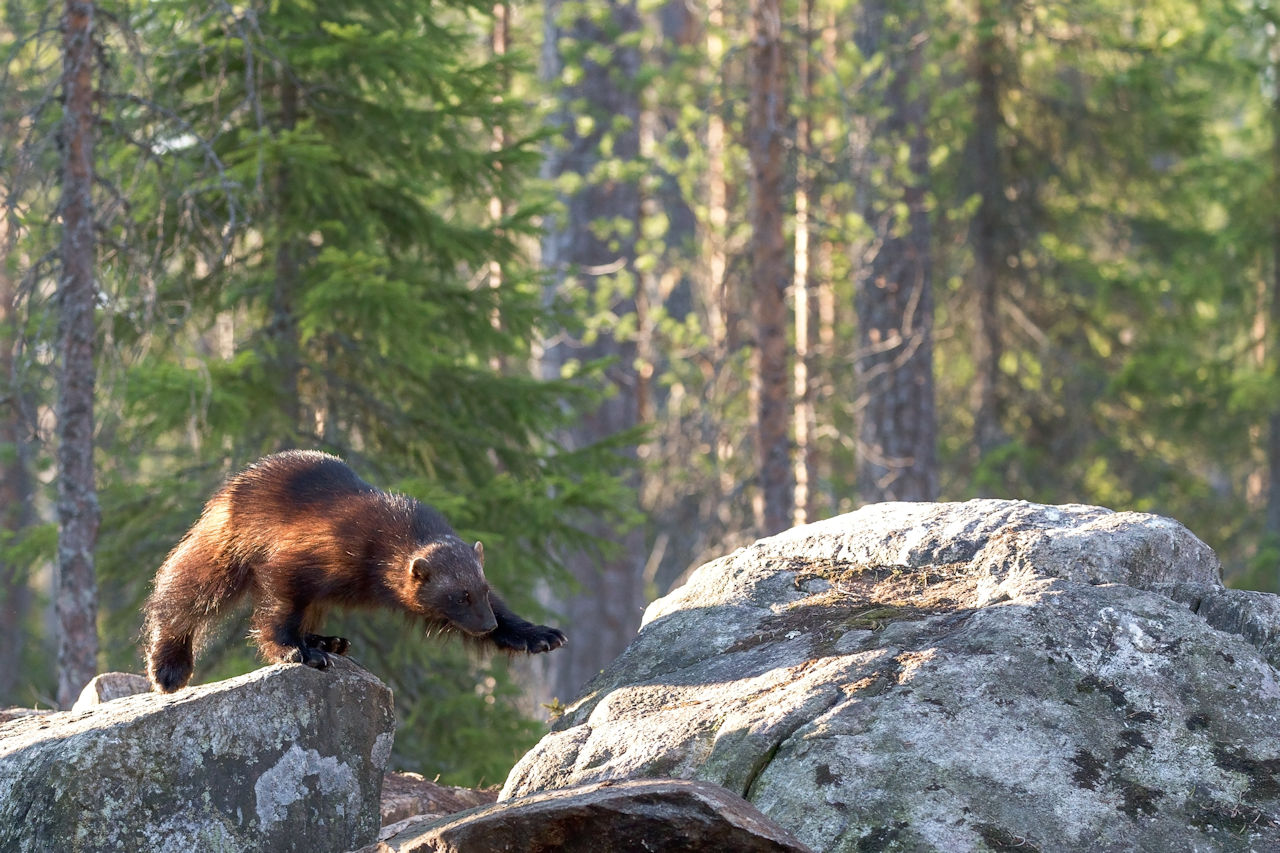
Wolverine on rocks – Photo by Hans Veth on Unsplash
Wait. What? . . .
Wolverines don’t make themselves easy to study. In addition to being able to gnaw their way out of log-cabin-like traps, they’re shaped kind of like a traffic cone. Even if you catch one, the radio collar tends to slip off.
So how do you study what snowmobiling and skiing do to wolverine habitat? Collar the humans.
“This was the biggest radio-collar project with wolverines ever,” said University of Montana wildlife biologist Mark Hebblewhite, one of the study co-authors. “The part I didn’t think would work was collaring humans. A friend tried this in Canada, and everyone was, ‘Get out of my face.’ But we wound up with better data on the humans than on the animals.”
Will Hammerquist, owner of the Polebridge Mercantile, had a nice op-ed in the Flathead Beacon regarding the effectiveness of collaborative land planning . . .
As the owner of a small business in one of the most remote locations in Montana, my livelihood depends on public lands. And I’m not the only one who has a stake in these places – that was clear when over 30 groups came together five years ago to collaborate about the management of the Whitefish Range on the Flathead National Forest. I’m glad to say that the Flathead National Forest’s most recent revision of their management plan largely adopts the recommendations of the Whitefish Range Partnership.
The forest has taken leadership by listening to the needs and wishes of the community, and I hope that our elected decision makers will do the same. The Whitefish Range Partnership, the Kootenai Forest Stakeholders Coalition, and the Blackfoot Clearwater Stewardship Act are all shining examples of what is possible when community members sit down at the table and find common ground solutions in land management. We need to look for answers from the people who know the land best, and within the communities that will feel the outcomes the most.
Blue Joint Wilderness Study Area in western Montana – photo by Zack Porter
Here’s a pretty good overview by the Flathead Beacon of Senator Steve Daines’ top-down attempt to close several Montana wilderness study areas.
By the way, take a close look at the photo accompanying the Beacon article. The guy handling the oars of that drift boat should look familiar . . .
Scrolling through the Instagram account managed by U.S. Sen. Steve Daines, a conservative Republican from Bozeman, it’s clear he’s hewed a well-established groove in the firmament of Western outdoors pursuits.
Populating the first-term senator’s social media feed are pictures of him on backpacking trips deep in the Beartooth Mountains; him bagging ungulates on sunbaked foothills with his wife, Cindy; the family’s mini-Aussies, Reagan and Ruby, chasing mice; and Daines plucking native cutthroat trout from the Yellowstone River. The pictures often bear captions championing public-land access as a cornerstone value in Montana, and they leave behind the politicking inherent to Daines’ work in Washington, D.C.
Daines’ views on public-land access have led him to call for opening up nearly 450,000 acres of federally protected parcels — currently managed by the U.S. Forest Service as wilderness study areas — to a suite of new uses, including logging, grazing and motorized use.
The Flathead National Forest is busy dealing with objections to their new forest plan. Some are a few paragraphs, some run hundreds of pages . . .
With one deadline past and another looming, Flathead National Forest officials will be working weekends to identify the issues raised in objections filed on a proposed land-use plan.
They tallied 74 objections when the objection period ended Monday [February 19] on the plan that will guide future management decisions on the 2.4 million-acre forest for the next decade or longer.
Over the next 90 days, the agency will work with different groups in an effort to resolve a variety of issues raised during a process that will be closely watched by those who care about the future of that landscape.
Here’s a pretty good, locally focused backgrounder on the USFWS proposal to delist the Canada Lynx. You’ll encounter several familiar names . . .
The new millennium brought a new challenge for Lorin Hicks.
For years, Hicks has worked as a wildlife biologist for Weyerhaeuser and its predecessor, Plum Creek Timber Co., studying the inhabitants of Northwest Montana’s sensitive forests.
He gained a new research focus in 2000, when the U.S. Fish and Wildlife Service listed the Continental U.S. population segment of Canada lynx as a threatened species. That move required the agencies that manage area forests to take the lynx’s well-being into account.
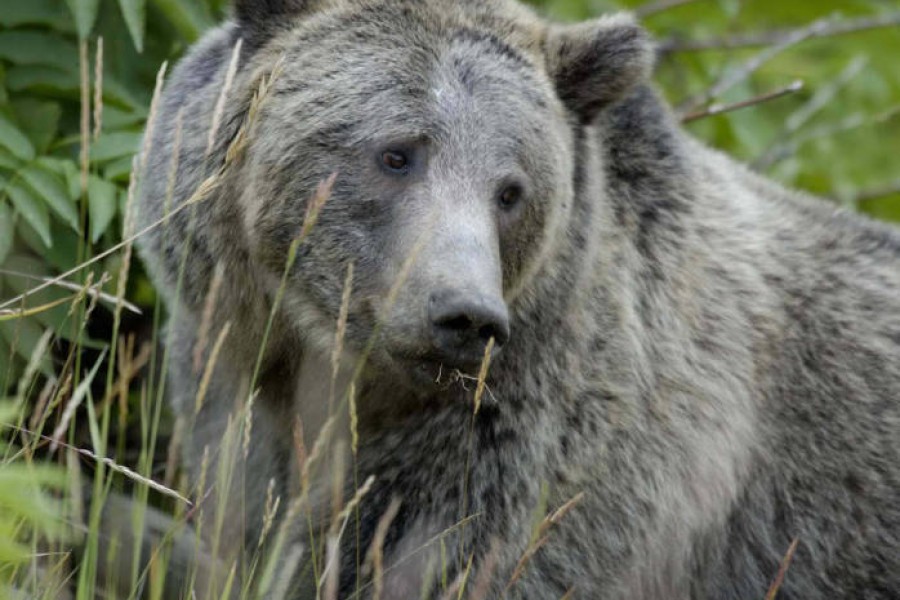
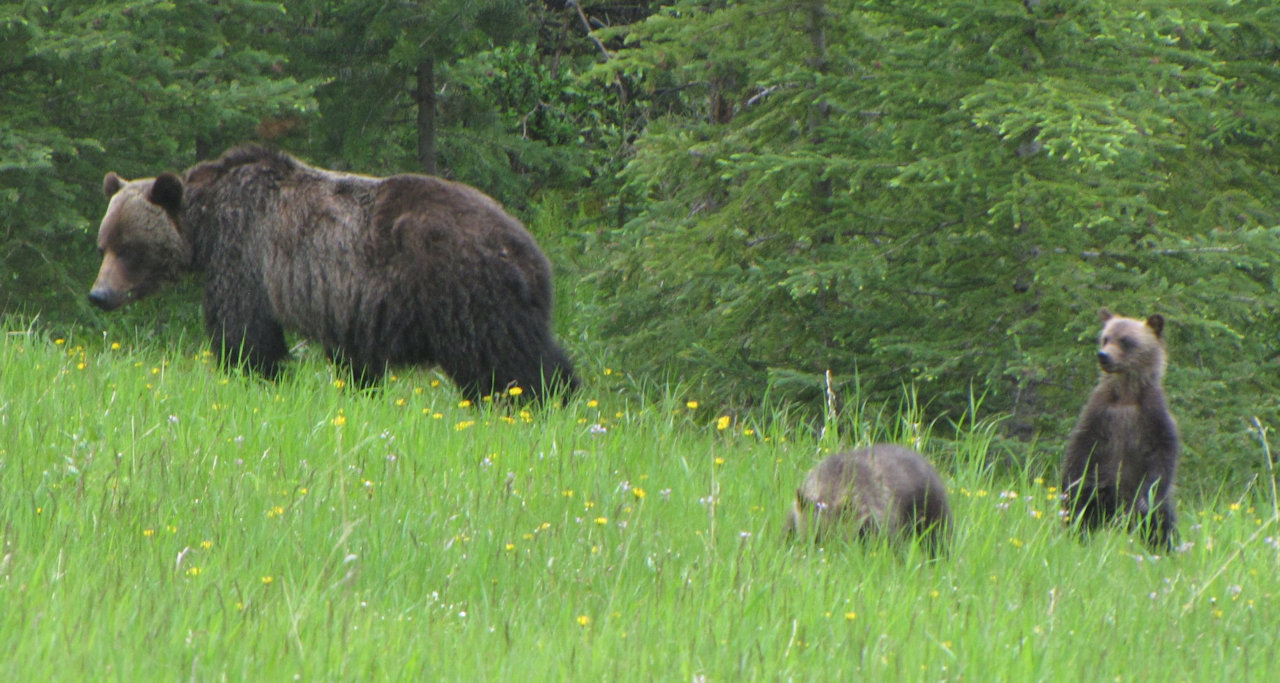
Grizzly Sow with Two Cubs – – Wikipedia en:User Traveler100
As expected, Montana Fish and Wildlife Commissioners voted not to allow hunting of Yellowstone grizzlies this year. Basically, they are waiting for the dust to settle before they make a move . . .
Montana won’t hold a grizzly bear hunt in 2018 after state officials said Thursday they want to avoid complicating lawsuits over the animal’s legal status.
Federal officials last year lifted Endangered Species Act protections for about 700 bears in and around Yellowstone National Park, opening the door to potential hunting in the three-state region.
Montana wildlife commissioners said letting hunters kill some of those bears could give momentum to pending legal challenges that seek to restore protections.
Flathead National Forest – view of Whitefish Divide
This op-ed has been making the rounds of local and state newspapers for the past week.
The NFPA has been a member of the Whitefish Range Partnership from the beginning . . .
There’s a lot of bad news about divisiveness in America. Here’s a local good-news story: Folks with very diverse interests in the Flathead Valley met over a 13-month period, got way past “No!” and achieved a unanimous agreement on national forest management. Sound impossible? No, not really. The Flathead Forest has formally adopted most of the Whitefish Range Partnership’s recommendations in their recently released revised forest plan, proving that local input matters, and that people who work together in good faith can have a positive impact.
The Partnership focused exclusively on the Whitefish Range, located north of Whitefish and west of Glacier Park. Our group is composed of nearly 30 members from landowners, business owners, wilderness advocates, motorized recreationists, horsemen, fishermen and women, mountain bikers, timber interests, and wildlife and trails advocates, among others.
The Partnership came together early in the Flathead Forest plan revision process. This was the first time that many historically divergent interests in the Flathead sat in the same room together to try and talk it out. In the beginning no one was sure what we were doing or what would come of it. But, after the first few meetings, we were able to define our collective vision for the Whitefish Range and began putting our results on paper.
We worked in sub-committees on ten subjects ranging from wildland and prescribed fire, to fisheries, weed management, recreation, and more. Experts came and shared information about each topic to inform our work, and keep us within the Forest Service laws and guidelines. Committees reported back to the larger group for further debate and a vote. By our own rules, we had to reach 100 percent consensus on each topic before we could proceed to the next.
So, what’s resulted from this hard work?
In the end, we agreed unanimously to submit our recommendations on ten subjects to the Forest Service. Everyone felt that by supporting one another, each of our values could be elevated in the planning process for the Whitefish Range. Where and how was timber harvest best? Where are the areas that snowmobiling is important and desired? Where should there be more trails? What special areas should be protected as Wilderness? These are examples of the elements of our agreement.
Ultimately, for our partnership to succeed, we need to see a signed forest plan. It’s important that officials in Washington DC allow the Flathead Forest plan to proceed and conclude without top-down interference. The Final Plan should be signed following the official “objection period” that is currently underway.
Collaborative groups and processes represent the best available opportunities for resolving socially complex, natural resource decision-making. Other Montana-based collaboratives, like the Blackfoot Clearwater Stewardship Project and the Kootenai Forest Stakeholders Coalition, can only succeed if our elected officials and our local decision-makers consider and act on citizen recommendations.
In this period of American history where many people – and many elected officials – seem to think that their point of view is the only point of view, we recommend talking and listening, and coming up with forest plans, community plans, even state and national legislation, that reflects the consensus of the community served.
We wish to thank the Flathead Forest planning staff for taking time, providing resources, and listening to citizens. While the Flathead staff clearly considered other points of view and suggestions for the North Fork Geographic Unit (the Whitefish Range), as reflected in the Final Plan, the plan also reflects the consensus of the Whitefish Range Partnership.
—
Noah Bodman, Flathead Area Mountain bikers; Allen Chrisman, North Fork Compact; Paul McKenzie, F.H. Stoltze Land & Lumber Company; Amy Robinson, Montana Wilderness Association; Heidi Van Everen, Whitefish Legacy Partners; Bill Walker, North Fork Preservation Association; Larry Wilson, North Fork landowner
Elk Crossing North Fork of Flathead River, north of Camas Bridge, March 4, 2016 – Greg Evans
Now that the Forest Plan is in its final stages, the Forest Service and allied agencies are rolling up its sleeves and getting to work on a management plan for the three forks of the Flathead River. Here’s a good overview by the Hungry Horse News. See also the official Comprehensive River Management Plan announcement . . .
Columbia Falls will host the first of several meetings on a new comprehensive river management plan for the three forks of the Flathead River.
The meeting is scheduled from 6 to 8 p.m. March 6 at the Cedar Creek Lodge Conference Room.
The Flathead National Forest and Glacier National Park are embarking on a joint plan to track river use on the three forks of the Flathead, with the eventual goal of crafting management plans for the Wild and Scenic rivers.