Category Archives: Environmental Issues

Record low streamflows for North and Middle Fork

Creeks and rivers are very low across this corner of Montana . . .

The two primary tributaries of the Flathead River have the lowest streamflows on record for late August, further reflecting the extreme drought conditions that are tormenting the region in a year being defined by smoky skies and stingy weather.

Entering the final days of August, the Middle Fork Flathead River was running at 470 cubic feet per second, a new record surpassing the previous low set in 1940, according to the National Weather Service. The median flow for this time of year is 977 cfs.

The North Fork Flathead River was running at 628 cfs, surpassing the 2001 record low. The median flow is 1,260 cfs. The streamflows are the lowest since monitoring gauges were established 75 years ago, according to Ray Nickless, NWS hydrologist.
Read more . . .

FWP bear managers ask residents to secure attractants

From a recent Montana Fish, Wildlife and Parks press release . . .

FWP bear managers are asking residents in northwest Montana to secure garbage, pet food and other attractants in light of recent conflicts in the Whitefish area. Bear and Lion Specialist Erik Wenum notes that several black bears have been accessing unsecured garbage particularly in the Lion Mountain and Whitefish State Park Road areas.

“If residents secure garbage it would take care of most of our problems there,” says Wenum. He advises the following:

  • Secure garbage inside a garage or secure shed
  • Bring pet food in at night
  • Clean up livestock food
  • Bring in bird feeders, clean up spilled seed

When bears access garbage they can become food conditioned and can potentially be dangerous. Wildlife biologists usually have to kill food conditioned bears in the interest of public safety.

For information or to report a problem, call:
Erik Wenum, FWP Bear and Lion Specialist; 756-1776.


See also:

Black bears ‘pour down’ on western Montana valleys for apples, berries (Missoulian)

Hungry bears create problems across Flathead (Daily Inter Lake)

Montana senators, others meet to celebrate North Fork protection

Besides smoke and fires, there has been some other North Fork-related news. Most notably, there was a meet-n-greet last Monday at the Blankenship Bridge to celebrate passage of the North Fork Watershed Protection Act. Included were Montana’s Senators Jon Tester and Steve Daines, Marcy Grossman, Canadian Consul General for the Rocky Mountain Region, and several other speakers. There was a substantial North Fork contingent present and lots of press.

They also had munchies and coffee. Pretty good munchies and coffee, in fact.

Anyway, here are links to most of the press coverage . . .

On a smoky day, celebrating the North Fork (Hungry Horse News and Daily Inter Lake)

Bipartisan Collaboration Preserves the North Fork (Flathead Beacon)

Montana Senators Celebrate North Fork Protection (ABC-fOX)

North Fork Flathead protection celebrated by Tester, Daines, others (Missoulian)

Timeline submitted for decision on Badger-Two Medicine drilling leases

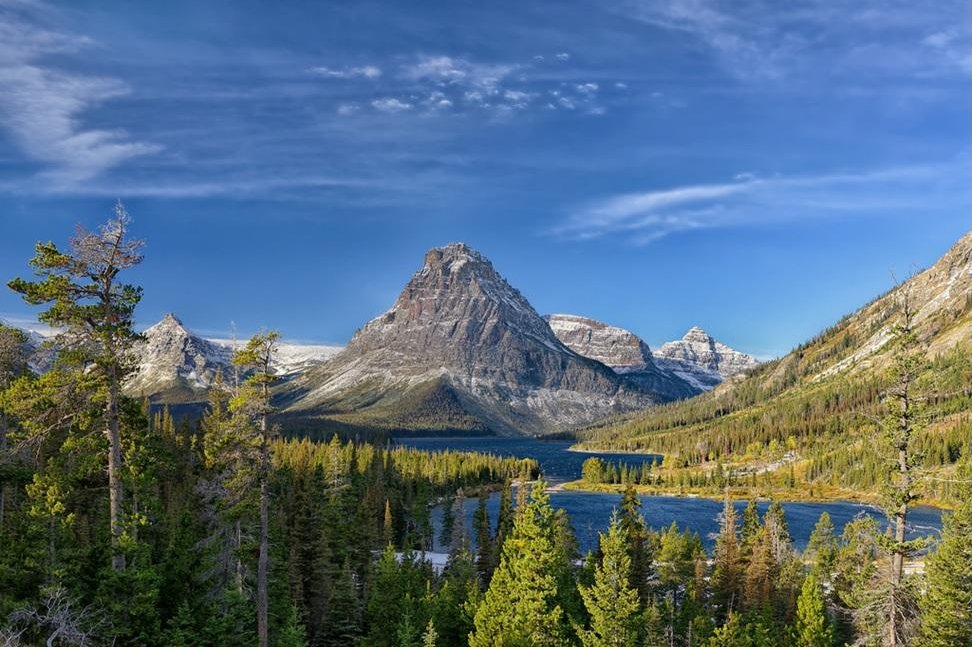
Two Medicine Lake
Two Medicine Lake – Flikr User Phil’s Pixels

The feds have decided to make a decision about energy leases in the Badger-Two Medicine region. By November 30, they will either commence to cancel the leases …or not.

This would be funny if the consequences weren’t so serious. Just read the darn article while I go bang my head on my desk . . .

Public land managers have submitted a court-ordered schedule framing the steps they’ll take to either lift a suspension of oil and gas drilling on a prized and culturally sacred landscape adjacent to Glacier National Park or cancel the energy leases outright.

In setting the schedule, federal land managers for the first time are considering the dissolution of energy leases in the Badger-Two Medicine area as an option to settle a dispute over whether they were granted illegally, as leaders of the Blackfeet Nation contend. The Badger-Two Medicine is home to the Blackfeet creation story and is at the center of a hard-fought legal battle, with the lease-holder calling for the drilling suspension to be lifted on one side and a vast coalition of tribes, conservation groups and Montana politicians urging permanent protection on the other.

The timeline to resolve the decades-old suspension of an energy lease in the Badger-Two Medicine was drafted after a federal judge ordered the U.S. Department of Justice, the Bureau of Land Management and the U.S. Forest Service to draft a schedule for the agencies to complete their review.

Read more . . .

Whitefish Range video – A Community Vision for a special place

Anyone who worked in or with the Whitefish Range Partnership will see some familiar faces in this segment from This American Land. A big hand to Amy Robinson, Bob Brown, Heidi Van Everen, Frank Vitale, John Frederick, Paul McKenzie and Erin Sexton for participating in this video . . .

You can see the  full television episode here: https://www.youtube.com/watch?v=quI1pjZWys0

Urine, sweat and antifreeze: The story of Logan Pass goats

Chris Peterson has a very interesting article in this week’s Hungry Horse News about the ongoing study of Glacier Park’s mountain goats. It seems humans are an excellent source of salt . . .

Hike the Hidden Lake Overlook Trail in Glacier National Park during the summer and you’re almost assured to see a mountain goat.

The region is excellent goat habitat, notes University of Montana biologist and researcher Wesley Sarmento. But the goats are also drawn there for another big reason: Salt.

Sarmento currently has 22 goats fitted with radio collars from the Logan Pass area as part of a three-year-study of the iconic creatures.

Read more . . .

Badger-Two Medicine: “Too wild to drill”

Two Medicine Lake
Two Medicine Lake – Flikr User Phil’s Pixels

The Wilderness Society weighs in on the issue of drilling leases in the Badger-Two Medicine region . . .

As the Blackfeet Nation’s leaders ramp up efforts to protect the Badger-Two Medicine area near Glacier National Park from oil and gas development, a nationwide conservation group has issued a report singling out the sacred region as a top priority for environmental safeguards.

The Wilderness Society’s 2015 edition of “Too Wild to Drill,” which identifies places the group believes should be off limits to energy development, featured the Badger-Two Medicine among three other lands deserving protection, including Alaska’s Arctic National Wildlife Refuge, Colorado’s Thompson Divide and Grand Junction region and Utah’s Bears Ears and lands near Desolation Canyon.

Flanked on the northwest by Glacier National Park, on the east by the Blackfeet Indian Reservation and on the south by the Bob Marshall and Great Bear Wilderness, the 130,000-acre Badger-Two Medicine is central to the cultural identity of the Blackfeet.

Read more . . .

Feds set timeline to decide on Badger-Two Medicine area drilling lease

Two Medicine Lake
Two Medicine Lake

The next chapter begins in the battle over the fate of the Solonex oil and gas lease in the Badger-Two Medicine region. The feds have, uh, decided to make a decision . . .

U.S. government officials plan to decide this fall whether to take steps to lift the suspension of an oil and gas lease on land sacred to Native Americans or to begin the four-month process of canceling it, according to court documents filed Monday.

The timeline for resolving the decades-old suspension of the lease in the Badger-Two Medicine area near Glacier National Park was created after a federal judge ordered the U.S. Department of Justice, Bureau of Land Management and Forest Service to come up with a timeline to complete their review.

Baton Rouge, Louisiana-based Solenex LLC sued to lift the suspension and begin drilling this summer on the 6,200-acre oil and gas lease it acquired in 1982. The suspension has been in place since 1993 while federal officials consider the environmental and cultural impacts.

Read more . . .

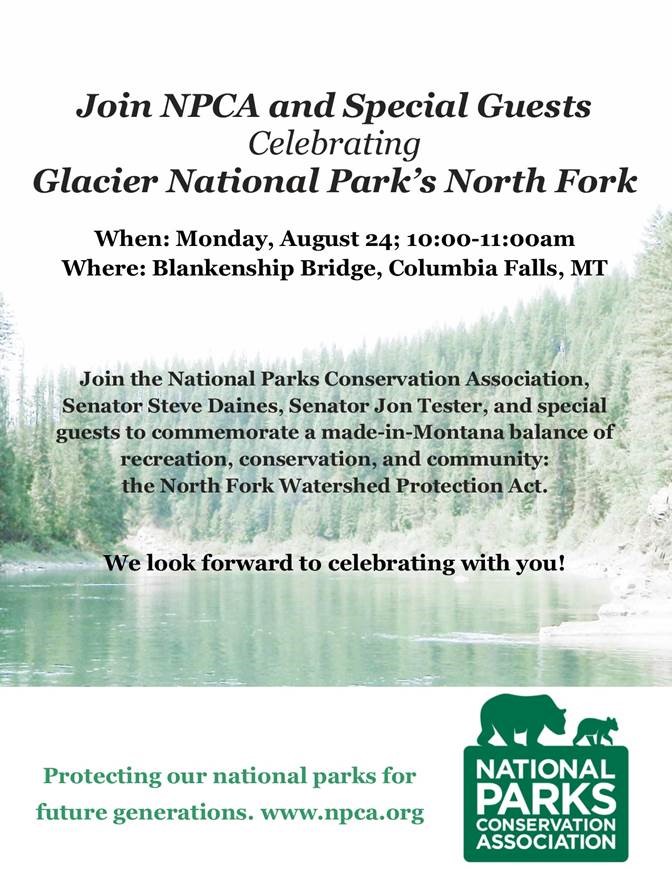
Celebrating Glacier National Park’s North Fork – Aug 24

From our friends at the National Parks Conservation Association . . .

Greetings, friends!

We’re planning a summer celebration of Glacier National Park’s North Fork, right on the riverbank the morning of Aug. 24.

Sens. Jon Tester and Steve Daines together will welcome Canada’s Consulate General Marcy Grossman to commemorate a truly historic transboundary and bipartisan alliance, forever protecting the communities and culture of Waterton-Glacier International Peace Park.

Places such as Waterton-Glacier and the North Fork Flathead River Valley do not happen by accident. They are choices that we make together – choices such as the recent Canadian and US legislation that protects our North Fork heritage. Please join us to celebrate the priceless gift of many more summers on the river! We’ll bring the coffee.

Details and directions below…

Celebrating Glacier National Park’s North Fork

Directions to Blankenship Bridge (for non-North Forkers):

  • Enter Columbia Falls on US Hwy 2
  • Turn north on Nucleus Avenue
  • Turn Right at the “T” intersection, onto Railroad Street
  • Continue 8.5 miles up the North Fork Road
  • Turn Right on Blankenship Road
  • Continue 2.4 miles to Blankenship Bridge
  • Cross the bridge; parking is on the left

Cabinet-Yaak grizzly recovery slow

Grizzly bear recovery in the Cabinet-Yaak region is proceeding slowly . . .

Despite the robust recovery of grizzly bears in the forested mountains of Glacier National Park, the Bob Marshall Wilderness Complex and the surrounding landscape, the great bear’s future across the region remains far from certain.

The recovery zone spanning the Cabinet Mountains Wilderness, Yaak River basin and areas in between— about one quarter of the size of the Northern Continental Divide Ecosystem — has about one 20th of the grizzly population, growing at about half the rate.

The Cabinet-Yaak grizzly bear population contained 45 bears in 2012 when the U.S. Fish and Wildlife Service last conducted a population estimate. Wayne Kasworm, a grizzly bear biologist for the agency, estimates that population at about 50 today, half of the 100-bear recovery target identified after the population’s 1975 listing as “threatened” under the federal Endangered Species Act.

Read more . . .