Category Archives: Environmental Issues

Kootenai Forest stakeholder group reaches accord

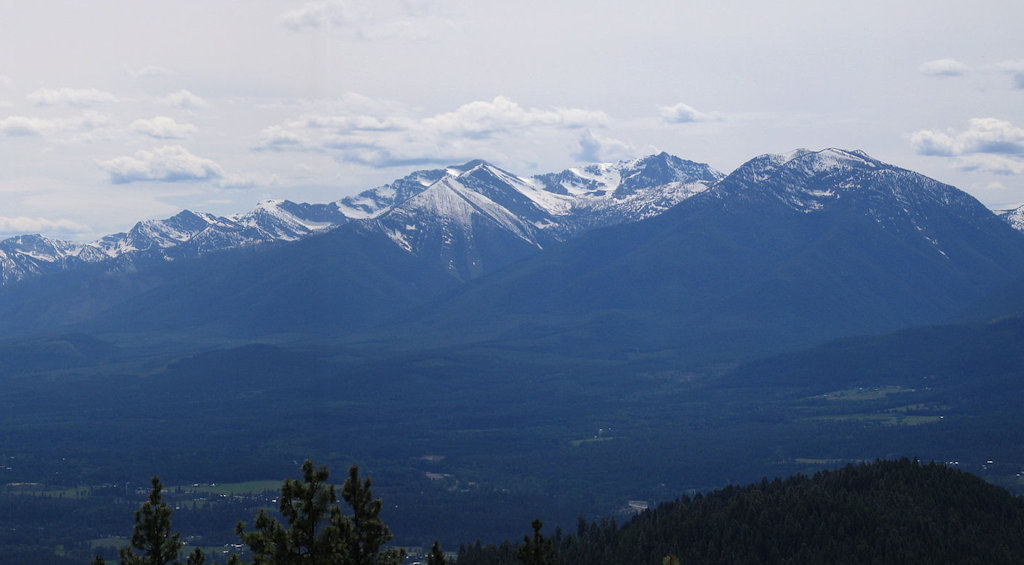
Southern Cabinet Mountains, as seen from Swede Mountain, near Libby

This is a decent summary of the status of the Kootenai Forest Stakeholders Coalition, including a discussion of a couple of rather contentious lawsuits stirring the pot over there . . .

A collaborative group representing stakeholders in and around the Kootenai National Forest announced an agreement last week that will guide its input on proposed land management projects.

The Kootenai Forest Stakeholders Coalition includes representatives from environmental, industry and recreation groups that often are at odds on forest policy. Robyn King, executive director of the Yaak Valley Forest Council, said the group was formed in 2006 to come up with a set of shared objectives to minimize litigation blamed for slowing down projects in the national forest.

“This is the guiding document that we would use, as a group, to make our comments to the U.S. Forest Service,” King said. “This is an organic document, so as we get out on the ground and see different applications being proposed by the U.S. Forest Service, we may make changes over time.”

Read more . . .

North American ecosystem shift 6,000 years ago caused by humans

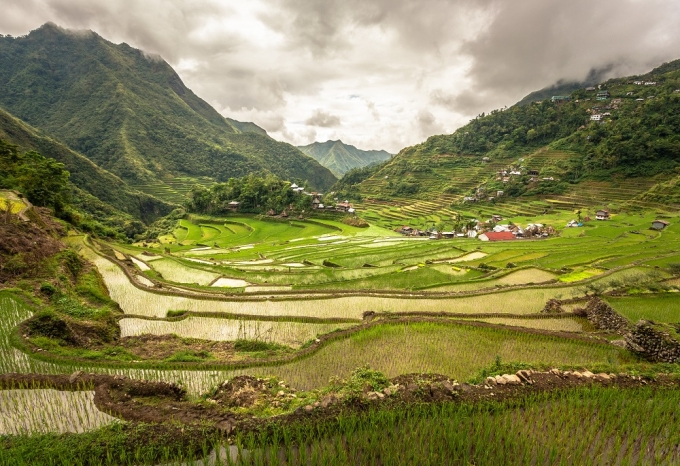
Terraced Farming

I’m not sure if the study referenced in this review has a solid statistical basis or not, but the findings certainly are fascinating. Researchers claim to have found evidence for an abrupt ecosystem shift in North America (!) triggered by the arrival of humans dependent on agriculture . . .

For the past 6,000 years, human beings have been having an extreme effect on the distribution of animals and plants across the globe, some of which had been in place for up to 300 million years, to the point that some species are more segregated from others than they have ever been. A research team from the Evolution of Terrestrial Ecosystems (ETE) program, led by S. Kathleen Lyons, performed a study that looked deeper into plants’ and animals’ distribution across the landscapes of the planet through fossil records.

The shift has been so dramatic that the team discovered that the consequences of a shift like this could usher in a new stage in global evolution equivalent to that of the evolution of complex organisms from single-cell microbes, according to Smithsonian Magazine.

The team decided to focus on locating patterns among plants and animals, filtering out the relationships that could be classified merely as chance. They looked at two types of relationships – pairs and segregations – to find these patterns. Pairs would include animals that occur together, like cheetahs and giraffes, which are often found in the same areas, while segregations would include animals that are not present when another is.

Read more . . .

LWCF makes it into spending bill; ‘fire-borrowing’ does not

Reauthorization for the Land and Water Conservation Fund made it into the pending omnibus spending bill, but the ‘fire-borrowing’ fix for funding large wildfires did not. The wildfire measure was tied to a set of logging measures that raised opposition on both sides of the aisle . . .

Proposals to speed up logging projects apparently killed chances for fixing the U.S. Forest Service’s “fire borrowing” problem as Congress moved an omnibus budget bill toward passage Wednesday.

The 2,009-page bill does include re-authorization of the Land and Water Conservation Fund, which was a bipartisan goal of Montana Republican Sen. Steve Daines, Republican Rep. Ryan Zinke and Democratic Sen. Jon Tester. But the Montana delegation’s push for categorical exemptions and expedited approvals of logging projects ran into opposition from both national environmental groups and Senate Republican leadership.

Both Senate Energy and Natural Resources Chairwoman Lisa Murkowski, R-Alaska, and ranking member Sen. Maria Cantwell, D-Wash., opposed including the Forest Wildfire Funding and Forest Management amendment that was backed by a large coalition of logging, recreation and conservation groups as well as members of Congress from both parties and the Agriculture Department.

Read more . . .

Climate impacts to hunting, fishing and wildlife heritage

Over at the Flathead Beacon, Tristan Scott posted an article on a recently released report by the National Wildlife Federation . . .

Montana’s hunters and anglers have as much vested in the Paris climate negotiations as the state’s abundant suite of wildlife, according to research compiled by the National Wildlife Federation, which recently released a report detailing what’s at stake culturally, ecologically and economically if a solution is not forthcoming.

As 150 world leaders at the 2015 United Nations Climate Change Conference hash out a binding agreement for curbing greenhouse gas emissions, scientists studying moose, cutthroat trout, mountain goats, and other wild animals in Montana are sounding the alarm about climate impacts in the Treasure State.

The National Wildlife Federation’s report is entitled “Game Changers: Climate Impacts to America’s Hunting, Fishing and Wildlife Heritage,” and outlines the historic role of hunters and anglers in conservation and the many ways in which the changing climate is affecting hunting and fishing opportunities and the state’s robust outdoor economy.

Read more . . .

Feds aim to maintain current Greater Yellowstone grizzly numbers

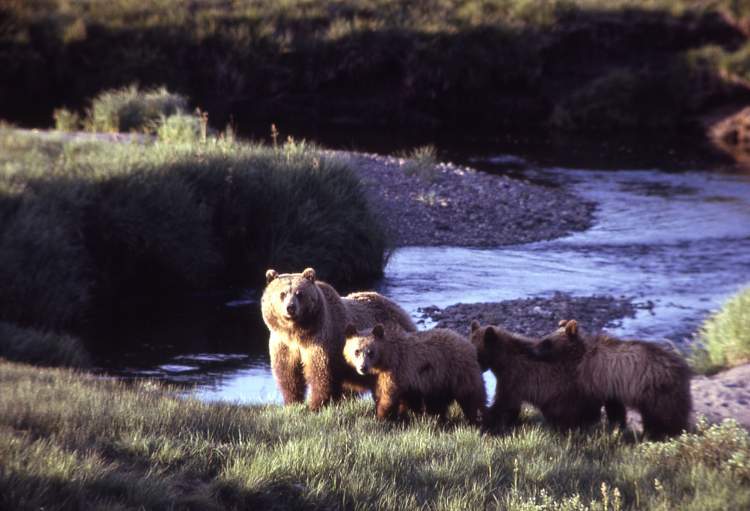
Grizzly bear sow with three cubs

Federal wildlife managers edge closer to delisting the grizzly bear . . .

Wildlife managers will seek to maintain grizzly bear numbers in the three-state Yellowstone region near current levels as they move toward lifting protections for the threatened species, a U.S. Fish and Wildlife Service spokeswoman said Wednesday.

The agency has set a management goal of 674 grizzly bears across the 19,300-square-mile region. That’s enough of the animals to “ensure a sustainable and resilient population,” spokeswoman Serena Baker said.

The population target is consistent with the average number of bears between 2002 and 2014. But it’s about 6 percent below the most recent tally of 714 bears at the end of 2014.

Read more . . .

Also read: Grizzly counting methods face scrutiny as delisting decision nears

Bear-proof storage getting better; still room for improvement

Cinca, May 5, 2015 by W K Walker

Here’s an update on the current state of bear-proof storage. I particularly like the bit about “Kobuk the Destroyer” . . .

An unexpected problem has developed in the world of bear-resistant food storage testing: The grizzly bears responsible for tearing containers to shreds are getting bored or depressed.

“With some of these containers, the bears are no longer interested in testing,” U.S. Forest Service national carnivore program leader Scott Jackson told the Interagency Grizzly Bear Committee meeting in Missoula on Tuesday. “For the metal cases that are bolted to the ground that they can’t tip over and knock around, that’s becoming more and more of a problem. They just lick the bait off the outside and leave them alone. The manufacturers are kind of left in limbo.”

In a way, that’s a good problem to have. Bear-resistant food storage rules apply to more and more places in the woods as both grizzlies and black bears add human food to their foraging plans. Next summer, floaters who win a coveted permit to spend a week on Montana’s Smith River must pack their steaks and beer in bear-resistant containers.

Read more . . .

Grizzlies keep pushing out onto high plains

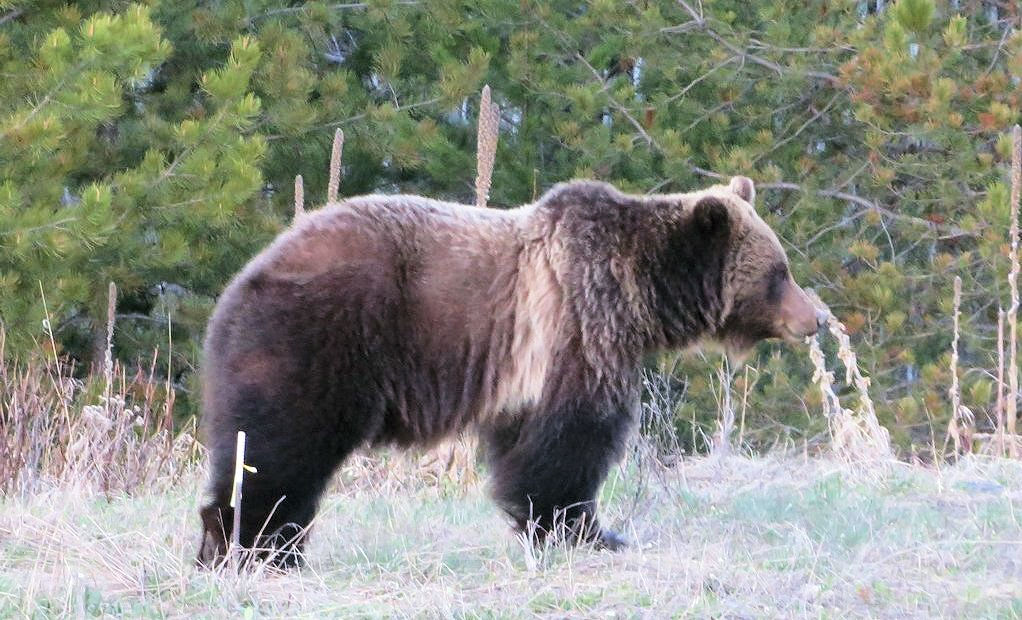
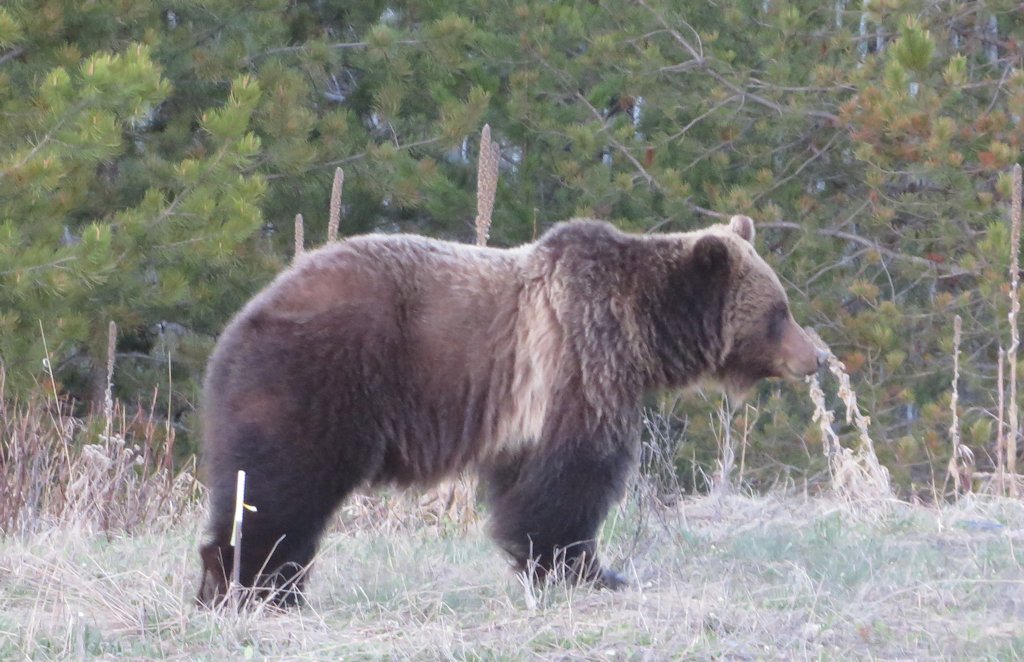
Grizzly bear sow with three cubs

Grizzlies continue to move down from the mountains and out into their old range on the high plans . . .

As the lone grizzly bear expert for the Montana Fish, Wildlife and Parks’ Region Four office, Mike Madel hasn’t had any problems keeping busy along the Rocky Mountain Front. “It was a heck of a year,” he said during a presentation to regional grizzly experts Wednesday near Kalispell. “We had bears expanding way out into the plains again, and further than we’ve ever had them.”…

The range of grizzly bears along Montana’s Northern Continental Divide has roughly doubled since they received federal protection under the Endangered Species Act in 1975, and much of that new territory has been east of the Rockies.

Grizzlies are increasingly present on the Blackfeet Indian Reservation, often following the winding, tree-lined drainages that extend east from the mountains. Even Great Falls might not be immune to the encroaching bears for long.

Read more . . .

Also read: State, federal grizzly bear experts to meet in Missoula

Lawsuit over Badger-Two Medicine leases retreats behind closed doors

Badger-Two Medicine Region

Here’s a non-surprise: After the Solonex lawsuit forced the federal government to take an official stance on the issue of energy leases in the Badger-Two Medicine region, attorneys on both sides want to move the discussion behind closed doors for a while . . .

The Interior Department and a Louisiana energy company are asking a federal judge to pause court proceedings in a dispute over a drilling lease near Glacier National Park.

Attorneys for the two sides said in a Wednesday court filing that they want more time to see if they can resolve the case outside of court.

They asked U.S. District Judge Richard Leon to put the case on hold until Jan. 8.

Read more . . .

Montana FWP recommends purchase of Haskill Basin and Trumble Creek easements

Some good news: Montana FWP recommended purchasing conservation easements on better than 10,000 acres in the north end of the Flathead Valley . . .

Public comments are in, and two proposed major conservation easement purchases in the Flathead Valley – including one that would protect the primary source of Whitefish’s water supply – are moving forward.

Montana Fish, Wildlife and Parks on Monday recommended the FWP Commission immediately approve the purchase of a $16.7 million easement on more than 3,000 forested acres in Haskill Basin north of Whitefish.

The agency also recommended the commission approve the purchase of a $9.5 million easement on more than 7,000 acres northwest of Columbia Falls in the Trumble Creek area once the conservation easement and associated management plan are finalized, and other due diligence is completed.

Read more . . .