Category Archives: History

Next Flathead Forest Friday meeting focuses on upcoming Wilderness Act anniversary

The Flathead National Forest has another “Flathead Forest Friday” meeting coming up on Friday, November 22. This time it’s at the Nite Owl in Columbia Falls. Here’s the press release . . .

Everyone Invited for a Breakfast Chat on Friday, November 22nd

Next year is the 50th anniversary of the Wilderness Act which preserves more than 100 million acres of wild-lands nationwide, including the Mission Mountains, Great Bear, Scapegoat and Bob Marshall Wilderness areas on the Flathead National Forest. The public is invited to a no-host breakfast on Friday, November 22, 2013 to learn about a number of events planned around the Flathead Valley next year to mark the anniversary and to help connect people to the wilderness. The breakfast will start at 7:00 AM at the Night Owl restaurant in Columbia Falls.

On September 3, 1964 President Lyndon B. Johnson signed into law the Wilderness Act which established the National Wilderness Preservation System (NWPS) setting aside an initial 9.1 million acres of wild-lands for the use and benefit of the American people. Over the past 50 years Congress has added over 100 million acres to this unique land preservation system. The 1964 Wilderness Act defines “Wilderness” as areas where the earth and its communities of life are left unchanged by people, where the primary forces of nature are in control, and where people themselves are visitors who do not remain.

Multiple agencies and organizations are partnering to host a number of events during 2014. Spotted Bear District Ranger Deb Mucklow and Bob Marshall Wilderness Foundation Executive Director Carol Treadwell will join our Flathead Forest Friday guests to discuss the events planned in the Flathead Valley.

Every other month, the Forest Service will coordinate these no-host breakfast meetings at a local restaurant with the goal of sharing good food, great company, and a little information about what’s happening on our National Forest. We hope the event will be a great way to discuss public land management opportunities and challenges that are important to us all.

If you plan to attend or have any questions, please notify Public Affairs Officer Wade Muehlhof at ewmuehlhof@fs.fed.us or (406) 758-5252. Your response allows us to plan accordingly with the restaurant.
The Robert Fire ten years later

The Flathead Beacon has a nice retrospective on the 2003 fire season, the Robert Fire in particular . . .

The rolled-up maps in Dennis Divoky’s office show the enormity of the 2003 fires in Glacier National Park. Huge swaths of land are colored in red and orange, depicting in print the 136,000 acres of land burned that summer. It was the biggest fire season in the park’s history – even larger than 1910’s “Big Burn.”

“The 2003 season is the pinnacle,” said Divoky, fire ecologist for the park.

That summer, the National Park Service responded to 26 wildfires that scorched roughly 13 percent of the park’s land. Of those, six blazes were larger than 10,000 acres. The Robert Fire alone burned 57,570 acres of land in the park and Flathead National Forest and forced multiple evacuations of the Lake McDonald Valley and West Glacier. By September, the fires had cost the Park Service more than $68 million.

Continue reading . . .

Beacon posts articles marking 40th anniversary of Endangered Species Act

The Flathead Beacon recently published a well-written pair of articles marking the 40th anniversary of the introduction of the Endangered Species Act. Both are worth a read . . .

The Road to Recovery – By the spring of 1973, the American conservation movement had reached a boiling point. The early warnings from visionaries like Theodore Roosevelt, who promoted stewardship of the country’s natural wonders and resources or risk losing a sacred heritage, had presaged the concerned state of the wild interior. Continue reading . . .

How the Endangered Species Act Changed Everything – In the four decades since Congress passed the Endangered Species Act, widely regarded as the crown jewel of the nation’s environmental laws, the watershed legislation has led to the recovery of a suite of species that once hung on the brink of extinction. Continue reading . . .

National park photos by Ansel Adams accessible online

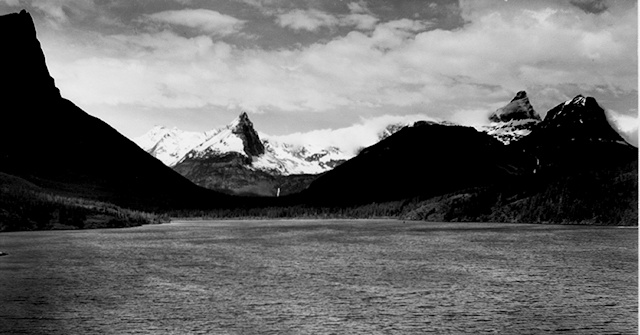
St. Mary Lake, Ansel Adams, 1941

Here’s a little gem I ran across this morning on the U.S. National Archives website. It seems they have a pretty good collection of photos taken by Ansel Adams back in 1941 of many of the national parks. This includes some two dozen photos of Glacier National Park. According the the site:  “In 1941 the National Park Service commissioned famed photographer Ansel Adams to create a photo mural for the Department of the Interior Building in Washington, DC. The theme was to be nature as exemplified and protected in the U.S. National Parks.” The advent of World War II killed the project, but the images are in the national archives and accessible to the public.

Further reading:

“Ansel Adams Photographs” page at the U.S. National Archives

“Discover Ansel Adams’ 226 Photos of U.S. National Parks (and Another Side of the Legendary Photographer)” via Open Culture

Bison once roamed Glacier Park’s high country

Here’s an interesting tidbit about Glacier Park’s — and perhaps the North Fork’s — historic fauna . . .

A project to study cultural and biological resources near ice patches in Glacier National Park has revealed an interesting find in the Park’s high country — bison.

Often thought of as a plains animal, researchers recently found bison remains at an elevation of 8,000 feet in the Park’s St. Mary drainage.

Researchers say the bison remains were not left by hunters — it’s a nearly complete skeleton. Bison may have their home on the range, but that homeland extended into the mountains, it turns out.

Continue reading . . .

Larry Wilson: Fifth-generation North Fork wedding

Larry spent a few days in Seattle last week, officiating at a fifth-generation, North Fork-connected wedding . . .

I spent most of last week in the Seattle area officiating at a wedding. I have had the honor of doing this several times, and this is only the second time I felt it was worthy of mention in this North Fork column.

The first, which was the first ceremony I ever performed, was when I officiated at John Fredericks’ latest wedding when he married Sharon Costantino. That ceremony was performed in a meadow south of Polebridge, and the bride was delivered in the back of a pickup. Also, the ceremony was mostly attended by family and North Fork friends.

This most recent wedding took place more than 500 miles from the North Fork, but the groom is the fifth-generation of his family with North Fork ties. That makes his wedding of interest to North Forkers.

Continue reading . . .

Scapegoat, first citizen-designated wilderness, created 40 years ago

The Missoulian starts an excellent two-part series on the Scapegoat Wilderness today . . .

While camped above Ringeye Falls in the 1950s, Cecil Garland pulled an elk reed bugle from his duffel bag and released a call into the crisp September air.

Within minutes, the calls rang back – big bulls hidden deep in the Lincoln backcountry. Sleep wouldn’t come easy for Garland that night, his heart pounding and his senses alive.

“All through the frosty fall air the calls echoed back and forth and I knew I’d found wilderness,” Garland testified before the U.S. Senate on Sept. 23, 1968. “But all was not at peace in my heart; for I knew that someday, for some unknown reason, man would try to destroy this country as man had altered and destroyed before.”

Continue reading . . .

(See also this related article: Support waning for future Montana wilderness designations.)

Marker erected to commemorate Flathead’s 1964 flood

Forty-eight years ago, the Flathead experienced a massive flood when something like a foot of rain fell over the Continental Divide. Last Thursday, the National Weather Service and the U.S. Geological Survey commemorated the event with a flood level marker at the foot of South Nucleus Avenue in Columbia Falls . . .

On Thursday afternoon, the Flathead River through Columbia Falls didn’t look that dangerous. Sure, it was a little high and a little muddy – normal for this time of year. But 48 years ago this month, there was no such thing as “normal.”

On June 7 and 8, 1964, 10 to 14 inches of rain fell over the Continental Divide. That rain, combined with melting snow, resulted in the largest flood to hit the Flathead Valley in nearly a century. On June 9, the Flathead River through Columbia Falls hit 25.58 feet; normal flood conditions are between 12 and 14 feet. That flood was commemorated on Thursday, when the National Weather Service and the United States Geological Survey erected a sign to note the high-water mark of that event at the end of South Nucleus Avenue in Columbia Falls.

Continue reading . . .

Larry Wilson: Around the Park on snowshoes

This week, Larry passes along a story about Norton Pearl, one of the early Glacier Park rangers . . .

During the winter of 1913, Park ranger Norton Pearl completely circled Glacier National Park on snowshoes. His story, used here with permission from his daughter, Dorothy, tells a lot about the early day rangers.

They were not only a tough group of men, but they obviously loved the area as much as any of us do today. In most cases, their word was their bond and was valued by all who knew them. Following is a portion of Pearl’s account:

Continue reading . . .