Here’s a pretty good, locally focused backgrounder on the USFWS proposal to delist the Canada Lynx. You’ll encounter several familiar names . . .
The new millennium brought a new challenge for Lorin Hicks.
For years, Hicks has worked as a wildlife biologist for Weyerhaeuser and its predecessor, Plum Creek Timber Co., studying the inhabitants of Northwest Montana’s sensitive forests.
He gained a new research focus in 2000, when the U.S. Fish and Wildlife Service listed the Continental U.S. population segment of Canada lynx as a threatened species. That move required the agencies that manage area forests to take the lynx’s well-being into account.
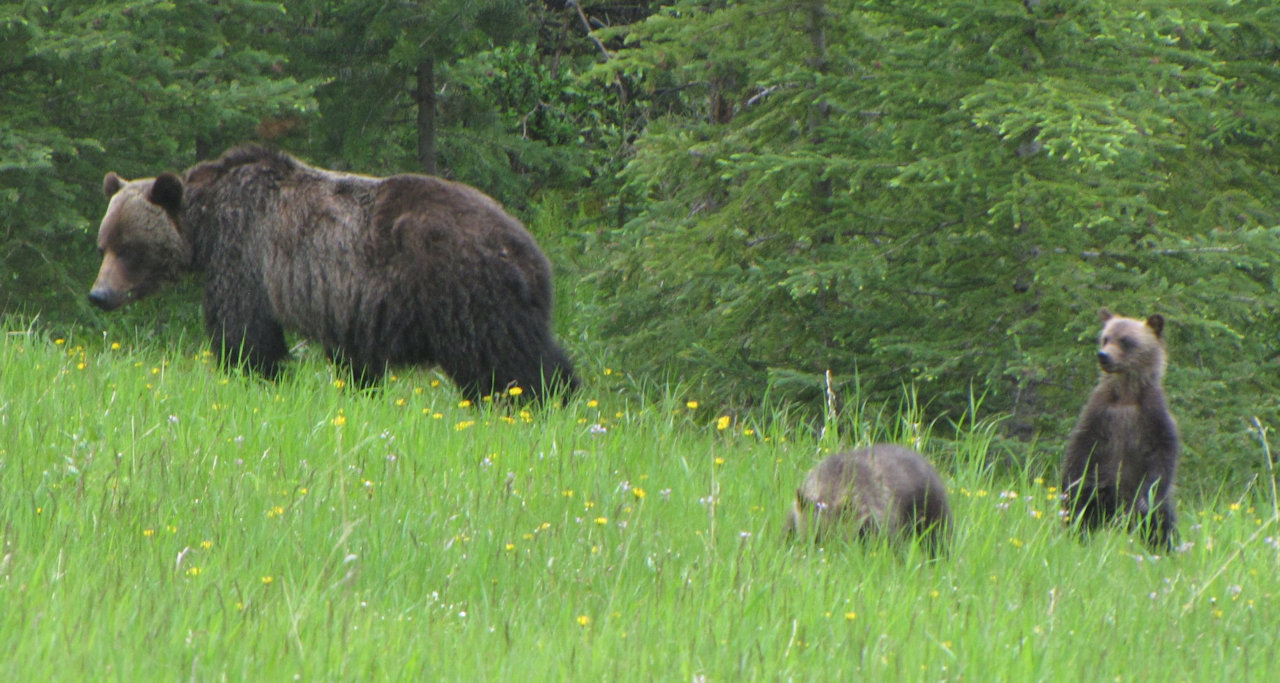
Grizzly Sow with Two Cubs – – Wikipedia en:User Traveler100
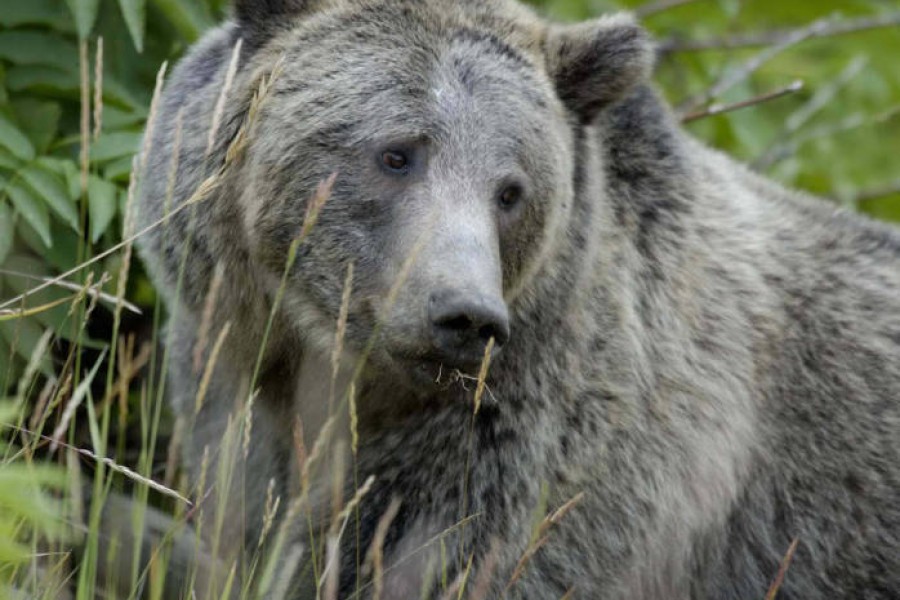
As expected, Montana Fish and Wildlife Commissioners voted not to allow hunting of Yellowstone grizzlies this year. Basically, they are waiting for the dust to settle before they make a move . . .
Montana won’t hold a grizzly bear hunt in 2018 after state officials said Thursday they want to avoid complicating lawsuits over the animal’s legal status.
Federal officials last year lifted Endangered Species Act protections for about 700 bears in and around Yellowstone National Park, opening the door to potential hunting in the three-state region.
Montana wildlife commissioners said letting hunters kill some of those bears could give momentum to pending legal challenges that seek to restore protections.
Bob Dunkley explains Park plans for the Polebridge Ranger Station, post Red Bench Fire, at the 1988 Interlocal at Sondreson Hall.
The 2018 winter North Fork Interlocal Agreement meeting will be held Wednesday, February 21 at the Glacier Park Community Center in West Glacier (not the Hungry Horse/Glacier View Ranger Station, as previously announced). Start time is 10:00 a.m. The meeting usually lasts abut three hours.
The Interlocal Agreement provides for face-to-face contact with representatives of agencies whose policies and actions affect the North Fork. Interlocal Agreement meetings are held in the winter (in town) and summer (at Sondreson Hall). Agency attendees include Montana Fish, Wildlife & Parks Montana Department of State Lands, U.S. Border Patrol, Glacier National Park, Flathead National Forest, U.S. Fish &Wildlife Service and Flathead County..
This is always a very interesting meeting, with reports from a range of government agencies and local organizations and often some quite vigorous discussion.
1990 Interlocal at Sondreson Hall – Mike Conner talking; Bruce Hayden is next to him. See who else you can spot – that is Bonny Ogle to the left…
Montana FWP is recommending against a grizzly hunt in 2018. The official press release has the details. The Flathead Beacon posted a less bureaucratic summary of the issues . . .
Montana wildlife officials are recommending against holding a grizzly bear hunt in 2018 after the animals lost their federal protections across a three-state region around Yellowstone National Park.
Fish, Wildlife and Parks Director Martha Williams said Thursday the state wants to demonstrate its commitment to the grizzly’s long-term recovery.
State wildlife commissioners will consider the matter Feb. 15.
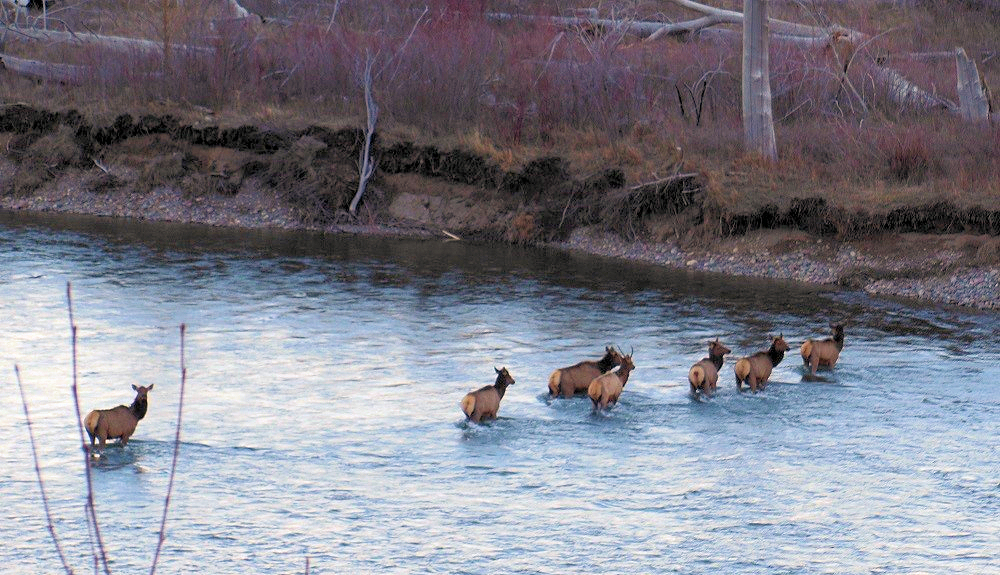
Elk Crossing North Fork of Flathead River, north of Camas Bridge, March 4, 2016 – Greg Evans
Now that the Forest Plan is in its final stages, the Forest Service and allied agencies are rolling up its sleeves and getting to work on a management plan for the three forks of the Flathead River. Here’s a good overview by the Hungry Horse News. See also the official Comprehensive River Management Plan announcement . . .
Columbia Falls will host the first of several meetings on a new comprehensive river management plan for the three forks of the Flathead River.
The meeting is scheduled from 6 to 8 p.m. March 6 at the Cedar Creek Lodge Conference Room.
The Flathead National Forest and Glacier National Park are embarking on a joint plan to track river use on the three forks of the Flathead, with the eventual goal of crafting management plans for the Wild and Scenic rivers.
Canada lynx sitting – US Fish and Wildlife Service
The U.S. Fish and Wildlife Service is considering removing the Canada lynx from the threatened species list . . .
Wildlife officials in the United States declared Canada lynx recovered on Thursday [January 11] and said the snow-loving wild cats no longer need special protections following steps to preserve their habitat.
The Fish and Wildlife Service said it will begin drafting a rule to revoke the lynx’s threatened listing across the Lower 48 state under the Endangered Species Act. Wildlife advocates said they would challenge the move.
First imposed in 2000, the threatened designation has interrupted numerous logging and road building projects on federal lands, frustrating industry groups and Western lawmakers.
Chronic Wasting DIsease (CWD) – illustration of effects on elk
From the New York Times comes this article about what the states, especially Montana, are doing to combat deer family CWD . . .
As darkness closed in, one hunter after another stopped at this newly opened game check station, deer carcasses loaded in the beds of their pickups.
They had been given licenses for a special hunt, and others would follow. Jessica Goosmann, a wildlife technician with Montana’s Fish, Wildlife & Parks Department, stepped outside to greet them, reaching for the neck of each freshly killed deer to cut an incision and remove a lymph node for testing.
On the edge of this south-central Montana village, where deer hunting is a way of life, the game check station has become the front line of the state’s efforts to stop the spread of a deadly infection known as chronic wasting disease.
Grizzly bear cubs on old road bed – Montana Fish, Wildlife and Parks
Here’s an interesting roads vs. grizzlies study based on DNA data out of British Columbia . . .
It’s simple math, says scientist Clayton Lamb. The closer grizzly bears are to humans, the more ways there are for the bears to die. Put more simply, more roads equal fewer grizzly bears.
In a recent study examining a long-term DNA dataset of grizzly bear activity in British Columbia, Lamb and his colleagues conclusively determined what scientists have long suspected: higher road density leads to lower grizzly bear density, a critical problem for a species still rebounding from a long period of human persecution.
“The problem with grizzly bears and roads is a North American-wide issue. This is the first time that strongly links roads to decreased grizzly bear density,” said Lamb…
Invasive mussel DNA is still being found in Tiber Reservoir, but no larvae or adults so far . . .
Samples taken last year from Tiber Reservoir bolstered older evidence for the presence of invasive mussels.
In a press release Thursday, Montana Fish, Wildlife and Parks announced that samples of environmental DNA (eDNA) taken by it and the U.S. Geological Survey during 2017 indicated invasive mussels’ presence in Tiber Reservoir.
In Fall 2016, the discovery of quagga mussel larvae and a shell fragment there triggered a massive effort to detect and contain the animals. Over the course of 2017, the press release states, “FWP and partner agencies collected more than 1,500 plankton samples from 240 waterbodies,” including 128 plankton tow samples from Tiber and 147 at Canyon Ferry, where their presence is suspected.
Through these tests, “no adult mussels or larvae were found.”
Alan Rideout McNeil died of a heart attack on the 29th of December, 2017. The family wish to thank the neighbors, the Sheriff’s department, and the Coroner, all of whom were most helpful in the midst of the recent blizzard conditions.
Alan was the son of Cecily and Edward McNeil. He was born in Urbana, Illinois in 1951 and lived there until he was five, when the McNeils moved to Chicago.There he attended the Laboratory School of the University of Chicago from first grade through High School. He was most interested in art. After graduation he enrolled at the University of Illinois in Chicago, where his father Edward was a professor of physics. There, Alan majored in art, not the conventional pen and brush sort of art, but “performance art,” and also computer-generated art.That was back in the pre-internet days when computers were cumbersome and required stacks of perforated cardboard slips.
After graduating from college, Alan worked for a year or so at a Chicago trading firm, doing electronic stock transfers. Then he went to work for a company devoted to video games, which at that time resembled pinball machines and were available in the same type of venue.
Alan was the creator of one of the most famous of these early games: Berzerk. It made money for his employers, big time, but not so much for him.
In about 1987, Alan and his then wife, Karen Chesna McNeil, moved to the Flathead. Their children, Henry and Fiona McNeil, attended the Kalispell Montessori schools, and later, Flathead High School.
Alan is survived by his children—Henry and Fiona— and also by his mother, and his brother, Bruce McNeil, as well as his nieces , Lt. Commander Anna McNeil and Ellie McNeil, and his young nephew Eddie McNeil.
Alan loved the North Fork, where his parents had brought their two sons for summers when they were boys. He held office in North Fork organizations over the years, and was seriously conservation-minded. He also loved music and was an accomplished pianist.
One of Alan’s gifts was his easy comradeship with children. He taught at Montessori for a year and was a scoutmaster when his son was in a Boy Scout troop.
Responsible, friendly, creative, kind—his family and friends will miss him dearly. There will be a gathering on the North Fork this summer in Alan’s memory.
Donations to the Montana Wilderness Society would be an appropriate remembrance.