Glacier Park proposes solutions for Sun Road congestion

Glacier Park is trying to figure out what to do about overcrowding on Going-to-the-Sun Road. At this point, they’ve proposed five alternatives, none of which are entirely palatable. If you want a hand in this process, download the current management plan newsletter, read about the alternatives and submit comments. The deadline for comments is June 5.

Here’s a write-up from the Flathead Beacon . . .

The Going-to-the-Sun Road is a global icon, attracting millions of visitors to Glacier National Park each year and consistently garnering praise for its awe-inspiring views and connection to pristine recreation opportunities.

But with the growing popularity comes a significant dilemma. Once word spreads that the Sun Road is fully open in summer, visitors flood the park, clogging the narrow two-lane corridor with vehicles and filling the surrounding trails with hikers.

Amid this increased visitation and congestion along the main thoroughfare, park officials are proposing several changes that could impact how visitors travel throughout Glacier.
Read more . . .

Genetic research gives insight into Greater Yellowstone foxes

Here’s some interesting research about foxes which, I was surprised to learn, are relatively recent arrivals on this continent . . .

Blame the snow and cold.

Thanks to nasty winters, the Greater Yellowstone Ecosystem, including the Beartooth Mountains, have become a genetic island for Rocky Mountain red foxes.

That’s one of the findings from research that Patrick Cross conducted over two years while spending finger-numbing winter days in the Beartooth Mountains trapping the native high-elevation foxes. Cross, a University of Montana graduate student in systems ecology, was working with the Yellowstone Ecological Research Center. For his research, Cross had hypothesized that the foxes may be genetically different from those found in nearby Yellowstone National Park. Instead, he found that the two populations are related.

Read more . . .

Stoltze conservation plan to be presented April 28

If you’ve an interest in the proposed conservation  easements on Stoltze Lumber land in the Haskill Creek and Trumbull Creek drainages, there’s a open house next week to discuss them . . .

Montana Fish, Wildlife and Parks will hold an open house in Columbia Falls to take preliminary public input on two proposed conservation easement projects on lands owned by the F.H. Stoltze Land & Lumber Co.

The open house will take place at the Columbia Falls Fire Hall, 624 First Avenue West, on Tuesday, April 28, from 7 to 9 p.m.

Personnel from FWP, Stoltze and The Trust for Public Land will be on hand to discuss the proposed projects, answer questions and gather issues, concerns or ideas raised by the public, adjoining landowners, and any other interested people.

Read more . . .

‘Flathead Forest Friday’ meeting focuses on the Forest Plan Revision

It’s time for another “Flathead Forest Friday” meeting. The next one is on Friday, May 1, at the Nite Owl Café in Columbia Falls. They’ll be talking about the Forest Plan Revision. The official press release has the details . . .

The Flathead National Forest has released for public comment the proposed action for the revision of the land and resource management plan (forest plan) as directed by the National Forest Management Act. The public is invited to learn about and discuss the forest plan revision process during the next Flathead Forest Friday on May 1, 2015 at the Nite Owl Café located at 522 9th St. West (US Hwy. 2) in Columbia Falls., Montana. The no-host breakfast chat starts at 7:00 AM.

The proposed action for the revised forest plan includes management direction to support a variety of proposed and possible actions that may occur on the plan area over the next ~15 years, or life of the plan. Concurrently, the forest is releasing an amendment to integrate the Northern Continental Divide Ecosystem (NCDE) Grizzly Bear Conservation Strategy (“strategy”) into the forest plans for the Helena, Kootenai, Lewis and Clark, and Lolo National Forests. The Flathead National Forest is incorporating the relevant portions of the strategy as part of its plan revision process.

Every other month, the Forest Service will coordinate these no-host breakfast meetings at a local restaurant with the goal of sharing good food, great company, and a little information about what’s happening on our National Forest. We hope the event will be a great way to discuss public land management opportunities and challenges that are important to us all.

If you plan to attend or have questions, please notify Public Affairs Officer Colter Pence at cfpence@fs.fed.us or (406) 758-5252. Your response allows us to plan accordingly with the restaurant.

Flathead National Forest hosts the spring NCDE grizzly bear management meeting

Another darn reason to run to town. From the official Forest Service press release . . .

The public is invited to participate in the upcoming spring Northern Continental Divide Ecosystem (NCDE) grizzly bear management meeting hosted by Flathead National Forest. The meeting is scheduled from 10:00 a.m. to 3:30 p.m. on May 6, 2015 at the Hungry Horse/Glacier View and Spotted Bear Ranger District Office located at 10 Hungry Horse Drive in Hungry Horse, Montana.

During the meeting there will be updates from NCDE members on the Draft NCDE Grizzly Bear Conservation Strategy, work plans for the coming year, educational tools, bear mortality rates for 2014 and bear management spring activity.

The Flathead National Forest is one of many agencies and organizations working to ensure the sustainability of the grizzly bear population in the Northern Continental Divide Ecosystem. Additional information on those efforts can be found at: http://www.fws.gov/mountain-prairie/species/mammals/grizzly/continentalindex.html

For more information contact the NCDE Chair, Deb Mucklow at 406/387-3800.

Blackfeet Nation launches campaign to kill oil leases in Badger-Two Medicine

The Blackfeet kick it up another notch in their campaign to terminate oil leases in the Badger-Two Medicine region . . .

The Blackfeet Nation is enlisting the help of a member of one of America’s most popular rock bands to help protect a culturally and environmentally significant plot of land on the eastern edge of Glacier National Park.

On April 22, members of the Blackfeet Nation held a press conference to kick off a campaign to rally public support to terminate 18 oil leases within the Badger-Two Medicine. The mountainous area, located between the Blackfeet Reservation, Glacier National Park and the Bob Marshall Wilderness, is an important part of the tribe’s creation story and is known as the “Backbone of the World.”

To help get the word out, the Blackfeet have enlisted the help of Jeff Ament, bass player for Pearl Jam. On Wednesday, Ament posted a message supporting the Badger-Two Medicine effort on the band’s official Facebook page.

Read more . . .

See also: Blackfeet announce legal, social campaign to save Badger-Two Medicine

Carol Edwards: A personal letter to Flathead planners

A very timely missive from Carol “Kelly” Edwards, a longtime NFPA member . . .

To the Flathead Forest and Watershed Planners,

My plea, as a local resident and land owner in the Flathead watershed area is that you protect, increase, and  safeguard wilderness within your management area.  By wilderness, I mean strongly regulated, pristine wilderness. Walk in only. At your own risk. No motors. No machines. No logging. No mining. No drilling.  Just the creatures that live there naturally, in the forests that grow there, with water sources running free and clean, accessible only to those who are willing to enter those places on those terms.

Over the last 200+ years on this continent we have taken everything we could get from the natural world in trade for economic growth.  Well, as the song goes… “…This is the end, my friend.”  At this point it is either work to save the little bit of it that remains, or just dig it up, chop it down, pollute the rest of it.

Somewhere along the way we have to open our eyes, look around and realize that we’re in trouble if we continue the way we’ve done before. Sustainable is not just a nonsense word that radicals throw around.  It means something that can be continued……like life on earth, for example.

I think we’d all like that, and it’s time that people in your position, with your responsibility to the environment, helped us out in that direction.

Sincerely,
Carol Edwards
10641 North Fork Rd.
Polebridge, MT 59928

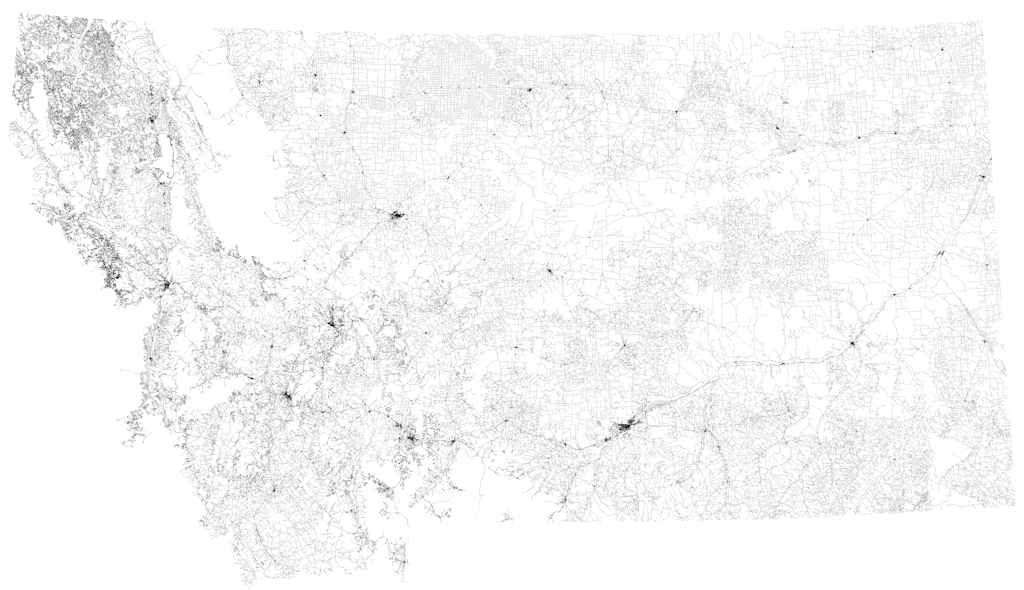
Roads-only map shows little whitespace

Montana Public Roads

Now, here’s a graphic illustration of the importance of wildlife corridors. Impressive . . .

Step off Montana Highway 200 at Rogers Pass, hop on the back of a wolverine, and you would cross pavement just three times before reaching Banff, Alberta.

Two of those roads, U.S. Highway 2 and Going-to-the-Sun Road, cross the otherwise blank spot on an unusual map that’s been floating around the Internet recently. The map, assembled by Reddit user WestCoastBestCoast94, displays virtually all the nation’s roads – and nothing else. The resulting black-and-white representation of the Lower 48 tends to get one common response:

Wow.

The United States has about 4 million miles of public roads. According to federal highway statistics, 97 percent of the continental U.S. is less than three miles away from a road. Eighty-three percent lies within half a mile. A recent analysis prepared by the Western Transportation Institute at Montana State University looked at the unroaded areas of Montana, Idaho and Wyoming – three states with the least population density short of Alaska – and found that 16 percent of their combined territory qualified as essentially roadless. The study included national parks, which do have some roads.

Read more . . .

Two hefty grizzlies caught near Big Fork and relocated

Bears are definitely on the move and looking for munchies, as witnessed by events near Big Fork earlier this month . . .

Officials with Montana Fish, Wildlife and Parks caught and relocated two large grizzlies near Bigfork earlier this month during a trapping effort to capture a calf-killing bear that remains at large.

On April 2, a landowner reported that a newborn calf had been killed on his property near Mud Lake, while a second calf was missing. There were large grizzly tracks at the site, and investigators determined a large grizzly killed and consumed the missing calf.

The investigation showed that the bears trapped by FWP officials were not involved in the April 2 incident involving the deaths of the two calves, but FWP Grizzly Bear Specialist Tim Manely radio-collared and relocated the bears and continued trying to capture the target bear.

Read more . . .

Secure Rural Schools money restored

Secure Rural Schools funding (aka “RAC Grant” money) has been restored. Locally, this means some bucks for work on the North Fork Road, including dust abatement . . .

A federal funding program that will provide about $1.4 million for Flathead County roads and schools this year has been reauthorized.

The U.S. Senate on Wednesday voted to extend Secure Rural Schools funding for two years as part of the Medicare Access and CHIP Reauthorization Act of 2015.

In September 2013 the U.S. Senate passed legislation to extend Secure Rural Schools funding for an additional year. The 113th Congress, however, failed to reauthorize the act, which expired in September 2014. The Senate’s latest action retroactively restores the funding for fiscal year 2014 and assures funding through fiscal year 2015.

Read more . . .